DONATE

Showing posts with label UBL. Show all posts

Sunday, April 24, 2016

Saudi Arabia: The Golden Chain and The Missing 28 Pages


There are a lot of voices on both the Left and Right side of aisle calling for Obama to declassify the infamous 28 pages of a report that may link Saudi Arabia in some fashion or another to the al Qaeda attack on American soil on September 11, 2001. The Saudis are now saying they either don’t want the declassification or at the very least not allow the Justice Against Sponsors of Terrorism Act (JASTA) Bill to become law. JASTA would allow surviving victims of the 9/11 attack to sue Saudi Arabia in civil court for any culpability in financing the al Qaeda attack.


Authors Millard Burr and Rachel Ehrenfeld of the American Center for Democracy (ACD) have posed further incrimination against Saudi Arabia that beyond the 28 pages. Evidently a Bosnian police raid on a Muslim charity group in Sarajevo turned up some evidence of fund raising for Usama (or Osama – depending who you read) bin Laden’s al Qaeda. That Burr and Ehrenfeld suggest that evidence points to numerous Saudi families of wealth that were sugar-daddies to al Qaeda. Al Qaeda called these sugar-daddies the Golden Chain. The problem: The U.S. Government has made much of that evidence classified just as the 28 pages. Here is a teaser paragraph from the Burr-Ehrenfeld essay:

How much of the Sarajevo material remains classified and unpublished is debatable. However, like the missing Congressional report, substantial material that covers the genesis and expansion of al Qaeda in the 1990s has never been released. What we do know is that one note taken from the Sarajevo hoard that surfaced at the trial is a bin Laden note saying: “we took very huge gains from the country’s people in Saudi. We were able to give political power to the Mujahideen, gathering donations in very large amounts…”

Just think if there are some names on the 28 classified pages that are also on the Golden Chain. That could finally reveal just how involved the Saudi government or policies that can be associated with wealthy Saudis that are today considered legitimate global business partners. A civil trial could then open some cans of worms that the Intelligence communities of both the USA and Saudi Arabia that might lead to some criminal investigations. AND there you have it – My guess is neither the U.S. Government nor the Saudis want those cans of worms opened. What do you think?

Just a brief aside: I heard on Fox News that Obama might declassify some of those 28 pages today. However, Google is fairly silent on the today thing. Google searches do point to former Senator Bob Graham reporting that a partial declassification of the 28 pages (e.g. AP, Fox News and Esquire) Hmm … Do you think the U.S. Intelligence community might be pressing Obama on what the public can see?

JRH 4/24/16
*********************

Saudi Arabia: The Golden Chain and The Missing 28 Pages

April 23, 2016 6:32PM


The American media, which continues to concentrate on a bill making its way through Congress that would allow American citizens to sue the Kingdom of Saudi Arabia for losses suffered as a result of the 9/11 attacks, paid no attention to the Golden Chain.

The victims claim that the release of the 28 pages missing from the 9/11 Commission Report is of crucial importance to their case. Those pages, they say, would show the interrelationship that ties the hijackers to the Saudi regime itself and therefore would offer a damning indictment of the Kingdom. But President Obama, like President Bush before him, refuses to make it public. And the Saudi Royal Family that vehemently denies funding al Qaeda threatened that if the 28 pages are released, they would sell more than $750 billion of Saudi investments in the U.S.

Of equal if not of greater importance than the missing 28 pages, is the forgotten investigation of the Bosnia-BIF office. Crucially, among the boxes and files was found a note ostensibly written by Osama Bin Laden that lists a “Golden Chain” of twenty Arab plutocrats who were and remain suspected of financing international terrorism, including the funding of al Qaeda.

—-

The Golden Chain was established about the time of al Qaeda’s founding in 1988. Bin Laden’s notes on efforts to recruit wealthy Saudi Arabian families who could fund his group were also found at Sarajevo. Much of the information derived from the Sarajevo came to light during the 2003 trial of an al Qaeda financier, Enaam Arnaout, in Chicago.

In March 2002, a search of the Benevolence International Foundation (the BBosanska Idealna Futura, or BIF) in Sarajevo, Bosnia, would provide the West with the most significant trove of information ever to be found on the Genesis and growth of the al Qaeda organization.

In fact, Bosnian investigators unearthed an intelligence mother lode: Not only did they seize weapons, false passports, plans for making bombs, jihadist videos and literature, their search also yielded material of great historic value. On a computer file titled “Tareekh Osama” (Osama’s History), there were found documents, letters, and photos relating to the birth and early days of al Qaeda, some of it in bin Laden’s handwriting. Included in the haul was an organizational chart, and notes on al Qaeda activity reportedly prepared by bin Laden, and his mentor Sheikh Abdallah Azzam. The file had been kept by Bin Ladin confidant Enaam Arnaout, who clearly obviously thought the BIF office in Bosnia was safe from intrusion. Ironically, before 9/11 Arnaout and the BIF were under investigation in the United States for operating the charity as a racketeering enterprise. One that provided material support to al Qaeda. Following 9/11, it seemed only a matter of time before Arnaout would be indicted.

Why the raid took place when it did, and who sponsored the raid (in Sarajevo and Washington), remains something of a mystery. As a result of the Dayton Accords, Bosnia-Herzegovina had been governed by a unique tripartite power-sharing arrangement since 1996; a rotating presidency allowed Muslim Bosniaks, Serbs, and Croats to share power. Importantly, in 2002 Alija Izetbegović, the powerful Islamist Muslim Brother, was no longer first among equals. The West’s bete-noire had stepped down after serving as Chairman of the Presidency from October 1996 through October 2000. Thus, given the power structure that existed in Sarajevo in early 2002 (and in the aftermath of 9/11 2001), it is posited that the CIA either took part in or at least was instrumental in, the raid on the BIF location.

Incredibly, the trove of information discovered in that raid was given publicity in Bosnia itself. No effort was made by the Bosnia intelligence agency to tailor, redact, or eliminate information found in the Bosanska, and thus, the information itself proved to be a bombshell both inside and out of Bosnia. Unlike Washington where the most astounding intelligence is immediately classified secret and squirreled down some intelligence rat hole, the Bosnian services shared their find with the world. And in an order issued on 6 March 2003 by the Supreme Court of Bosnia, the computer files that had been seized were delivered to the U.S. Embassy. The documents were then translated into English. Later, some appeared in a trial of a BIF official Enaam Arnaout.

Included in the files were “scanned letters” between Arnaout and bin Laden (using their nom de guerre) and letters concerning other al Qaeda principals. The letters revealed that al Qaeda leaders were paid, and weapons for the group were purchased from funds provided by Muslim charities. There were also letters authorizing the purchase, and purchase orders for rifles, RPGs, mortars, and other weaponry, with instructions to distribute the weapons to camps operated by al Qaeda.

Other memoranda provided a chronology of events from the founding of al Qaeda in Khost to the movement’s activity in Peshawar, Pakistan, during its first months of existence. There were reports on al Qaeda activity in the various jihad on-going in Bosnia, the Sudan, and Chechnya. An article published in 1988 in Arab News outlined bin Laden’s activity and included a photo of Arnaout and Bin Laden walking together at “Masada”, an Arab-Afghan camp for mujahideen.

In the search of the BIF’s Sarajevo offices, “law enforcement authorities” discovered conclusive evidence that tied the BIF Chief Executive Officer Enaam Arnaout to al Qaeda, and to its leader Osama Bin Laden. One letter even allowed Arnaout to sign an authorization on bin Laden’s behalf. Though the Sarajevo documents remained secret for months, they included the minutes of an 11 August 1988 meeting during which bin Laden discussed the creation of what would then be known as the al Qaeda. It is recalled that in the decade following the founding of al Qaeda 1988 only a few hundred jihadists had been permitted to take the oath of allegiance (the baya’t) to Osama bin Laden. Arnaout was thus a member of a very select body of mujahideen.

The evidence unearthed in Sarajevo was sufficient to charge Arnaout with conspiracy to provide material support to terrorists. Arnaout, who was born and raised in Syria and was a member of a Saudi family of Albanian heritage, was also an American citizen and had been a resident of the U.S. since 1992. Thus, in the end, there would be no escaping U.S. justice.

Concerning the BIF, a “charity” incorporated in the State of Illinois in March 1992, the arrest of Arnaout was soon followed by the closure of BIF operation in Canada and Bosnia, and then by most of its offices located overseas; namely, in Pakistan, Bosnia, Yemen, Sudan, Azerbaijan, Tajikistan, Bangladesh, Turkey, Dagestan, Soviet Georgia, China, and Ingushetia (moved from Chechnya).

In December 2001, and shortly after 9/11 but before the indictment of Arnaout himself, BIF funds had been blocked in the USA, Canada, and Bosnia. At that time, it was reported that the US government had in its possession substantial evidence proving that the Arnaout-bin Laden intimate relationship dated from the mid-1980s. The relationship was in fact fixed well before the creation of the al-Qaeda organization in August 1988 in Khost, Afghanistan.

Given the evidence uncovered at the BIF office in Sarajevo (and, reportedly additional evidence of BIF’s terrorist ties discovered by Bosnian police in a later raid on local charities on 3 June), it was not surprising that Arnaout was soon indicated in the United States.

See UNITED STATES of America v. Enaam M. ARNAOUT, a/k/a “Abu Mahmoud”, a/k/a “Abu Mahmoud al Suri”, a/k/a “Abu Mahmoud al Hamawi”, a/k/a “Abdel Samia”, U.S. v. ARNAOUT, No. 02 CR 892, 231 F.Supp.2d 797 (2002), U.S. District Court, N.D. Illinois, Eastern Division. November 22, 2002, Patrick J. Fitzgerald, et.al., United States Attorneys.

The Trial

On March 2003 the Chicago trail [sic] of Enaam Arnaout was truncated just before it began == much to the dissatisfaction of most observers. Arnaout had been charged with racketeering conspiracy, providing material support to organizations engaged in violent activities, money laundering, mail fraud and wire fraud. He faced a possible 90-year sentence. However, before the charges could be tried Arnaout pleaded guilty in federal court to a single count of illegally funding and supplying military assistance to mujahideen in Bosnia and Chechnya.

The federal case, which focused on the Arnaout-Bin Laden relationship, was blown to smithereens when a federal judge ruled that evidence was spotty at best. Prosecutors dropped all charges after Arnaout pled guilty to a single felony count. For reasons still not clear, the government settled for a penalty less than the twenty years that Arnaout could have received. As an editorial in the New York Sun put it, “The government’s decision to accept a plea to a single, and relatively minor, count [transpired] so as to avoid a risky trial.” Nonetheless, federal prosecutors were “unwilling to credit [Arnaout] for cooperating.”

True or false, and despite the congressional testimony of then-FBI Director Robert Mueller before a U.S. House Appropriations Subcommittee on 14 September 2006, the Arnaout imbroglio was not one of the FBI’s finest hours.

Indeed, in February 2006, a federal judge had reduced the Enaam Arnaout sentence from 11 years and four months to 10 years, after the 7th Circuit Court of Appeals ruled that his original sentence was improperly enhanced.

The Golden Chain

The Golden Chain was established about the time of al Qaeda’s founding in 1988. Bin Laden’s notes on efforts to recruit wealthy Saudi Arabian families who could fund his group were also found at Sarajevo. Much of the information derived from the Sarajevo came to light during the 2003 trial of an al Qaeda financier, Enaam Arnaout, in Chicago.

How much of the Sarajevo material remains classified and unpublished is debatable. However, like the missing Congressional report, substantial material that covers the genesis and expansion of al Qaeda in the 1990s has never been released. What we do know is that one note taken from the Sarajevo hoard that surfaced at the trial is a bin Laden note saying: “we took very huge gains from the country’s people in Saudi. We were able to give political power to the Mujahideen, gathering donations in very large amounts…”

Within the Sarajevo trove, there was found the essential minutes of a meeting held on 11 August 1988 during which Bin Laden initiated actions that established a jihadist movement loyal to himself. A week later the organization was officially established, and a copy of the oath of allegiance taken by some 40 participants was included in the file. The minutes of that seminal conclave end on 20 August.

Also recorded were bin Laden’s “own statements on the efforts to recruit members from Saudi Arabia for his network and to raise money.” Also included in the Bosnia find was a letter on Saudi Red Crescent/Peshawar letterhead and with it a note added by Osama Bin Laden to his money-manager Wael Jalaidan citing “an extreme need for weapons.” (John Solomon, “Bosnia Raid Yields al-Qaida Donor List,” Miami Herald via AP, Feb. 19, 2003.)

Many questioned why bin Laden, a member of one of Saudi Arabia’s wealthiest family, searched for funds outside his fortune to fund al Qaeda. But Osama was not rich enough to fund the expensive jihad he had in mind. Though the bin Laden family was wealthy, Osama could not easily access the $300 million that some analysts felt he had squirreled away. His accounts were blocked in the United States and Saudi Arabia, and his family was watched closely and warned not to assist him financially. Still, during his stay in the Sudan (1991-1996) he probably invested more than $50 million (including $30 million deposited in the al-Shamal Bank). But when bin Laden departed the Sudan in 1996, he had little to show for his investments. By the admission of those al Qaeda members who knew him best, his personal wealth had been squandered. To carry out his jihadist agenda he had to continue to call on wealthy Gulf plutocrats, viz., the Golden Chain, to finance al Qaeda.

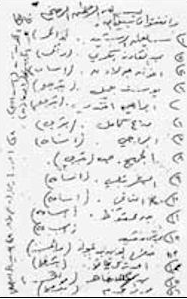
Included in the US government indictment of Enaam Arnaout on 9 October 2002 (02 CR 892) was an interesting memorandum, “Clarifying the Mujahideen’s situation to the world and keeping the spirit of Jihad alive.” (Exhibit 17, Department of Justice, “Government’s Evidentiary Proffer Supporting the Admissibility of Coconspirator Statements” in the case of USA v. Arnaout, USDC, Northern District of Illinois, Eastern Division, filed 29 January 2003.) Of even more explosive power, however, was a memorandum that appeared as Exhibit 5: With regard to that piece of evidence the Justice Department noted: “Among the recovered files was a copy of a 1988 handwritten draft listing wealthy financiers of UBL’s mujahideen operation in Afghanistan, referred to within al Qaeda as the ‘Golden Chain.'” The information presented on lined paper and translated from the Arabic by the U.S. Department of Justice was headed by a verse in Arabic from the Koran: “And spend for God’s cause.” (“Government’s Evidentiary Proffer Supporting the Admissibility of Coconspirator Statements” in the case of USA v. Arnaout, USDC, Northern District of Illinois, Eastern Division) filed on January 29, 2003.)

The Golden Chain memorandum, it included twenty-five names, including twenty very wealthy Saudis. (N.B: at the time of the discovery only two names on the list remained unidentified.) Of the twenty Saudis, six were bankers, and they were tied to the big three of Saudi banking: the National Commerical [sic] Bank of Saudi Arabia, Riyadh Bank, and Al Rajhi Banking and Investment Corp. Ther[e] twelve Saudi businessmen on the list, and the bankers owned or controlled sixteen of the top 100 Saudi companies. The list included eight individuals charged by the families of victims of 9/11 with being complicit in aiding and assisting al Qaeda. Also included were the names of two former government Ministers.

After each name, there was a second name, in parenthesis, of the al Qaeda operative who received money from the donor. “Osama” appeared after seven entries. The donors [sic] names included Saudi Arabia’s most prominent citizens including the bin Laden family, the al Rajhi, Sharbatly, al Naghi, bin Mahfouz, and Adel Faqih. The corporate net worth of the Golden Chain, as calculated more than a decade later accounted for more than $85 billion, or approximately 42% of Saudi Arabia’s GDP.

Whether or not bin Laden personally wrote the Golden Chaim memo, it is indisputable that he was in a position to know the family fortunes of the individuals named. In some cases, they were allied directly or tangentially with his family. They included Saleh Kamel, head of third largest Saudi company, and Suleiman Abdulaziz al Rajhi, head of 4th largest Saudi commercial bank. The “bin Mahfouz” family was in charge of Saudi Arabia’s most important bank. Also on the list, Abdel Qader Faqeeh (Adel Faqh) head of Savola Group, the 13th largest Saudi company. Mohammed al-Issa was head of the powerful al-Issa group, itself the 20th largest Saudi Company. Issa himself was a board member of the Saudi Research & Marketing Company (along with Mohammed Hussein al-Amoudi, Saleh Abdullah Kamel, Abdullah Bin Khaled bin Mahfouz, among others.) He was also Deputy Chairman of the Arab Cement Company whose shareholders included the Binladin Group, the bin Mahfouz and the al Rajhi, and whose chairman was Turki Bin Abdulaziz al Saud. That the individuals listed would be asked to assist Osama bin Laden in his jihadist mission is not surprising. It was all one big happy family.

Wael Julaidan, the al Qaeda moneyman and former Secretary-General of the Muslim World League, and of the well-funded Rabita Trust of Pakistan, was charged with collecting donations from four wealthy individuals. Mohammad al-Amin Khalifa, Osama’s wealthy brother-in-law, was another collection agent, who was known to have close ties to bin Laden’s two money men, Julaidan, and Yasin al-Qadi.

As could be imagined, the list which included such luminaries as “bin Mahfouz,” created a furor in Saudi Arabia, where the memorandum appeared to implicate a score of the Kingdom’s wealthiest citizens. Nearly all were either indirectly or directly involved in the Royal Family’s charity organizations as founders or board members.

Years later, following the September 2001 attacks on the U.S., the “9/11 Commission” issued a report in which a chapter devoted to “The Foundation of the New Terrorism, acknowledged that Osama bin Laden sought financial assistance from wealthy Muslims in Saudi Arabia and the Gulf states, and that “the eventual success of the jihad in Afghanistan depended on an increasingly complex, almost worldwide organization.” Unfortunately, the report was long on implication and short on names.

The Golden Chain list included names of persons who were friendly to the Afghan-Arab movement and later to bin Laden himself. The Golden Chain gained importance after 1990 — when Osama bin Laden escaped house arrest in Saudi Arabia and a year later emerged in the Sudan. Indeed, the name al Qaeda came into vogue and the need for funding expanded after Osama move to the Sudan and al Qaeda’s expanding activities first in Somalia, and later in the Balkans.

Why then should anyone believe that any individual whose name appears on the Golden Chain memorandum, and who, like Khalid bin Mahfouz, claims he “never knowingly made any donation to al Qaeda or any organization or person acting on al Qaeda’s behalf or to any other terrorist organization,” is telling the truth?

It is unknown if any of those whose names appeared on the Golden Chain memo has ever been interrogated, charged with a crime, or chastised by the Saudis. It is safe to assume that In the Dessert Kingdom, where jihad is paramount and ‘silence is golden,” the Golden Chain members have little to worry about.
________________________
Copyright © 2013 [Blog Editor: I wish people would keep their copyright up to date] | The American Center for Democracy is a 501(c)(3) non-profit organization. Your contribution is tax-deductible to the fullest extent of the law.

About ACD


The ACD is dedicated to exposing threats to our free speech rights, political and economic freedoms and national security.

ACD is a 501(c)(3) not-for-profit organization. All contributions are tax-deductible to the fullest extent of the law.

OUR DISTINCTION

ACD fills an important gap created by inadequate risk assessments of our cyberspace, GPS & UTC. We use our Threatcon programs, our multidimensional Terrorist Finance Network Tracker (TFNT), and our experts to better inform government, public and private sectors’ policy makers.

CONNECTING THE DOTS


• ACD’s synergistic approach to connect the dots on emerging threats is facilitated by READ THE REST

Thursday, May 26, 2011

The Bin Laden Operation: Tapping Human Intelligence

UBL Deceased

STRATFOR analysts have pieced together a speculated scenario on the capture and killing of public enemy number one. STRATFOR used a combination of publically released data and private (if not also anonymous)  sources to piece together how Osama bin Laden was more than likely sent to the fires of hell.

JRH 5/26/11
***************************
The Bin Laden Operation: Tapping Human Intelligence

By Fred Burton
May 26, 2011 0853 GMT

Since May 2, when U.S. special operations forces crossed the Afghan-Pakistani border and killed Osama bin Laden, international media have covered the raid from virtually every angle. The United States and Pakistan have also squared off over the U.S. violation of Pakistan’s sovereign territory and Pakistan’s possible complicity in hiding the al Qaeda leader. All this surface-level discussion, however, largely ignores almost 10 years of intelligence development in the hunt for bin Laden.

While the cross-border nighttime raid deep into Pakistan was a daring and daunting operation, the work to find the target — one person out of 180 million in a country full of insurgent groups and a population hostile to American activities on its soil — was a far greater challenge. For the other side, the challenge of hiding the world’s most wanted man from the world’s most funded intelligence apparatus created a clandestine shell game that probably involved current or former Pakistani intelligence officers as well as competing intelligence services. The details of this struggle will likely remain classified for decades.

Examining the hunt for bin Laden is also difficult, mainly because of the sensitivity of the mission and the possibility that some of the public information now available could be disinformation intended to disguise intelligence sources and methods. Successful operations can often compromise human sources and new intelligence technologies that have taken years to develop. Because of this, it is not uncommon for intelligence services to try to create a wilderness of mirrors to protect sources and methods. But using open-source reporting and human intelligence from STRATFOR’s own sources, we can assemble enough information to draw some conclusions about this complex intelligence effort and raise some key questions.

The Challenge

Following the 9/11 attacks, finding and killing bin Laden became the primary mission of the U.S. intelligence community, particularly the CIA. This mission was clearly laid out in a presidential “finding,” or directive, signed on Sept. 17, 2001, by then-U.S. President George W. Bush. By 2005 it became clear to STRATFOR that bin Laden was deep inside Pakistan. Although the Pakistani government was ostensibly a U.S. ally, it was known that there were elements within it sympathetic to al Qaeda and bin Laden. In order to find bin Laden, U.S. intelligence would have to work with — and against — Pakistani intelligence services.

Finding bin Laden in a hostile intelligence environment while friends and sympathizers were protecting him represented a monumental intelligence challenge for the United States. With bin Laden and his confederates extremely conscious of U.S technical intelligence abilities, the search quickly became a human-intelligence challenge. While STRATFOR believes bin Laden had become tactically irrelevant since 9/11, he remained symbolically important and a focal point for the U.S. intelligence effort. And while it appears that the United States has improved its intelligence capabilities and passed an important test, much remains undone. Today, the public information surrounding the case illuminates the capabilities that will be used to find other high-value targets as the U.S. effort continues.

The official story on the intelligence that led to bin Laden’s Abbottabad compound has been widely reported, leaked from current and former U.S. officials. It focuses on a man with the cover name Abu Ahmed al-Kuwaiti, a Pakistani Pashtun born in Kuwait who became bin Laden’s most trusted courier. With fluency in Pashto and Arabic, according to media reports, al-Kuwaiti would be invaluable to al Qaeda, and in order to purchase bin Laden’s property and run errands he would also need to be fluent in Urdu. His position as bin Laden’s most trusted courier made him a key link in disrupting the organization. While this man supposedly led the United States to bin Laden, it took a decade of revamping U.S. intelligence capabilities and a great deal of hard work (and maybe even a lucky break) to actually find him.

The first step for U.S. intelligence services after Bush’s directive was focusing their efforts on bin Laden and the al Qaeda leadership. Intelligence collection against al Qaeda was under way before 9/11, but after the attacks it became the No. 1 priority. Due to a lack of human intelligence in the region and allies for an invasion of Afghanistan, the CIA revived connections with anti-Taliban forces in Afghanistan and with Pakistan’s Inter-Services Intelligence (ISI) directorate in order to oust the Taliban government and accrue intelligence for use in disrupting al Qaeda. The connections were built in the 1980s as the CIA famously operated through the ISI to fund militant groups in Afghanistan fighting the Soviet military. Most of these links were lost when the Soviets withdrew from the Southwest Asian state and the CIA nominally declared victory. Pakistan, left with Afghanistan and these militant groups, developed a working relationship with the Taliban and others for its own interests. A coterie of ISI officers was embedded with different militant groups, and some of them became jihadist sympathizers.

U.S. intelligence budgets were severely cut in the 1990s in light of the “peace dividend” following the fall of the Soviet Union, as some U.S. leaders argued there was no one left to fight. Intelligence collection was a dirty, ambiguous and dangerous game that U.S. politicians were not prepared to stomach. John Deutch, the director of the CIA from 1995 to 1996, gutted the CIA’s sources on what was known as the “Torricelli Principle” (named after then-Rep. Robert Torricelli), which called for the removal of any unsavory characters from the payroll. This meant losing sources in the exact kind of organizations U.S. intelligence would want to infiltrate, including militants in Southwest Asia.

The CIA began to revive its contacts in the region after the 1998 U.S. Embassy bombings in Nairobi, Kenya, and Dar es Salaam, Tanzania. While the U.S. intelligence community was looking for bin Laden at this time, he was not a high priority, and U.S. human-intelligence capabilities in the region were limited. The United States has always had trouble with human intelligence — having people sitting at computers is less of a security risk than having daring undercover operatives running around in the field — and by the end of the 1990s it was relying on technological platforms for intelligence more than ever.

The United States was in this state on Sept. 12, 2001, when it began to ramp up its intelligence operations, and al Qaeda was aware of this. Bin Laden knew that if he could stay away from electronic communications, and generally out of sight, he would be much harder to track. After invading Afghanistan and working with the ISI in Pakistan, the United States had a large number of detainees who it hoped would have information to breach bin Laden’s operational security. From some mix of detainees caught in operations in Afghanistan and Pakistan (particularly with the help of the ISI), including Khalid Sheikh Mohammed and Abu Farj al-Libi, came information leading to an important bin Laden courier known by various names, including Abu Ahmed al-Kuwaiti. (His actual identity is still unconfirmed, though his real name may be Sheikh Abu Ahmed.)

The efficacy of enhanced interrogation and torture techniques is constantly debated — they may have helped clarify or obfuscate the courier’s identity (some reports say Mohammed tried to lead investigators away from him). What is clear is that U.S. intelligence lacked both a sophisticated and nuanced understanding of al Qaeda and, most important, human sources with access to that information. With the United States not knowing what al Qaeda was capable of, the fear of a follow-on attack to 9/11 loomed large.

Anonymous U.S. intelligence officials told Reuters the breakthrough came when a man named Hassan Ghul was captured in Iraq in 2004 by Kurdish forces and turned over to the United States. Little is known about Ghul’s identity except that he is believed to have worked with Abu Musab al-Zarqawi and to have given interrogators information about a man named “al-Kuwaiti” who was a courier between al-Zarqawi and al Qaeda operational commanders in Afghanistan and Pakistan. Ghul was then given over to the Pakistani security services; he is believed to have been released in 2007 and to now be fighting somewhere in the region.

While U.S. intelligence services got confirmation of al-Kuwaiti’s role from al-Libi, they could not find the courier. It is unknown if they gave any of this information to the Pakistanis or asked for their help. According to leaks from U.S. officials to AP, the Pakistanis provided the National Security Agency (NSA), the main U.S. communications interception agency, with information that allowed it to monitor a SIM card from a cellphone that had frequently called Saudi Arabia. In 2010, the NSA intercepted a call made by al-Kuwaiti and began tracking him in Pakistan. Another U.S. official told CNN that the operational security exercised by al-Kuwaiti and his brother made them difficult to trail, but “an elaborate surveillance effort” was organized to track them to the Abbottabad compound.

From then on, the NSA monitored all of the cellphones used by the couriers and their family members, though they were often turned off and had batteries removed when the phones’ users went to the Abbottabad compound or to other important meetings. The compound was monitored by satellites and RQ-170 Sentinels, stealth versions of unmanned aerial vehicles (UAVs), which were reportedly flown over the compound. According to The Wall Street Journal, the National Geospatial-Intelligence Agency (NGA) even built a replica of the compound for CIA Director Leon Panetta and other officials. The NGA is the premier U.S. satellite observation agency, which could have watched the goings-on at the compound and even spotted bin Laden, though it would have been difficult to confirm his identity.

Some of these leaks could be disingenuous in order to lead the public and adversary intelligence agencies away from highly classified sources and methods. But they do reflect long-believed assessments of the U.S. intelligence community regarding its advanced capability in technology-based intelligence gathering as well as the challenges it faces in human-intelligence collection.

The Utility of Liaison Relationships

Historically, U.S. intelligence officers have been white males, though the CIA has more recently begun hiring more minorities, including those from various ethnic and linguistic groups important to its mission (or at least those who can pass the polygraph and full-field background investigation, a substantial barrier). Even when intelligence officers look the part in the countries in which they operate and have a native understanding of the cultures and languages, they need sources within the organizations they are trying to penetrate. It is these sources, recruited by intelligence officers and without official or secret status, who are the “agents” providing the information needed back at headquarters. The less an intelligence officer appears like a local the more difficult it is to meet with and develop these agents, which has led the United States to frequently depend on liaison services — local intelligence entities — to collect information.

Many intelligence services around the world were established with American support or funding for just this purpose. The most dependent liaison services essentially function as sources, acquiring information at the local CIA station’s request. They are often made up of long-serving officers in the local country’s military, police or intelligence services, with a nuanced understanding of local issues and the ability to maintain a network of sources. With independent intelligence services, such as Israel’s Mossad, there has been roughly an equal exchange of intelligence, where Israeli sources may recruit a human source valuable to the United States and the CIA may have satellite imagery or communications intercepts valuable to the Israelis.

Of course, this is not a simple game. It involves sophisticated players trying to collect intelligence while deceiving one another about their intentions and plans — and many times trying to muddy the water a little to hide the identity of their sources from the liaison service. Even the closest intelligence relationships, such as that between the CIA and the British Secret Intelligence Service, have been disrupted by moles like Kim Philby, a longtime Soviet plant who handled the liaison work between the two agencies.

Since most U.S. intelligence officers serve on rotations of only one to three years — out of concern they will “go native” or to allow them to return to the comfort of home — it becomes even more challenging to develop long-term human-intelligence sources. While intelligence officers will pass their sources off to their replacements, the liaison service becomes even more valuable in being able to sustain source relationships, which can take years to build. Liaison relationships, then, become a way to efficiently use and extend U.S. intelligence resources, which, unlike such services in most countries, have global requirements. The United States may be the world’s superpower, but it is impossible for it to maintain sources everywhere.

Liaison and Unilateral Operations in the Hunt for Bin Laden

In recent years, U.S. intelligence has worked with Pakistan’s ISI most notably in raids throughout Pakistan against senior al Qaeda operatives like Abu Zubaydah, Ramzi bin al-Shibh, Khalid Sheikh Mohammed and Abu Farj al-Libi. We can also presume that much of the information used by the United States for UAV strikes comes through sources in Pakistani intelligence as well as those on the Afghan side of the border. Another example of such cooperation, also to find bin Laden, is the CIA’s work with the Jordanian General Intelligence Department, an effort that went awry in the Khost suicide attack. Such is the risk with liaison relationships — to what extent can one intelligence officer trust another’s sources and motives? Nevertheless, these liaison networks were the best the United States had available, and huge amounts of resources were put into developing intelligence through them in looking for major jihadists, including bin Laden.

The United States is particularly concerned about Pakistan’s intelligence services and the possibility that some of their officers could be compromised by, or at least sympathetic to, jihadists. Given the relationships with jihadists maintained by former ISI officers such as Khalid Khawaja and Sultan Amir Tarar (known as Colonel Imam), who were both held hostage and killed by Pakistani militants, and most famously former ISI Director Hamid Gul, there is cause for concern. These three are the most famous former ISI officers with links to jihadists, but because they were (or are) long retired from the ISI and their notoriety makes them easy to track to jihadists, they have little influence on either group. But the reality is that there are current ISI and military officers sympathizing or working with important jihadist groups. Indeed, it was liaison work by the CIA and Saudi Arabia that helped develop strong connections with Arab and Afghan militants, some of whom would go on to become members of al Qaeda and the Taliban. The ISI was responsible for distributing U.S.- and Saudi-supplied weapons to various Afghan militant groups to fight the Russians in the 1980s, and it controlled contact with these groups. If some of those contacts remain, jihadists could be using members of the ISI rather than the other way around.

Due to concerns like these, according to official statements and leaked information, U.S. intelligence officers never told their Pakistani liaison counterparts about the forthcoming bin Laden raid. It appears the CIA developed a unilateral capability to operate within Pakistan, demonstrated by the Raymond Davis shooting in January as well as the bin Laden raid. Davis was a contractor providing security for U.S. intelligence officers in Pakistan when he killed two reportedly armed men in Lahore, and his case brought the CIA-ISI conflict out in the open. Requests by Pakistani officials to remove more than 300 similar individuals from the country show that there are a large number of U.S. intelligence operatives in Pakistan. Other aspects of this unilateral U.S. effort were the tracking of bin Laden, further confirmation of his identity and the safe house the CIA maintained in Abbottabad for months to monitor the compound.

The CIA and the ISI

Even with the liaison relationships in Pakistan, which involved meetings between the CIA station chief in Islamabad and senior members of the ISI, the CIA ran unilateral operations on the ground. Liaison services cannot be used to recruit sources within the host government; this must be done unilaterally. This is where direct competition between intelligence services comes into play. In Pakistan, this competition may involve different organizations such as Pakistan’s Intelligence Bureau or Federal Investigation Agency, both of which have counterintelligence functions, or separate departments within the ISI, where one department is assigned to liaison while others handle counterintelligence or work with militant groups. Counterintelligence officers may want to disrupt intelligence operations that involve collecting information on the host-country military, or they may simply want to monitor the foreign intelligence service’s efforts to recruit jihadists. They can also feed disinformation to the operatives. This competition is known to all players and is not out of the ordinary.

But the U.S. intelligence community is wondering if this ordinary competition was taken to another level — if the ISI, or elements of it, were actually protecting bin Laden. The people helping bin Laden and other al Qaeda operatives and contacts in Abbottabad were the same people the CIA was competing against. Were they simply jihadists or a more resourceful and capable state intelligence agency? If the ISI as an institution knew about bin Laden’s location, it would mean it outwitted the CIA for nearly a decade in hiding his whereabouts. It would also mean that no ISI officers who knew his location were turned by U.S. intelligence, that no communications were intercepted and that no leaks reached the media.

On the other hand, if someone within the ISI was protecting bin Laden and keeping it from the rest of the organization, it would mean the ISI was beaten internally and the CIA eventually caught up by developing its own sources and was able to find bin Laden on its own. As we point out above, the official story on the bin Laden intelligence effort may be disinformation to protect sources and methods. Still, this seems to be a more plausible scenario. American and Pakistani sources have told STRATFOR that there are likely jihadist sympathizers within the ISI who helped bin Laden or his supporters. Given that Pakistan is fighting its own war with al Qaeda-allied groups like Tehrik-i-Taliban Pakistan, the country’s leadership in Islamabad has no interest in protecting them. Furthermore, finding an individual anywhere, especially in a foreign country with multiple insurgencies under way, is an extremely difficult intelligence challenge.

Assuming the official story is mostly true, the bin Laden raid demonstrates that U.S. intelligence has come full circle since the end of the Cold War. It was able to successfully collect and analyze intelligence of all types and develop and deploy on-the-ground capabilities it had been lacking to find an individual who was hiding and probably protected. It was able to quickly work with special operations forces under CIA command to carry out an elaborate operation to capture or kill him, a capability honed by the U.S. Joint Special Operations Command (JSOC) in the development of its own capture-and-kill capabilities in Iraq and Afghanistan. The CIA is responsible for missions in Pakistan, where, like the JSOC, it has demonstrated an efficient and devastating capability to task UAV strikes and conduct cross-border raids. The bin Laden raid was the public proof of concept that the United States could collect intelligence and reach far into hostile territory to capture or kill its targets.

It is unclear exactly how the U.S. intelligence community has been able to develop these capabilities, beyond the huge post-9/11 influx of money and personnel (simply throwing resources at a problem is never a complete solution). The United States faced Sept. 11, 2001, without strategic warning of the attacks inspired by bin Laden, and then it faced a tactical threat it was unprepared to fight. Whatever the new and improved human-intelligence capabilities may be, they are no doubt some function of the experience gained by operatives in a concerted, global campaign against jihadists. Human intelligence is probably still the biggest U.S. weakness, but given the evidence of unilateral operations in Pakistan, it is not the weakness it used to be.

The Intelligence Battle Between the U.S. and Pakistan

The competition and cooperation among various intelligence agencies did not end with the death of Osama bin Laden. Publicity surrounding the operation has led to calls in Pakistan to eject any and all American interests in the country. In the past few years, Pakistan has made it difficult for many Americans to get visas, especially those with official status that may be cover for intelligence operations. Raymond Davis was one of these people. Involved in protecting intelligence officers who were conducting human-intelligence missions, he would have been tasked not only with protecting them from physical threats from jihadists but also with helping ensure they were not under the surveillance of a hostile intelligence agency.

Pakistan has only ratcheted up these barriers since the bin Laden raid. The Interior Ministry announced May 19 that it would ban travel by foreign diplomats to cities other than those where they are stationed without permission from Pakistani authorities. The News, a Pakistani daily, reported May 20 that Interior Minister Rehman Malik chaired a meeting with provincial authorities on regulating travel by foreigners, approving their entry into the country and monitoring unregistered mobile phones. While some of these efforts are intended to deal with jihadists disguised within large groups of Afghan nationals, they also place barriers on foreign intelligence officers in the country. While non-official cover is becoming more common for CIA officers overseas, many are still traveling on various diplomatic documents and thus would require these approvals. The presence of intelligence officers on the ground for the bin Laden raid shows there are workarounds for such barriers that will be used when the mission is important enough. In fact, according to STRATFOR sources, the CIA has for years been operating in Pakistan under what are known as “Moscow rules” — the strictest tradecraft for operating behind enemy lines — with clandestine units developing human sources and searching for al Qaeda and other militant leaders.

And this dynamic will only continue. Pakistani Foreign Secretary Salman Bashir told The Wall Street Journal on May 6 that another operation like the bin Laden raid would have “terrible consequences,” while U.S. President Barack Obama told BBC on May 22 that he would authorize similar strikes in the future if they were called for. Pakistan, as any sovereign country would, is trying to protect its territory, while the United States will continue to search for high-value targets who are hiding there. The bin Laden operation only brought this clandestine competition to the public eye.

Bin Laden is dead, but many other individuals on the U.S. high-value target list remain at large. With the bold execution and ultimate success of the Abbottabad raid now public, the overarching American operational concept for hunting high-value targets has been demonstrated and the immense resources that were focused on bin Laden are now freed up. While the United States still faces intelligence challenges, those most wanted by the Americans can no longer take comfort in the fact that bin Laden is eluding his hunters or that the Americans are expending any more of their effort looking for him.
____________________________
Reprinting or republication of this report on websites is authorized by prominently displaying the following sentence, including the hyperlink to STRATFOR, at the beginning or end of the report.

"
The Bin Laden Operation: Tapping Human Intelligence
is republished with permission of STRATFOR."

Copyright 2010 (- 2011)

Saturday, May 14, 2011

Hirsi Ali Writes about MB Strategy of Transformation

PD*37572560

John R. Houk
© May 14, 2011

Have you ever heard of Antonio Gramsci? Essentially Gramsci was a Marxist that stuck more to the original Karl Marx dialectical more than the Lenin/Stalin determinism. Gramsci added another wrinkle to Marxist thought that diverged from both Karl Marx and Lenin/Stalin. Gramsci determined that open revolution was not a successful path to transform the thought patterns of the global working class and the global poor. Rather Gramsci felt that the hearts and minds of those who live for gratification even if that gratification was distributed by the rules of the wealthy elite should be gradually won over by the illusion of caring about the gratification of the working class and poor.

So what is the reason for the micro-Gramsci lesson? The Gramsci method is amazingly similar to the Alinsky method. And the Alinsky method is one of the hugest influences on President Barack Hussein Obama’s ideas for American transformation.

There is another nefarious organization that has nothing politically in common with Marxism and yet seems to have studied Gramsci’s methods of infiltration to gain the trust of non-elitist people and yet move up the chain of command of elitist ruling structures.

What is that organization? That organization is the radical Islamic organization known as the Muslim Brotherhood (aka Ikhwan often abbreviated as MB).

Former Muslim Ayaan Hirsi Ali fled her land of birth Somalia because her father was persona non grata to Somalia’s dictator Mohamed Siad Barre. From Somalia she moved around the Muslim Middle East of which one stop was Saudi Arabia. Ayaan’s family ultimately settled in Kenya. Somewhere between leaving Kenya and facing an arranged Muslim marriage in Canada she landed in Netherlands. She became a citizen and an actual Parliamentarian PM. In her apostasy from Islam she joined Theo Van Gogh (a descendant of legendary artist Vincent Van Gogh) to make the film Submission about female oppression in Islam. Both Theo and Hirsi Ali received death threats from Muslims about the exposé of Islam. For Theo Van Gogh the death threat became a reality – he was murdered in the streets of Amsterdam with a letter written blood directing the same death would await Hirsi Ali.

At this point the PM Hirsi Ali came under guard from Dutch authorities. Hirsi Ali’s spirited condemnation of the Van Gogh murder in the name of Islam evidently irked the Muslims of Netherlands to the point that Hirsi Ali resigned her PM position which shortly followed by the Netherlands stripping her of her Dutch citizenship in an act of dhimmitude to resident Muslims in the Netherlands. I know Hirsi Ali came to America but as of 2011 I have had a difficult time with search engines if she is still here. Wherever she is living (America or Netherlands) she still needs to lay low to avoid an assassination attempt from a psycho Muslim. There has been a bit of a row because Hirsi Ali lied about her name when she arrived to the Netherlands that at one time had given her citizenship status (stripped and renewed). Evident Ayaan Hirsi Ali was originally Ayaan Ali Magan. For someone fleeing oppressive Islam it understandable as to the reason she changed her name. And yet Muslim apologists and Muslims who abhor Hirsi Ali’s apostasy are crawling out of the woodwork to call her a liar and therefore an unbelievable person.

I say those accusers are the kind of morons that Hirsi Ali fled from in the first place!

At any rate thanks to the Jewish World Review I found a Hirsi Ali article on the Muslim Brotherhood in which she explains that organization is a greater threat to Western Society than actively violent terrorist organizations such as al-Qaeda. Read that Jewish World Review posting of Hirsi Ali’s article, “Will Muslim Brotherhood succeed where Osama bin Laden failed?” She does not allude to my thoughts about Gramsci Marxism; however the Muslim Brotherhood tactics she illustrates sounds allot like the Gramsci method to transform a nation or a culture.

JRH 5/14/11