
A Subject Essential to Winning, Yet Repugnant to the Western Mind

Intro by John R. Houk, Blog Editor
Intro © August 5, 2026
You have to realize the USA is probably the most powerful military on the planet with the CCP-controlled China not far behind (and formerly Communist-controlled Russia probably lagging in 3rd as the new sick-man of Europe military that can’t even smack corrupt Ukraine into oblivion).
If there is a lesson learned from the Global War on Terror - a politically correct term that that should have been termed the Global War on Islam; where Islam controls the nation, ONLY the destruction of Islam as a theo-political force will end the conflict.
THAT CONCEPT is repugnant to Western thinking. It is especially repugnant to the typical Liberal Woke individual. Why? The destruction of Islam would mean destroying those who propagate Islam and those devoted to those propagators.
A military power would have to do to Muslim devotees what Islamic conquest did to conquered populations over a span of centuries that insured and secured Islamic power. MUST READ BOOKS:
o Legacy of Jihad: Islamic Holy War and the Fate of Non-Muslims; By Andrew G. Bostom M.D.; Amazon; Published 3/1/08
o Islamic Jihad: A Legacy of Forced Conversion, Imperialism, and Slavery; By M A Khan; Amazon; Published 1/26/09
SEE ALSO:
o The Historical Reality of the Muslim Conquests; By Raymond Ibrahim (via Jihad Watch); Middle East Forum; 3/1/12
o Islam’s Bloody Legacy: Conquest, Coercion, and Centuries of Abuse; By HEL MORT®; Hel's Substack; 5/3/26
o Qur'an, Hadith and Scholars: Forced Conversion; Last Edited by Asmith; WikiIslam; Last Edited May 2026
Western history paints such destruction in a negative light when whole populations were slaughtered who refused conquest assimilation.
Frankly, I do not believe there is a single Western leader ready to implement the destruction of Islamic Theo-Political power. Not even President Trump. IRONICALLY, the CCP-controlled China is capable of such a bloody endeavor. HOWEVER, the CCP is using Islamic dominated nations as a foil against Western Powers.
Herein lies the problem President Trump is facing in negotiating with the Iranian Shia-Twelver death cult [Doctrine Explained: HERE, HERE, HERE & HERE] controlling Iran: Islam tells a more powerful non-Muslim foe what the non-Muslim wants to hear to regroup and then re-attack. It’s a combination of Taqiyya [Explanation: HERE, HERE & HERE] and Hudna [Explanation: HERE & HERE] with the objective of vanquishing the non-Muslim foe.
This is the reason Daniel Greenfield says, “…we have to be willing to kill them”. This is where it is insightful to read the Greenfield post at Front Page Magazine entitled, “Treat Iran Like Terrorists, Not a State”.
JRH 8/5/26
ALWAYS FREE TO READ yet READER SUPPORTED!
PLEASE! I need more Patriots to step up. I need Readers to chip in $5 - $10 - $25 - $50 - $100 (PAYPAL or CARD - one-time or recurring). YOUR generosity is APPRECIATED. PLEASE GIVE to Help me be a voice for Liberty:
Big Tech Censorship is pervasive – Share voluminously on all social media platforms!
Our Senior Citizen Family Supplements our income. Diana & I endorse Magic Functional Coffee and Matcha Tea. It’s MAGIC because there is a weight loss or weight control emphasis among other wellbeing benefits. Clicking the Diana Wellness Store will take you to the online store. CLICK or SCROLL to the BUY tab (Agara Coffee or Agara Matcha). DRINK COFFEE or MATCHA:
https://dianawellnessstore.com
**************************
Treat Iran Like Terrorists, Not a State
We can defeat enemies who are not afraid to die. But we have to be willing to kill them

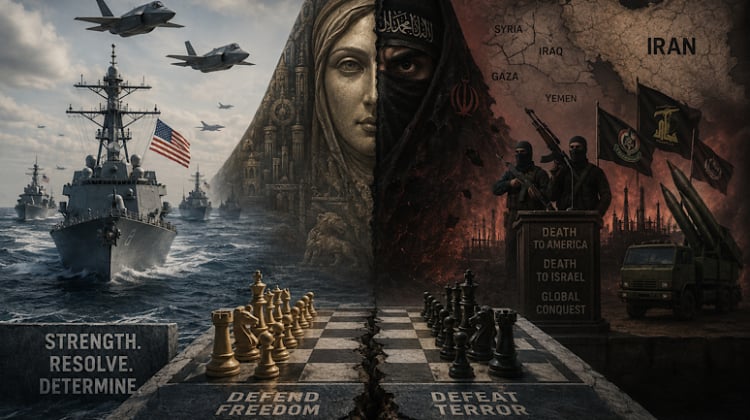
Defend Freedom – Defeat Terror (FPM Photo)
August 4, 2026
Treating Iran like a state has been a policy failure. Both diplomatic and military efforts to either engage or pressure Iran have all rested on the assumption that its terrorist regime is a state with national interests and that it could be tempted with membership in the international community or pressured to comply through economic sanctions or selective strikes on key targets.
Some of those tactics might have worked on normal countries that prioritize commerce over conquest, value international engagement, deplore losing money and military assets in a war that they can’t win and at the very least care about maintaining their everyday state functions.
But those same tactics have failed not only in Iran, but also when confronting other Islamic terror states like the Taliban, Hamas in Gaza or the Houthis in Yemen which do not care about the normal functioning of a state, and can absorb military and economic losses because they see them as only means to a larger ideological end only achievable through constant conflict.
Dictators conquer in order to rule a state, terrorists rule a state in order to conquer. The state, its people, its wealth and weapons are expendable assets to spread the ideology of the terrorists.
We’re not fighting Iran as a country. What we are fighting is a fanatical cult and terrorist organization that has taken over Iran. The distinction is harder to spot because, unlike Afghanistan or Yemen, the terrorists took over a large, sophisticated and urbane nation, they command professional diplomats and nuclear scientists, vast industries and great wealth.
But all of that is in service to terrorists who see them as assets to be used to conquer the world.
Iran’s regime turned its weak hand into a strong one, not by traditional statecraft, but through the usual tactics of terrorists, showing a complete disregard for its losses while hijacking a vital waterway, calculating that the infidels may have bigger weapons, but weaker morale.
Islamic terrorists don’t win victories on the battlefield, they prevail by persisting until they negotiate concessions, and then taking those concessions, gaining more recruits and then pressing the attack again, absorbing the blowback, and achieving more concessions.
Oct 7, like the ISIS campaign, showed that when Islamic terrorists attack even a poorly prepared modern force, they rely on insurgent tactics and their victories fall apart when modern armies can bring their full command of the battlefield to bear on any organized opposition.
This Maoist model, losing battles and winning the war through fortitude and global propaganda, has been adopted by successful Islamic terrorists. Those like ISIS and Al Qaeda who stray too far from it are defeated. It’s the model used by the Taliban, who didn’t set out to win, only to remain in the field long enough to negotiate a worthless deal and watch us leave and it’s the model that was used by Hamas many times before and is being used by it once again.
That’s the easily recognizable model that Iran is relying on now.
And it’s only possible because Western nations have come to rely on a heavily flawed foreign policy toolkit that emphasizes leverage, displays strength without expecting to have to make full use of it, offers an economic carrot and waits for rogue nations to reform and come to heel. This approach has been completely useless on countries and in theaters that reject its basic premise, whether it’s North Korea or the Russia-Ukraine War, that the conflict must end.
Most civilized nations don’t want a prolonged conflict. To win, the other side just has to be willing to prolong the conflict indefinitely. There are two responses to this, one is to unleash sufficient power so as to completely crush the other side, the other is to save face and make a deal after a show of force that is supposed to convince someone outside D.C. that we mean business.
Ever since WWII, we’ve been pursuing the latter course from Korea to Vietnam to Afghanistan, and that’s understandable because Americans don’t want to fight any ‘forever wars.’
But that just means our enemies can win every time by threatening us with a ‘forever war’.
Jihadists, like the old fanatical Communist movements, are using the apparatus of state power not for national purposes, but the international ones of global conquest, and so whether we like it or not, we are stuck in a ‘forever war’ with them until they defeat us or we defeat them.
The alternative, a balance of power, could be sustainable with Cold War enemies like the USSR and China whose leaders were more concerned with their national power than an imminent global revolution, and preferred subversion to an apocalyptic world war, but may be less so with actual Islamic terror that are prepared to sacrifice the traditional prerequisites of statehood states as opposed to their modern Soviet national equivalents like Pakistan or Saudi Arabia.
To defeat Iran or at least return to a balance of power, we have to stop thinking of it as a state. Iran has had better luck using force as a leverage for forcing concessions from us than the other way around because it cares less about the most basic concern of a state: normalcy.
Most countries want order, not chaos. They want the systems of the state to work reliably because that is the means by which their power operates. They want to know what the price of wheat and oil will be tomorrow. Terrorists however are different. They embrace chaos, destabilize normalcy and see disruption as a banner broadcasting the triumph of their ideology.
We can’t defeat Iran by disrupting or threatening its normal functioning, as we’ve tried to do. We have crippled its larger ability to threaten us by directly targeting its nuclear program. If we want to stop threats from it on the water, we have to destroy its naval and aerial capabilities. If we want to end threats from its regime, we have to treat it like ISIS, not like an unfriendly state.
Anything else will just drag us into a waiting game with terrorists who can outwait us if all they have to fear from us are some limited economic sanctions and an occasional bombing raid.
We can defeat enemies who are not afraid to die. But we have to be willing to kill them.
Daniel Greenfield, a Shillman Journalism Fellow at the David Horowitz Freedom Center, is an investigative journalist and writer focusing on the radical Left and Islamic terrorism. Daniel became CEO of the David Horowitz Freedom Center in 2025.
Copyright © 2026 · frontpagemag.com

No comments:
Post a Comment