DONATE

Showing posts with label 1-State Solution. Show all posts

Sunday, September 23, 2018

Israel is Jewish, That’s My Ultimate Deal


John R. Houk
© September 23, 2018

President Trump has long formulated an “Ultimate Deal” between Israel and the Arabs that call themselves Palestinians. I am not going to lay out the perceived details of such a deal because so far those details seem to be a bit fluid. Meaning the Trump team hasn’t nailed down an internal agreement. My guess for that is negativity against potential details from Leftist supporters of the fake-Palestinians and some Jew-hating Muslim apologists globally as well some Arab nations.

In full disclosure, I’m a Christian Zionist. In case you haven’t realized it, ultimately that means I have little sympathy for the pseudo-Palestinian Arabs that can never pinpoint a historical period in which an Arab speaking nation of people called Palestinian EVER existed. INDEED, the current Arabs calling themselves Palestinians are overwhelmingly descendants of migrating Arabs outside the area who showed up after returning Jews began modernizing the land then managed by Ottoman Turks made employment attractive.

Prior to Arab immigration, the longstanding inherent Arabs were exploited peasants at the mercy of rich Muslim tenant owners who mismanaged the Land of the Jews into swamps and unusable agricultural land further impoverishing the shrinking peasant tenant farmers.

Thus my stand on Israel is leads toward disenfranchising hostile Arabs deporting them for sedition even if it means a forced depopulation of Arabs that do not accept the existence of the Jewish State of Israel. My Christian Zionist predilection of believing in the Jewish return to their Biblically promised homeland is my primary reasoning. And yes, I realize in the realm of political correctness, my ultimate plan for a One-State Solution is incomprehensible to Leftist Multiculturalists. I don’t care. Whatever hastens the return of Jesus the Messiah is the only realistic solution for world peace. (And yes I realize the Messiah concept produces misgivings among Observant Jews. But remember, I am not calling for any harm to Jews. I believe the Return of Jesus will inspire Jews rather than irritate them. SO, I stand with Jews for the Jewish State of Israel.)

The inspiration for these thoughts is some commentary by Martin Sherman on the President Trump initiative for the “Ultimate Deal” for Israel/Arab peace in the Middle. I found it in Ted Belman’s Israpundit.

JRH 9/23/18
In this current state of media censorship & defunding, consider chipping
in a few bucks for enjoying (or even despising yet read) this Blog.
**************************
INTO THE FRAY The rumored “ultimate deal”: Potential payoffs and possible pitfalls.


By Martin Sherman
Intro by Ted Belman
Email Alert Sent: 9/22/2018 3:17 PM

T. Belman. Martin’s point is that the “ultimate deal” must include incentivised emigration. I agree. In my article Trump’s Deal of the Century, I made no mention of this as I considered it to be the second stage of the process. First things first, namely end the Oslo Accords, UNRWA and the “peace process”. And finally destroy the Palestinian narrative. I did not want to jeopardize those very significant gains by suggesting that incentivised emigration must be part of the first deal.

Nevertheless the first deal as described by me includes a Jordanian initiative to incentivize emigration of Palestinians by providing free housing and jobs as the incentives. Also there is nothing to prevent Israel or others from providing further incentives.

I made it clear that the first deal, (Deal of the Century), includes Israel sovereignty west of the Jordan River. Pursuant to that sovereignty, Israel would appoint administrators of the former Area A namely a friendly Jordan. It is understood, though not mentioned, that Jordan would amend the text books and cirriculae [sic] for all students under its care to one acceptable to Israel. Jordan would be no more than the agent of Israel while admistering [sic] Area A and in no way autonomous.

By Martin Sherman


The potential impermanence of the positive measures already undertaken by the Trump team should not be the only reason for Israeli concern over the brewing “ultimate deal”

…we will not put forth a plan or endorse a plan that doesn’t meet all of Israel’s security issues because they are of extreme importance to us—Jason GreenblattAssistant to the President & special representative for international negotiations, JNS, September 12, 2018.

…To defend itself Israel must retain control over the Jordan valley…[A]ny future arrangement must include Israeli control of the mountain ridge and a demilitarized Palestinian state…[T]o defend itself Israel must control the airspace over the West Bank—Israel’s Critical Security Needs for a Viable Peace, The Jerusalem Center for Public Affairs, May 25, 2010.

…Arab officials say, Mr. Kushner is pushing the idea of a confederation between Jordan and the Palestinian rump of the West Bank. Far from new thinking, this recycles one of the oldest mantras of Israeli irredentism: that the Palestinians already have a state—Jordan.—David Gardner, “Trump’s ‘deal of the century’ offers nothing good to Palestinians”, Financial Times, September 5, 2018.

In recent weeks, there has been a spate of media speculation that the White House is soon to release details of the Trump administration’s ultimate peace deal to end the century-long conflict between Jew and Arab over control of the Holy Land.

Although almost no details have been revealed by official sources, rumors abound as to some of its more important components—and others have been inferred on the basis of some already implemented elements of Trump’s Mid-East policy.

Some transformative measures


Since the start of his presidency, Donald Trump has undertaken some bold, far reaching measures that have, in some significant ways, potentially transformed the discourse on the Israeli-Palestinian impasse. These have all been unequivocally favorable to Israel and considerably undermine long-held Palestinians positions.

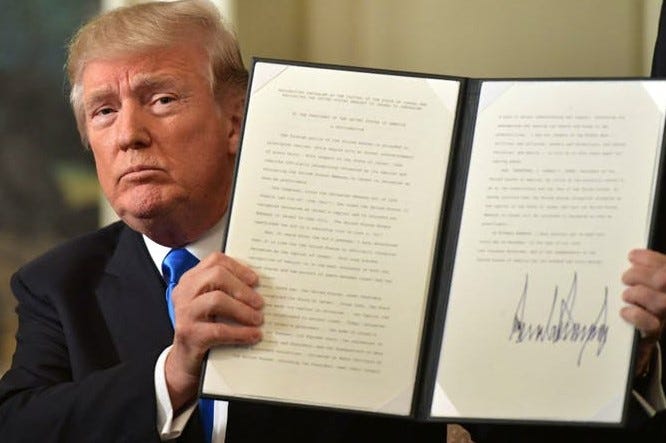
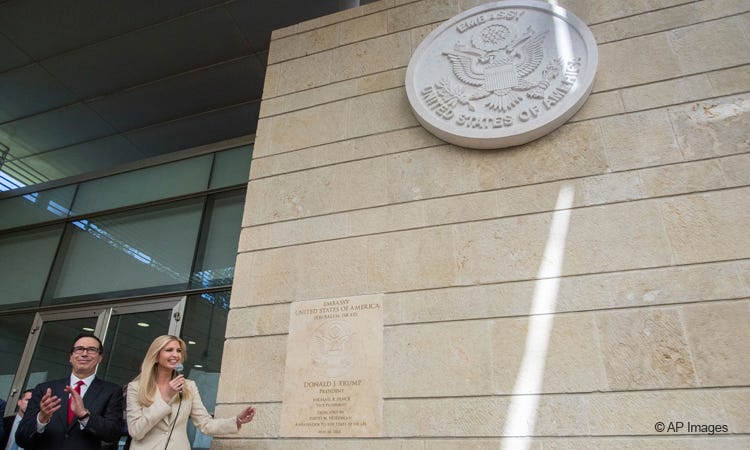
Thus, Trump has largely preempted the question of the status of Jerusalem as Israel’s capital—albeit not its precise geographical extent. Likewise, he exposed the enduring and egregious anomaly of the Palestinian “refugee” ruse, terminating all US funding to UNRWA (United Nations Relief and Works Agency(, the UN body charged with dealing with the Palestinian-Arab refugees and their multi-generational descendants. This burgeoning population has been held in political limbo for decades as stateless refugees until such day as they can exercise their illusionary “Right of Return” and reoccupy their now non-existent homes inside Israel, abandoned in 1948 and 1967.

As a direct derivative of the decision to defund UNRWA and to dispute the refugee status of millions of Arabs of Palestinian descent—resident in Arab countries for decades—there has been a flurry of reports suggesting another ground-breaking US initiative. According to these reports, the Trump administration is seriously considering engaging Arab countries over the permanent resettlement of the Palestinian-Arabs living as “refugees” within their borders, and their absorption as citizens of their host nations.

If implemented, such an initiative—which this writer has been promoting for almost a decade-and-a-half—would clearly take the “Right of Return” off the table and remove one of the most intractable—arguably the most intractable—issue from the agenda.

The question of durability

Although these are, of course, greatly welcome developments from Israel’s point of view and were totally inconceivable under earlier administrations—the previous one in particular—a word of caution is called for.

After all, just as such measures were unthinkable under the Obama administration, there is no way to ensure their durability under a post-Trump administration. Indeed, given the pathological animus toward the president from his political adversaries on the one hand; and the growing anti-Israel sentiment in the Democratic Party, on the other, there is good reason for concern that if a Democratic president were to be elected, a concerted effort would be made to undo anything perceived as a “Trump’s legacy”—including, perhaps, especially—his Mid-East policy initiatives.

Thus, just as a presidential decision precipitated the US’s exit from the Iran nuclear deal, the moving of the American embassy to Jerusalem, the shuttering of the PLO office in Washington, the defunding of UNRWA and emerging rejection of the “Right of Return,” so can any contrary presidential decision reverse them—or at least largely neutralize them.

Moreover, the closer Israel is perceived to be to the Trump administration, the harsher and more vindictive the backlash is liable to be, should the Democrats regain the White House?—?particularly with the growing erosion of bipartisanship over Israel.

The hazards of hubris

Of course, this caveat should not be interpreted as a call for reticence in accepting the GOP’s warm embrace. Indeed, that would be both detrimentally counterproductive and inappropriately ungrateful.

It should however, be seen as warning against complacency and as a caution that more inclement times may well be ahead. For, at this stage, little can be more hazardous than hubris.

It is essential that Israel now undertake a vigorous initiative to cement these unexpected favorable developments and ensure that they cannot be easily undone by future administrations.

This must be accomplished by a comprehensive strategic endeavor, both at the diplomatic level, aimed at changing hearts and minds and at the physical level, aimed at changing facts on the ground.

The diplomatic component must be directed at undermining the Palestinian claims to statehood west of the Jordan River—by discrediting and delegitimizing the “Palestinian narrative”. The physical component must be directed at making the Jewish presence in Judea-Samaria irrevocable—by launching a largescale construction drive to increase the Jewish population beyond “the point of no return”.

Without such a strategic initiative, any welcome gains that have accrued to Israel because of Trump’s largely unexpected—and certainly unpredicted—electoral victory will remain potentially ephemeral—exposed and vulnerable to the vicissitudes of the bile or the bias of some anti-Trump successor in the White House.

Rumors cause for concern?

But the potential impermanence of the positive measures already undertaken by the Trump team is not the only reason for Israeli concern over the brewing “ultimate deal”. For the rumors swirling around the ongoing contacts between US officials and various figures in the Arab world could also well be cause for alarm.

These rumors relate to the eventual source of authority envisioned for the governance of the territory beyond the 1967 lines in Judea-Samaria and Gaza. Some rumors refer to giving Jordan (whether under the current Hashemite regime or under some yet-to-be determined successor) a range of civilian powers to govern the Arab residents there. Others raise the possibility of likewise empowering a reformed and repentant Palestinian Authority—with or without some affiliation to Jordan. Yet others relate to the possibility of engaging “alternative Palestinians” as a more pliant alternative to the recalcitrant Abbas, to manage the civilian affairs of the Arab residents of Judea-Samaria.

All these suggested alternatives miss the most crucial point for the future of Israel as the nation-state of the Jewish people.

This is that they all entail the permanent presence of a large, potentially hostile Arab population, resident in territory vital to Israel’s security-and nurtured on decades of Judeocidal incitement and exposed to irredentist influences from the wider Arab/Muslim world. It therefore makes little difference what/who the envisaged source of formal authority is over this population, since its continued presence in the commanding highlands adjacent to Israel’s most populous area will render any “deal” –ultimate or otherwise?—?inherently unstable and potentially perilous for Israel.

Accordingly, if all the steps taken hitherto by the Trump administration do not converge towards synthesis of a single, unequivocal outcome, they will—despite all their positive features—eventually be of little—if any—avail. At least if the goal is for Israel to endure permanently as the nation-state of the Jewish people.

The autonomy paradox?

As I have been at pains to underscore repeatedly in the past, for Israel to indeed endure as the nation state of the Jews, it must extend its sovereignty over all the territory between the Mediterranean Sea and the Jordan River—including the highlands that protect Israel from invasion/infiltration from the East, and ensure the security of its coastal megalopolis in the West. But Israel’s sovereignty over this territory is incompatible with providing authority to any other party that does not acknowledge the legitimacy of that sovereignty.

This is something that the rumored formats of Trump’s “ultimate deal” seem to overlook. After all, the only reason to suggest allowing Arab governance (whether Jordanian or Palestinian) over the Arab population in Judea-Samaria is that they reject the legitimacy of Jewish sovereignty.

Indeed, this highlights the underlying contradiction in any attempt to confer “autonomy” (i.e. limited authority) on any Arab entity under Israeli sovereignty (i.e. unlimited authority) in the context of the conflict between Jew and Arab. For any “autonomous” arrangement to be inherently stable, it is essential that the autonomous entity acknowledge and accept the legitimacy of the sovereign entity (Israel). But this is precisely the reverse of the underlying rationale of all the proposals to grant some Arab entity limited authority to govern the Arab population in Judea-Samaria.

Here, such authority is being granted precisely because the legitimacy of Jewish sovereignty is rejected and hence, every limitation imposed on the authority of the Arab entity will be resented, and rejected—creating endless potential for friction.

The sovereignty imperative


This will be particularly acute at the interface between areas under full Jewish sovereignty and those under Arab autonomy and in contending with cross-border issues, such as pollution (particularly the carcinogenic emissions of the wide spread charcoal industry), sewage, pollution from industrial effluents, agricultural run-offs, treatment of transmissible diseases, compulsory inoculation of livestock and rabies and so on Who would be charged with setting standards for dealing with these matters and for enforcing those standards? Israel or the Arab entity? If the Arab entity, how would Israel protect its citizens from the resultant hazards if those standards were not enforced? If Israel, what would remain of the authority of the Arab entity, which would be virtually emptied of all substance?

Similar questions could be raised for almost every walk of life. Would Israel impose standards of road safety for vehicles on its roads? If not, what would the consequences be? Would Israel determine the content of education to prevent continued incitement? If so, how would this erode the authority of the Arab entity? If not, how would Israel contain the consequences of such incitement?

These questions are thrown into even sharper relief when it comes to matters of law and order and security. If, for example, Jordan were given authority to run civilian affairs in Arab populated areas, what would happen in case of insurrection and Israel were compelled to use force to quell the violence? Could Jordan accept the use of force against those in its charge? How would it justify inaction to the rest of Arab world?

Worse, what if an assumedly amicable regime were given administrative status west of the Jordan River and, for reasons beyond Israel’s control, it was replaced by a far less amicable one? Would Israel continue to grant powers of governance to an inimical entity?

These are merely a sampling of the myriad of unavoidable and intractable questions with which the architects of the “ultimate deal” will have to contend—and whose significance and severity the Israeli leadership will have to convey to its American counterparts—lest ill-considered and irreversible decisions are made.

In the final analysis

In the final analysis, there is only one “ultimate deal” that can ensure Israel’s long-term survival as the nation-state of the Jewish people. This requires Israel extending its sovereignty over the entire territory—from the Mediterranean Sea to the Jordan River.

The only way Israel can do this, without being compelled to rule over a recalcitrant non-Jewish population, which rejects the legitimacy of its sovereignty, is to remove that population from the territory over which it must exert sovereign rule.

The only way it can do this without engaging in forced expulsion, is by material inducements?—?a.k.a. incentivized emigration.

So simple. So logical. So incontrovertible!  The real conundrum is why others don’t embrace it as the “ultimate deal”.

Martin Sherman is the founder & executive director of the Israel Institute for Strategic Studies
__________________________
Israel is Jewish, That’s My Ultimate Deal
John R. Houk
© September 23, 2018
______________________
INTO THE FRAY The rumored “ultimate deal”: Potential payoffs and possible pitfalls.

Copyright © 2017- Israpundit - All Rights Reserved

Wednesday, July 12, 2017

Intro to ‘The Ultimate Alternate Israel-Palestine Solution’

John R. Houk, Editor
Intro posted July 12, 2017

British Mandate for Palestine League of Nation Award 1920

Ted Belman proposes a concept of a Two-State Solution for Israel and non-people Palestinians. The proposal is actually closer to a One-State Solution, but you decide.

Belman takes his cue from the Jordanian political opposition Jordan’s Hashemite Monarch King Abdullah II. Those that oppose their king are known as Jordanian Opposition Coalition (JOC) [SEE ALSO HERE]. The JOC suggests that the people who call themselves Palestinians should abandon their Islamic terrorist leadership and move to Jordan. Jordan would then take on the aegis as the Arab State originally set up by the League of Nations way back when Britain was given the Mandate for Palestine back in 1922. [This should be of interest to the formation of the British Mandate for Palestine leading to the British shaft of Jews, creation of modern Israel and Arab hatred of Jewish Israel: HERE, HERE, HERE AND HERE.

The thing that Ted Belman and the JOC don’t specifically bring up is that it is unlikely that Jordan’s King Abdullah II is unlikely to allow non-Hashemite supporting Arabs into his nation without a fight. Keep in mind that in the 1970s the PLO’s Yasser Arafat tried to dethrone Abdullah II’s father King Hussein in a civil war that the loyal Jordanian army won and gave Arafat and his PLO Islamic terrorists the boot.

British Mandate for Palestine 1923

JRH 7/12/17
***************
The Ultimate Alternate Israel-Palestine Solution

July 4, 2017
Email Alert Sent 7/11/2017 12:31 PM

With a new U.S. president, new ideas are emerging on how to resolve the Israel-Palestine debacle. One of the most promising comes from Jordanian Opposition Council who favor a new Palestinian state — in Jordan. 

The GOP unanimously approved a pro-Israel platform at their convention in July 2016 which stipulated:

“The U.S. seeks to assist in the establishment of comprehensive and lasting peace in the Middle East, to be negotiated among those living in the region,”

David Friedman and Jason Greenberg, representing Donald Trump, participated in the drafting and were in complete agreement with the final text.

Gone was any reference to the Palestinian people or to a two-state solution. In addition, the platform included the words “We reject the false notion that Israel is an occupier.” If not an “occupier,” then presumably Israel is a sovereign.

Accordingly, the search is on for an alternate solution. Such a solution could take inspiration from the short-lived Feisal/Weizmann Agreement of 1919. The essence of this agreement was that Palestine as it then was, was to be divided into two states, one for the Arabs and one for the Jews. Chaim Weizmann on behalf of the Jews agreed to help develop the Arab state and King Feisal agreed to welcome Jewish settlement in the Jewish state and favored friendly cooperative relations.

Although the British didn’t breathe life into this agreement, they did separate Trans-Jordan from Palestine in 1922 with the Jordan River being the boundary between them. Trans-Jordan (Jordan) thus got 78% of the lands promised to the Jews. The remaining 22% consisting of the land between the Jordan River and the Mediterranean was to be the Jewish state. This was enshrined in the Palestine Mandate signed by the League of Nations in 1922.

On June 30, 1922, a joint resolution of both Houses of Congress of the United States unanimously endorsed the “Mandate for Palestine,” confirming the irrevocable right of Jews to settle in Palestine—anywhere between the Jordan River and the Mediterranean Sea.

With respect to the Arabs living in Jewish Palestine, the Congressional Record contained the following:

“(2) That if they will not consent to Jewish government and domination, they shall be required to sell their lands at a just valuation and retire into the Arab territory which has been assigned to them by the League of Nations in the general reconstruction of the countries of the east.

“(3) That if they will not consent to Jewish government and domination, under conditions of right and justice, or to sell their lands at a just valuation and to retire into their own countries, they shall be driven from Palestine by force.” [Blog Editor: Bold Emphasis Mine]

The US was not a member of the League of Nations at this time. In order to be able to protect American interests in Palestine, she entered into the 1924 Anglo-American Convention in which the U.S. bound itself to the terms of the Mandate. This of course meant the recognition of Jewish right to close settlement of Palestine and that all of Palestine was to be the Jewish homeland.

Since then, there were a number of unsuccessful attempts, contrary to the terms of the Mandate, to further divide Jewish Palestine into two states.  UN General Assembly Resolution 181, passed in 1947, recommended partition, but was rejected by the Arabs. The Jews on the other hand took advantage of it and declared their independence in 1948. Israel owes its independence to that declaration and not to Resolution 181, which was only a recommendation, precipitating the move.

Nothing has happened of any legal consequence since, to cancel the right of the Jews to settle and be sovereign over all the land to the Jordan River.

To date, Israel has been reluctant to claim sovereignty over these lands as the Arabs living there would then demand citizenship resulting in a binational state. This is unacceptable to most Israelis. They also reject the two-state solution.

So what is the alternative?

Consider for a moment, that if Jordan agrees to grant citizenship to all Palestinians, as their law currently provides, and invites the return of all of them to live and work in Jordan, the conflict would soon be ended. While King Abdullah isn’t about to do so, the Jordan Opposition Coalition (JOC) would. This coalition represents all opposition groups in Jordan that back a secular state. The JOC since its creation six years ago has supported good relations with Israel. It does not include groups that support terrorism. This alliance has agreed to work together in order to form the government of Jordan should King Abdullah abdicate. Although at least 75% of Jordanians are Palestinians, the King has disenfranchised them to a great extent in favor of the ethnic Hashemites and Bedouins.

The JOC has produced a detailed plan, Operation “Jordan in Palestine,” which clearly identifies their goals and the operational steps needed to implement their plan.  Copies are available upon request.

All that is necessary for this to come to pass is for the U.S. to instruct the king, who currently spends most of his time outside Jordan, to not return home. Then it would arrange for the Jordanian army, which it controls, to support the next popular Palestinian uprising, and to designate who among them would form the interim government.

The JOC, puts it this way:

“This plan seeks to execute a feasible two-state solution where Jordan is the natural homeland for all Palestinians, and Israel becomes sovereign over all soil west to the River Jordan. This could only happen if the corrupt, terror-supporting and double-speaking Hashemite royal family leaves Jordan. The Palestinians often revolt against the regime but the king’s police force puts them down. The American media ignore this solution to the unrest in Jordan.

“What is needed is for the U.S. to influence the Jordanian army and security agency to stand with the revolution the next time it breaks out.  The security agencies and army are already securing the country without any influence from the king who is mostly abroad.  Under these conditions, the king would not return.  Once that happens an interim government of secular Palestinians who want peace with Israel could be appointed.

“Once the interim government is installed, it will strengthen the economy by stopping theft of government money and ending corruption. It will fully enfranchise the Palestinians. All Palestinians around the world would be welcomed to return to Jordan pursuant the current Jordanian citizenship act, which already recognizes all Palestinians as citizens of Jordan. Many Palestinians will emigrate to Jordan in part because many have family members and friends living in Jordan. Work opportunities as well as a rewarding benefits/welfare system will be made available to them by the new interim government as further inducement.”

Israel, with many international partners, including the U.S., could finance the building of a new Jordanian city of 1 million people. This would greatly stimulate the Jordanian economy and would provide work for the returning Palestinians. The new homes could be made available to the returnees and locals at subsidized prices further incentivizing people to return. The ending of King Abdullah’s discrimination against Palestinians living in Jordan, would also contribute to making Jordan a desired immigration destination.

Michael Ross, a Republican, wrote after the election of Donald Trump, “Trump Must  Speak to Mudar Zahran” because Zahran offers the alternate solution that Pres Trump is looking for.

As part of this solution, all Palestinian refugees enrolled with UN Relief And Works Agency for Palestine Refugees in the Near East could be repatriated to Jordan and given citizenship. Thus UNRWA could be wound up and the current UNRWA funding could be transferred to Jordan to assist in the resettlement.

According to Moshe Feiglin, the head of the Zehut Party in Israel, the Oslo Accords have cost Israel over 1 trillion shekels since they were signed. In addition, Israel has borne the cost of three military campaigns in Gaza. Finally, Israel supplies to the Palestinians their energy, water and sewage treatment for free or at greatly subsidized prices.

Last summer, Moshe Feiglin proposed a Solution in which Israel extends Israeli law from the Mediterranean to the Jordan:

“We will give the Arab population in those territories three options: The first is voluntary emigration with the aid of a generous emigration grant. The second is permanent residency, similar to the “Green Card” status in the US – not like what is currently the practice in East Jerusalem. This status will be offered to those Arabs who publicly declare their loyalty to the State of Israel as the state of the Jewish Nation. We will safeguard their human rights and will not do anything like we did to ourselves in Gush Katif. The third option will be reserved for relatively few Arabs, and only in accordance with Israeli interests. Those who tie their fate to the fate of the Jewish Nation, like the Druze, can enter a long-term process of attaining citizenship.”

Recently, Feiglin’s Party, Zehut, published The Diplomatic Plan.

Martin Sherman has published his plan which he calls the “Humanitarian Solution” as opposed to a strictly political solution. He summarized all his writings in support of such a plan and published them here.

With an estimated $300,000 per family grant, both he and Feiglin have estimated that incentivized compensated emigration will cost Israel over $200 billion USD but both argue it is feasible and worth doing.

The repatriation of Palestinians to Jordan, as proposed by JOC, would greatly facilitate the Palestinian emigration and greatly reduce the grants needed to incentivize it. UNRWA and the Palestinian Authority would both be wound up.

1.75 million Palestinians live in Judea and Samaria (West Bank). They should be induced to emigrate to Jordan.  The same goes for all Palestinian refugees living in Lebanon, Syria and elsewhere.

Considering the subsidies that the West provides to UNRWA, Gaza and the PA, this would be a bargain. Given that JOC has tied its fate to Israel, Israel would be happy to contribute to such a solution as the present conflict costs her hundreds of millions of dollars annually.

Currently the US gives $370 million to UNRWA, $300 million to the Palestinian Authority (PA) and $ to Jordan. The EU gives .  These monies could be redirected to Jordan to kick start this repatriation.  Others, including Israel could contribute. In time, the US and EU subsidies could be phased out.

It really is that simple.  There is much more that can be said in support of it.

Prof. Hillel Frisch, a senior research associate at the Begin-Sadat Center for Strategic Studies and Yitzhak Sokoloff, a fellow of the Ingeborg Rennert Center for Jerusalem Studies at Bar-Ilan University recently wrote Trump and the Jordanian Option.

“The inauguration of an American administration uncommitted to the principle of an independent Palestinian state provides Israel with the opportunity to advocate a long-term strategic vision of building up a prosperous Jordan that could provide an alternative to the model of a two-state solution based on the Palestinian Authority.”

They are wrong to suggest that this can be done with King Abdullah. I believe, as does the JOC, that the king is part of the problem and must be replaced by Palestinians.

Gideon Saar, a touted future Prime Minister of Israel, in his recent article, Goodbye Two-State Solution, wrote:

“A Jordanian-Palestinian federative solution would offer the Palestinians space in addition to their autonomy. We could also consider adopting a joint Israeli-Jordanian-Palestinian economic framework. And there are many other ideas that could be constructed as a result of quiet, serious work with the backing of a supportive US administration.”

He is right but the ultimate alternate solution is the one put forward by the JOC.

If anyone wants more information or can help this solution get traction, please write me (tbelman3@gmail.com).

NOTE:

After publishing this article, I heard from a reader who had done considerable work on a plan of his own similar to the Jordan Option described above.  I spent many hours with him discussing his research. We also met with a few movers and shakers in Israel.

Whereas I merely suggested the possibility of building a new Jordanian city to house one million people, he went further and researched a location for such a city and researched the cost of housing in Jordan.

According to his research, an 800 sq ft apartment in Jordan costs $40,000.  Thus if 2 million Palestinians in the West Bank, Jerusalem and the camps could be induced to move to Jordan, 400,000 homes (5 people per family) would be needed costing $16 billion; a far cry from the $200 Billion needed to induce emigration according to Feiglin and Sherman. These homes can be given to the Palestinians, free of charge.

Based on the enormous benefit caused by the plan to the Jordanian economy Abdullah can be convinced to invite all Palestinians to return to Jordan just as the JOC plans to do if they get into power.  Most people believe that Abdullah would never do it. But due to the poor Jordanian economy he could  be forced to do it
Prof Hillel Frisch, BESA, agrees. He recently wrote, Becoming Part of Jordan and Egypt: A Palestinian Economic Imperative which included this summary:

EXECUTIVE SUMMARY: Reintegrating into the Jordanian state is an economic imperative for the Arab inhabitants of the Palestinian Authority. Only by once again becoming citizens of Jordan will they be able to challenge the economic stone wall imposed by domestic Jordanian economic lobby groups barring West Bank exports. A two-state solution would lead, not to an economy of peace, but to an economy of violence as lobby groups in both Israel and Jordan shut out the Palestinian state’s exports. The Palestinian state would inevitably react by threatening and committing violence to extract the international aid to which the PA has become accustomed.

This reader also makes the novel suggestion that Israel can offer a water incentive to Jordan tied to the number of immigrants it absorbs. This would increase the water supply to Jordan and lower the cost per litre.  More on this later.

When presenting this plan to others, many mention that US Congressmen love King Abdulla. That may be so but they are ill informed. Recently Edy Cohen of BESA wrote Sorry but Jordan is not a friend?

Gaza and Egypt

Independent of this proposal or perhaps in tandem with it the same opportunity exists for helping all Gazans to emigrate to Egypt. There are approximately 1.5 million Gazans living in Gaza and the average family size is 6. Thus 250,000 apartments are required.

An 800 sq. ft. apartment in the new cities adjacent to Cairo that would accommodate 15 million people, costs about $16,000 USD: i.e, half the Jordan cost. This adds up to $4 billion USD.

Thus the Gazans would need only 10% of those homes. A 10 year plan would mean that 150,000 Gazans would emigrate there every year. This represents just 0.16% of the population of Egypt.1.5 million Gazans represent only 1.6% of the Egyptian population.

Other incentives might be pensions and welfare payments financed by the international community.

Considering how much it costs the EU and the US to support the current wave of migrants to their shores, this could well be a model for them to consider, i.e., a “Marshall Plan” for the Middle East as a means to get the migrants to stay where they are.

The obvious question is why would al Sisi agree to this, given how much trouble he is now having with Hamas that rules Gaza and is perceived as a threat to Egypt along with ISIS.

The obvious answer is that al Sisi needs help to meet its financial obligations and its security threats emanating from the Sinai and from Libya. The international community could provide that help.

Given that Saudi Arabia and other gulf states have started an initiative at Pres Trump’s urging, to stop the flow of funds to terrorists. They have severed relations with Qatar one of the biggest funders of terror demanding that it cease and desist. Specifically, they have demanded that Qatar stop funding Hamas.

Thus if Hamas is starved for money they will be less of a threat to Egypt too.

The reader above mentioned, is currently preparing a report in support of his Plan. It is 25 pages long and when completed in a few weeks will approach 35 pages. This Plan will make the case for why this is in the best interest of the US too.
_____________
Intro to ‘The Ultimate Alternate Israel-Palestine Solution’
John R. Houk, Editor
Intro posted July 12, 2017
_______________
The Ultimate Alternate Israel-Palestine Solution

Copyright © 2017- Israpundit - All Rights Reserved


Tuesday, June 13, 2017

Help Pseudo-Palestinians Emigrate


John R. Houk
© June 13, 2017

It has always been my opinion that a Two-State Solution would NEVER be a harbinger for peace between Israel and the Arabs that call themselves Palestinians. A Palestinian State would merely be a launching ground for Islamic terrorist attacks against Israel. The result would be Israeli military incursions to punish an independent Palestine for allowing the terrorist launching pads. Or an independent Palestine might have the hutzpah claim the terrorism is military incursions for whatever fake/false reason given.

The only raison d'être for a Palestinian State existence would be to end Israel’s existence and to kill Jews. Because of Muslim animus against Israel, a One-State Solution is the best solution.

The best One-State Solution is to find a way to move Jew-hating Muslims out of any area that is a part of ancient Jewish heritage.

Dr. Martin Sherman has written a two-part essay touching on the logistics and feasibility of an ethical fashion to aid Jew-hating Muslims to emigrate to another Arab-Muslim nation. I found out about Dr. Sherman’s from the Facebook Group “No Palestinian State!” (If you are a Pro-Israel kind of person you should go there and request to be a member and add to the discussion.)

The title is “INTO THE FRAY: The Humanitarian Paradigm - Answering FAQs”. You can read the 6/2/17 Part One HERE. Part Two is cross posted below.

JRH 6/13/17
*****************
INTO THE FRAY: The Humanitarian Paradigm - Answering FAQs (Part 2)

Sequel to the dispelling of doubts regarding the feasibility - and morality - of largescale, financially incentivized emigration as the only non-kinetic approach for resolution of the Israel-Palestinian impasse.

By Dr. Martin Sherman
June 9, 2017 06:48

The pessimist sees difficulty in every opportunity. The optimist sees the opportunity in every difficulty. -attributed to Winston Churchill

Readers will recall that last week I began a two part response to FAQs (Frequently Asked Questions) relating to the practical feasibility/moral acceptability of my proposed Humanitarian Paradigm (HP), which prescribes, among other measures, large-scale financially incentivized emigration of the Palestinian-Arabs, living across the pre-1967 lines as the only route to attain long-term survivability for Israel as the nation-state of the Jewish people.

To recap briefly

In last week’s column, I addressed the question of the overall cost of the funded emigration project, and showed that, given the political will to implement it, it would be eminently affordable – even if Israel had to shoulder the burden alone. If other industrial nations could be induced to participate, the total cost would be an imperceptible percentage of their GDP.

I then went on to demonstrate that there is ample evidence indicating a wide-spread desire in large sections of the Palestinian-Arab population to emigrate permanently in search of more secure and prosperous live elsewhere. This point was underscored by a recent Haaretz article, describing how thousands of Gazans had fled their home to Greece, undertaking perilous risk to extricate themselves from the harrowing hardships imposed on them by the ill-conceived endeavor to foist statehood on the Palestinian-Arabs.  Significantly, according to the Haaretz report, none of them blamed Israel for their plight—but rather the ruling Hamas-regime, which, it will be recalled, was elected by popular vote to replace the rival Fatah faction, ousted because of its corruption and poor governance.

Finally, I dealt with the question of the prospective host nations, pointing out that the funded Palestinian-Arab émigrés would not arrive as an uncontrolled deluge of destitute humanity, but as an orderly regulated stream of relatively affluent immigrants spread over about a decade-and-a-half, whose absorption would entail significant capital inflows for the host nation’s economy.  Moreover, given the fact that, globally, migrants total almost a quarter billion, Palestinian-Arab migration of several hundred thousand a year would comprise a small fraction of one percent of the overall number—hardly an inconceivable prospect.

Following this short summary of previously addressed FAQs, we can now move on to tackle several additional ones.

FAQ 4: Won’t fear of fratricide deter recipients?

One of the most commonly raised reservations as to the practical applicability of the HP is that potential recipients of the relocation/rehabilitation grants would be deterred from accepting them because of threats of retribution from their kin-folk who allegedly would view such action as perfidious betrayal of the Palestinian-Arabs’ national aspirations.

In contending with this question, it is necessary to distinguish between two possible scenarios, in which such internecine intimidation will be either a phenomenon whose scope is (a) limited; or (b) wide-spread and pervasive.
  
Clearly, if the former is true, it is unlikely to have any significant inhibiting impact on the conduct of prospective recipients of the relocation/rehabilitation grants.

If, however, the assumption is that the latter is the case, several points need to be made:

- If this objection to the HP is to have any credence, its proponents must present evidence (as opposed to unproven supposition) that potential violent opponents of the HP program have the ability not only to inflict harm on prospective recipients (as opposed to issuing empty threats), but that they can sustain such ability over time.

- In this regard, it should be kept in mind that implementation of the HP entails the disarming, dismantling and disbanding —if need be, coercively—of the ruling Palestinian regime, and reinstating Israeli governance over all territory under Palestinian-Arab control.    

Inhibiting internecine intimidation

The HP is hardly unique with regard to this latter point. All other proffered policy alternatives for the failed, foolhardy two-state formula entail such measures—either by explicit stipulation, or implicit inference—since preserving the current Palestinian regime intact would clearly preclude their implementation.  Indeed, they are even endorsed by some pundits who do not discount the eventual emergence of a Palestinian state, such as Middle East Forum president, Daniel Pipes.

Clearly, the dispersal of the central Palestinian governing body, together with the defanging of its armed organs and the deployment of Israeli forces in their stead, will greatly curtail (although not entirely eliminate) the scope for internecine intimidation and the capacity to dissuade potential recipients of the relocation/rehabilitation grants from availing themselves of the funds.

In addition, Israel should task its own formidable military and intelligence services to protect prospective recipients of these grants by identifying, intervening and thwarting attempts to intimidate those seeking to enhance their lives by extricating themselves from the control of the disastrously dysfunctional regime under which they live.

Moreover, the international community should be called upon to cooperate with and participate in this principled endeavor to prevent fratricidal elements within Palestinian society from depriving their brethren of the opportunity of better, safer lives. After all, violence against Palestinian-Arabs, who choose to reside within any given host nation, would comprise an intolerable violation of that country’s national sovereignty.

Appalling indictment of “Palestinian” society?
  
Of course invoking the specter of large-scale fratricide as an impediment to the acceptance of the HP is an appalling indictment of Palestinian-Arab society. 

After all, the inescapable implication of such an objection to the HP’s practical applicability is that its acceptance by otherwise willing recipients, wishing to avail themselves of opportunity to seek security and prosperity elsewhere, can only be impeded by violent extortion of their kin-folk.

Accordingly, if the concern over large-scale fratricide is serious, it is in fact, at once, both the strongest argument in favor of the HP and against the establishment of a Palestinian state.  After all, two unavoidable conclusions necessarily flow from it: (a) any predicted reluctance to accept the relocation/rehabilitating grants would not be a reflection of the free will of Palestinian-Arabs, but rather a coerced outcome that came about despite the fact that it is not; (b) Similarly, the endeavor for a Palestinian state is not one that manifests any authentic desire of the “Palestinian people” but rather one imposed on them, despite the fact that it does not.

As a result, any Palestinian-Arab state established under the pervasive threat of lethal retribution against any dissenter will not be an expression of genuine national aspirations but of extortion and coercion of large segments of Palestinian-Arab society, who would otherwise opt for an alternative outcome.

In summation then, if the fear of fratricide can be shown to be a tangible threat, it should not be considered a reason to abandon the HP formula. Quite the opposite! It should be considered an unacceptable phenomenon to be resolutely suppressed –by both Israel and the international community—in order to permit the Palestinian-Arab public the freedom of choice to determine their future.

FAQ 5: Would funded emigration not be considered unethical “ethnic cleansing”?
 
 I have addressed the question of the moral merits of the HP extensively elsewhere (see “Palestine”: Who Has Moral High Ground?), where I demonstrate that the HP blueprint will be the most humane of all options if it succeeds, and the least inhumane if it does not.

I shall therefore refrain from repeating much of the arguments presented previously and focus on one crucial issue: The comparative moral merits of the widely endorsed two-state paradigm (TSS) and those of my proposed Humanitarian Paradigm (HP).

Since there is very little doubt (or dispute) as to the domestic nature of any prospective Palestinian state, anyone seeking to disqualify the HP because of its alleged moral shortcomings must be forced to contend with the following question: Who has the moral high-ground?

(a) The TSS-proponents, who advocate establishing (yet another) homophobic, misogynistic Muslim-majority tyranny, whose hallmarks would be: gender discrimination, gay persecution, religious intolerance, and political oppression of dissidents? ; or 

(b) The HP-proponents who advocate providing non-belligerent Palestinian individuals with the opportunity of building a better life for themselves elsewhere, out of harm’s way, free from the recurring cycles of death, destruction and destitution, brought down on them by the cruel, corrupt cliques that have led them astray for decades.

Furthermore, TSS advocates should be compelled to clarify why they consider it morally acceptable to offer financial inducements to Jews in Judea-Samaria to evacuate their homes to facilitate the establishment of said homophobic, misogynistic tyranny, which, almost certainly, will become a bastion for Islamist terror; yet they consider it morally reprehensible to offer financial inducements to Arabs in Judea-Samaria to evacuate their homes to prevent the establishment of such an entity?

FAQ 6: What about those who remain?

This is, of course, a serious question and a detailed response would depend on, among other things, the size of the residual Palestinian-Arab population who refuse any material compensation as an inducement to emigrate.

The acuteness of the problem would undoubtedly be a function of its scale. Clearly, the smaller this residual population, the less pressing the need will be to deal with it. For example it seems plausible that if, say, only a hundred thousand Palestinians remain, consideration may well be given to the possibility of offering them Israeli citizenship – subject to stringent security vetting and sworn acceptance of Jewish sovereignty as the sole legitimate source of authority in the land – without endangering the Jewish character of the country.

However, it should be remembered that, unlike the two-state approach which advocates perilous concessions, and the one-state prescription which calls for incorporating the Palestinian-Arabs resident across the pre-1967 lines into Israel’s permanent population, the HP does not involve any cataclysmic irreversible measures.

At the heart of the HP program is a comprehensive system of material inducements to foster Palestinian emigration, which includes generous incentives for leaving and harsh disincentives for staying. As detailed elsewhere, such incentives would entail substantial monetary grants, up to 100 years GDP per capita per family in Palestinian terms; while the latter entail phased withdrawal of services (including provision of water, electricity, fuel, port facilities and so on) that Israel currently provides to the Palestinian-Arabs across the pre-1967 lines.

 Accordingly, should it be found that the initial proposed inducements are ineffective, the former can be made more enticing, and/or the latter more daunting, until the proffered package is acceptable.

Seen in this context, it is difficult to envisage that many non-belligerent Palestinian-Arabs would prefer to endure the rigors of discontinued provision of services rather than avail themselves of the generous relocation/rehabilitation funds—especially given the dispersal of the Palestinian regime as an alternative source of such services.

 FAQ 7 What if the same kind of offer were made to induce Jewish emigration? 

In addressing this question several points should be borne in mind:

The offer would clearly not be made by an Israeli government. After all, the HP is intended as a measure to: (a) Ensure – not undermine – the survival of Israel as the nation-state of the Jews, and (b) Relieve the genuine humanitarian predicament of the Palestinian-Arabs—precipitated by the dysfunctional administration they have been subjected to since the 1993 Oslo process—not Jewish disgruntlement with the imperfect functioning of the Israeli government.

Of course, it would be impossible to prevent Arab elements from offering Jews financial inducement to emigrate from Israel, but in this regard it should be recalled that: (a) As a sovereign nation Israel can control the financial flows into the country and impede money from hostile sources reaching Israeli citizens, considerably complicating the transfer and receipt of funds. (b) Arab governments have been singularly reticent in providing large sums  to advance the “Palestinian cause” and there is little chance (or evidence) that they would advance the hundreds of billions required to finance large scale Jewish emigration;  (c) The overwhelming majority of Israelis enjoy living standards of an advanced post-industrial nation with a GDP per capita around 20 times higher than that in the Palestinian-administered territories; (d) Accordingly, it would be commensurately more difficult to tempt them to leave. Indeed, sums offered would have to be considerably higher to create a comparable incentive, running into millions rather than hundreds of thousands per family. (e) Moreover, a slew of recent polls show the large majority of Israelis are satisfied with their lives – thus the prospect of material incentives to induce large-scale emigration seems remote.

Urgent Zionist imperative.

The HP is the only Zionist-compliant policy prescription that can save Israel from the perilous dangers of the two-state formula and the specter of Lebanonization/Balkanization inherent in other proffered alternatives. Embarking on its implementation is a Zionist imperative that is both urgent and feasible. 
_________________
Martin Sherman is the founder and executive director of the Israel Institute for Strategic Studies.


The writer served for seven years in operational capacities in the Israeli Defense establishment, was ministerial adviser to Yitzhak Shamir's government and lectured for 20 years at Tel Aviv University in Political Science, International Relations and Strategic Studies. He has a B.Sc. (Physics and Geology), MBA (Finance), and PhD in political science and international relations, was the first academic director of the Herzliya Conference and is the author of two books and numerous articles and policy papers on a wide range of political, diplomatic and security issues. He is founder and executive director of the Israel Institute for Strategic Studies (www.strategicisrael.org).

 Born in South Africa, he has lived in Israel since 1971. More from the author

© Arutz Sheva, All Rights Reserved


Tuesday, May 23, 2017

Palestinian State Means Israel’s Destruction


John R. Houk
© May 23, 2017 (Updated 7/7/17)

About a month ago I found an interesting PragerU video at the G+ Community Islam contribution to America about Israel’s constant offers to give up land for an Arab state to be called Palestine and the Palestinian terrorists constant rejection of the Israeli offers. The owner of the community Roland Oliva posted the video on 4/27/17.

The enumeration of the Arabs that call themselves Palestinians constant rejection is well presented on the video. David Brog is the video speaker. His conclusion for Israeli/Arab peace is to accept the existence of the Jewish State of Israel in a Two-State Solution format.


I know it is a bit extreme and politically incorrect, but I have no doubt that a Two-State Solution is an unworkable path. Why? The Multiculturalist believing world will continue to expect Israel to supply the infrastructure operations (electricity, water, etc.) while the fake Palestinian people will continue to find ways to destroy Israel. Hamas controlled Gaza (aka Hamastan) is enough evidence of the parameters of a Two-State Solution.


Rather the defensible survival of the Jewish nation is a One-State Solution with Israel annexing most of Judea and Samaria (known as the West Bank to Multiculturalists and Jew-hating Arabs) and Gaza. Push the Jew-hating Arabs out of the annexed areas. Offer Jordan a small portion of Judea and Samaria next to the Jordanian border. Let Jordan deal with the volatile Arabs that call themselves Palestinians in any way the best suits the maintenance of their government. Then let the chips fall where they may.

As a side note, the Hashemite Monarchy of Jordan had to expel Arabs that call themselves Palestinians because old Yasser Arafat tried to dethrone the Monarchy and claim Jordan for himself to launch future attacks against Israel. The Jordanians won that civil war and expelled Arafat and his military cadres. Arabs that consider themselves Palestinians still make up a large chunk of the Jordanian population. These pseudo-Palestinians do not have full citizenship benefits in Jordan undoubtedly due to Arafat’s attempt to root out the Hashemite Monarchy.

Here's the PragerU video but there is more to peace than for Arabs to recognize the existence of a Jewish State.


Posted by  PragerU
Published on Mar 27, 2017

Why don't the Palestinians have their own country? Is it the fault of Israel? Of the Palestinians? Of both parties? David Brog, Executive Director of the Maccabee Task Force, shares the surprising answers.

Donate today to PragerU: http://l.prageru.com/2eB2p0h

Read David Brog's book, "Reclaiming Israel's History". http://l.prageru.com/2nmj8ez

Get PragerU bonus content for free! https://www.prageru.com/bonus-content

Have you taken the pledge for school choice? Click here! http://www.schoolchoicenow.com

Download Pragerpedia on your iPhone or Android! Thousands of sources and facts at your fingertips.

iPhone: http://l.prageru.com/2dlsnbG

Android: http://l.prageru.com/2dlsS5e

Join Prager United to get new swag every quarter, exclusive early access to our videos, and an annual TownHall phone call with Dennis Prager! http://l.prageru.com/2c9n6ys

Join PragerU's text list to have these videos, free merchandise giveaways and breaking announcements sent directly to your phone! https://optin.mobiniti.com/prageru

Do you shop on Amazon? Click https://smile.amazon.com and a percentage of every Amazon purchase will be donated to PragerU. Same great products. Same low price. Shopping made meaningful.

VISIT PragerU! https://www.prageru.com

FOLLOW us!
PragerU is on Snapchat!
Facebook: https://www.facebook.com/prageru
Twitter: https://twitter.com/prageru
Instagram: https://instagram.com/prageru/

JOIN PragerFORCE!
For Students: http://l.prageru.com/2aozfkP
Sponsor a Student: http://l.prageru.com/2aoz2ht

JOIN our Educators Network! http://l.prageru.com/2aoz2y9

Script:

If Israel just allowed the Palestinians to have a state of their own, there would be peace in the Middle East, right? That’s what you hear from UN ambassadors, European diplomats and most college professors.

But what if I told you that Israel has already offered the Palestinians a state of their own - and not just once, but on five separate occasions?

Don’t believe me?

Let’s review the record.

After the breakup of the Ottoman Empire following World War I, Britain took control of most of the Middle East, including the area that constitutes modern Israel.

Seventeen years later, in 1936, the Arabs rebelled against the British, and against their Jewish neighbors.

The British formed a task force – the Peel Commission – to study the cause of the rebellion. The commission concluded that the reason for the violence was that two peoples – Jews and Arabs – wanted to govern the same land.

The answer, the Peel Commission concluded, would be to create two independent states – one for the Jews, and one for the Arabs. A two-state solution. The suggested split was heavily in favor of the Arabs. The British offered them 80 percent of the disputed territory; the Jews, the remaining 20 percent. Yet, despite the tiny size of their proposed state, the Jews voted to accept this offer. But the Arabs rejected it and resumed their violent rebellion. Rejection number one.

Ten years later, in 1947, the British asked the United Nations to find a new solution to the continuing tensions. Like the Peel Commission, the UN decided that the best way to resolve the conflict was to divide the land.

On November 7, 1947, the UN voted to create two states. Again, the Jews accepted the offer. And again, the Arabs rejected it, only this time, they did so by launching an all-out war. Rejection number two.

Jordan, Egypt, Iraq, Lebanon and Syria joined the conflict. But they failed. Israel won the war, and got on with the business of building a new nation. Most of the land set aside by the UN for an Arab state – the West Bank and east Jerusalem – became occupied territory; occupied not by Israel, but by Jordan.

Twenty years later, in 1967, the Arabs, led this time by Egypt and joined by Syria and Jordan, once again sought to destroy the Jewish State.

The 1967 conflict, known as the Six Day War, ended in a stunning victory for Israel. Jerusalem and the West Bank, as well as the area known as the Gaza Strip, fell into Israel’s hands. The government split over what to do with this new territory. Half wanted to return the West Bank to Jordan and Gaza to Egypt in exchange for peace. The other half wanted to give it to the region’s Arabs, who had begun referring to themselves as the Palestinians, in the hope that they would ultimately build their own state there.

Neither initiative got very far. A few months later, the Arab League met in Sudan and issued its infamous “Three No’s:” No peace with Israel. No recognition of Israel. No negotiations with Israel. Again, a two-state solution was dismissed by the Arabs, making this rejection number three. 


JRH 5/23/17
Please Support SlantRight 2.0