DONATE

Showing posts with label Ottoman Empire. Show all posts

Thursday, February 2, 2017

Ponder on the Greek Genocide, Americans


John R. Houk
© February 2, 2017

As WWI was nearing its end for Ottoman Turkey, their defeat now guaranteed and the loss of what was left of a large empire was unfolding before Ottoman-Turkish eyes. The Turkish power elites began to focus on Turkish nationalism. Turkish nationalism had no place for non-Turkish and non-Muslim minorities residing on Turkish land.

Eventually a Turkish power elite struggle ended with a leader Mustafa Kemal Atatürk (Greek perspective and Armenian
perspective) winning the day. Kemal viewed the WWI loss was partly due to a lack modernization that European nations had experienced. Kemal changed his name to solely Ataturk and began a secularizing process but still a nationalist process.

Between the Turkish elite struggles through to Ataturk hegemony, Turkey’s minorities began to experience an ethnic cleansing genocide. Christians in Turkey experienced genocide. The Armenian and Assyrian Christians suffered the most. The Greek people of western Turkey had a heritage of the area that stretched to a time before the birth of Christ.

At the end of WWI and the Greco-Turkish war an exchange of Turkish Greeks for Greek Muslims are agreed upon. The sadness is that the Greeks of Turkey were brutalized in their expulsion with loss of property, assaults, rapes and in many cases death. Also a sad issue: most of the Greeks leaving Turkey occurred between 2014 and 1922 as the losing Greek army retreated from Turkey. The fleeing Greeks in this stage were the most brutalized by the Turks and numbered probably close to a million or so. After the Lausanne Treaty legalized a population exchange between Greece and Turkey, the number of Greeks leaving was much smaller:

According to official records of the Mixed Commission, the ‘Greeks’ who were transferred after 1923 numbered 189,916 and the number of Muslims expelled to Turkey was 355,635 (Ladas 1932:438–9; using the same source, however, Eddy 1931:201 states that the exchange involved ‘192,356 Greeks from Turkey and 354,647 Muslims from Greece’). While accurate figures are impossible to ascertain, it is probable that the total number of Christians who entered Greece at this time was in the region of 1.2 million, the main wave being in 1922 during the period of hostilities (Bierstadt 1925: 248–250; Eddy 1931: 251; Ladas 1932: 438–442; Pentzopoulos 1962: 96–99; Kitromilides and Alexandris 1984–5; Hirschon 1998 [1989]: 36–9). (2 The Consequences of the Lausanne Convention, AN OVERVIEW; Demographic effects [pg. 2]; By Renée Hirschon; Oxford University – School of Anthropology; 2003)

The Greek perspective of the genocide can be read at “THE GREEK GENOCIDE: 1914-1923” among other places you can research. The first paragraph sums up the horrors experienced by Greeks living in Turkey in the time period:

The Greek Genocide was the systematic extermination of the Greek subjects of the Ottoman Empire before, during and after World War I (1914-1923). It was instigated by successive governments of the Ottoman Empire; the Committee of Union and Progress Party (C.U.P), and the Turkish Nationalist Movement of Mustafa Kemala Atatürk.  It included massacres, forced deportations and death marches, summary expulsions, boycotts, rape, forced conversion to Islam, conscription into labor battalions, arbitrary executions, and destruction of Christian Orthodox cultural, historical and religious monuments. According to various sources, approximately 1 million Ottoman Greeks perished during this period.

Other sources have differing stats to one degree or another. The point being is that Turkish Muslims were not pleasant toward Greeks then. Today the unpleasantness continues with illegal refugees flooding into Greece permitted largely by European Union (EU) multiculturalism. You’d think history would have taught the Greek government some lessons, right? Some observations by the essayist Fjordman (Thanks to Anders Breivik now exposed as Peder Jansen), should not only wake up the Greeks but also Americans. American Democrats are trying to force Muslim refugees down American throats in the name of Multiculturalism as if that is our “American values”. IT IS NOT! Our American values toward immigration is to welcome but to assimilate as in out of many, one American nation emerges (E PLURIBUS UNUM). NOT many diverse cultures tearing America apart!

Think of that as you read the Fjordman essay below from the Gates of Vienna.

JRH 2/2/17
*************
Trojan Seahorses in Greece

By Fjordman
Posted January 16, 2017 11:53 pm
Posted by Baron Bodissey

I visited Greece in the spring of 2013. Once a leader of ancient European civilization, Greece is now at the epicenter of many of the ills befalling modern European civilization. These include the financial crisis in the Eurozone and non-European mass immigration.

In Athens, the Thiseio metro station is situated close to the Temple of Hephaestus at the ancient Agora. When I visited it on several occasions, I saw immigrants urinating near the temple in broad daylight. The migrants who gathered in this area seemed to come from places such as Libya, Iraq, Afghanistan and Pakistan. I doubt all of them had entered legally.

Twenty-five centuries ago, Socrates lectured here. Today, Adbul Karim the illegal immigrant urinates here. This was in 2013. Things were about to get a lot worse.

Aristotle once founded biology as a scientific discipline while studying marine life on the beaches of Lesbos. More recently, Lesbos, Kos and other islands in the Aegean Sea have witnessed a flood wave of predominately Muslim immigrants entering uninvited.

The number of illegal immigrants coming to Europe was already significant in 2013. It continued growing in 2014 and exploded the following year. In 2015, more than a million people from the Islamic world and Africa forced their way into Europe, causing chaos from the Balkans to Germany. Most of the migrants were young and physically fit men of military age. Some of the hostile Muslims shouted “Allahu akbar!” while attacking the local police. Yet these aggressive intruders are still routinely labeled “refugees” by the Western mass media.

In the autumn of 2015, a single Greek island could receive thousands of boat migrants in a single day. I watched several drone videos during the peak of this influx. It looked like an invasion on a nearly industrial scale. It resembled D-Day on the beaches of Normandy in 1944, only without the tanks.

An invasion does not always require tanks or fighter jets.
Lesbos alone had to deal with tens of thousands of life jackets abandoned by the migrants.[1]

It would be tempting to call these culturally alien intruders Trojan seahorses, since many of them arrive in small boats or rubber dinghies. But perhaps that is unfair. Seahorses are gentle animals, after all. It is a documented fact that some of these Muslim asylum seekers were involved in serious crime and deadly terrorist attacks in Europe afterwards.


In December 2016 and January 2017, I spent some days on the islands of Kos and Rhodes. The town of Kos has a small but worthwhile archaeological museum, situated next to a mosque dating back to Ottoman times. Compared to world-class institutions in Athens such as the Acropolis Museum or the National Archaeological Museum, it was modest. Yet it contains a fine collection of statues and other ancient artifacts. It is testimony to the incredible richness of Greek art history that even local museums contain objects of such high quality.


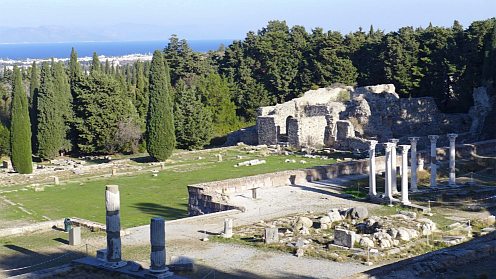
An Askleipion was a healing temple dedicated to Asklepios, the ancient Greek god of medicine. In addition to the ones in Thessaly and Epidaurus in mainland Greece, the Askleipion on Kos was among the greatest such establishments in the Greco-Roman world. Hippocrates of Kos, perhaps the most important Greek physician in Antiquity, probably received his medical training here. Galen, another prominent Greek physician, studied at the Askleipion at Pergamon on the west coast of Asia Minor.

The Staff of Asklepios, a serpent-entwined rod, is still used internationally as a symbol of medicine, healing and pharmacies. When visiting Kos around New Year’s, there were very few tourists on the island. I literally had the entire Askleipion all to myself. You can see from the ruins that it must have been a big and prominent temple a couple of thousand years ago.


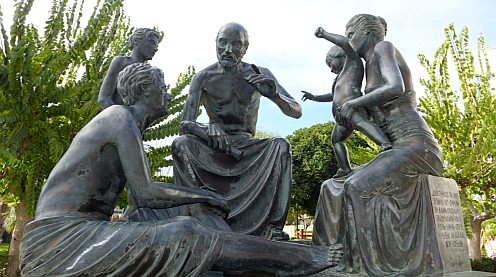
There is a statue of Hippocrates next to the modern harbor in Kos town. It is inscribed with the Hippocratic Oath for the ethical practice of medicine. “Do no harm,” the basic message of the Hippocratic Oath, remains a guiding principle for many modern physicians.


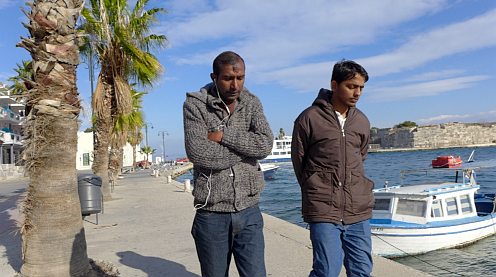
For several days in a row I could see a small group of illegal immigrants sitting directly behind this statue. They were literally hiding in the shadow of Hippocrates. There was some symbolism to this. Muslims force their way into Europe, using European ethical ideals and humanism as a weapon to gain entry. The migrants I saw in January 2017 did not speak Arabic. Based on their looks, I would guess that some of them came from South Asia, perhaps from Pakistan or Bangladesh, while others may have come from Afghanistan or Central Asia.


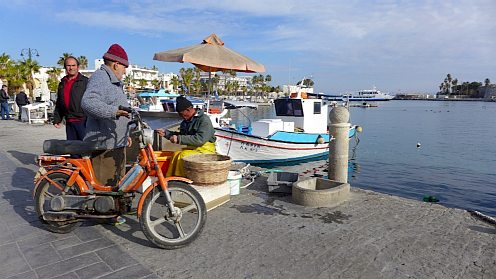
Kos is located very close to the west coast of Anatolia or Asia Minor, the country we now call Turkey. Using only the naked eye, I could clearly see individual houses in Turkey. You hardly need a motorized boat to travel this short distance. A kayak would be enough. In calm weather, an able swimmer might be able to swim from Turkey to Greece and the EU.

Several other Greek islands such as Samos, Lesbos and Chios are also situated close to the Turkish coastline. All of these islands have experienced major problems with illegal immigrants. Some of these problems still remain in 2017.

Turkey has been rocked by a series of deadly terror attacks in recent years. The number of foreign tourists visiting the country has fallen sharply because of this between 2014 and 2017.

The Islamic State (ISIS) is suspected to be behind several attacks on Turkish soil. This is somewhat ironic. Accusations have earlier been made that Turkish authorities quietly aided ISIS, as long as they were fighting the Kurds.[2] 2017 was just a couple of hours old when Turkey was hit by yet another bloody attack. This time, the target was a nightclub in Istanbul.[3]

For all its substantial social and economic problems, Greece is still a safer travel destination than neighboring Turkey. You will see more veiled Muslim women in Brussels, Berlin, Stockholm or Amsterdam, not to mention London or Paris, than you see in Rhodes or Kos.

Most of the migrants who arrive in Greek islands do not want to stay there. They want to get to countries in northwestern Europe with more generous welfare states.


The number of migrants entering Greece from Turkey was sharply reduced in 2016 compared to 2015. However, some illegal immigrants continue to arrive in Greek islands. Boat migrants crossing the Mediterranean along the longer route, from North Africa to Italy, reached record levels in 2016.[4] Moreover, this temporary reduction in the flow of migrants into southeast Europe is entirely dependent upon the actions and policies of Turkish authorities.

The Turkish government and President Erdogan engage in open blackmail and demographic warfare against Europe. They have repeatedly stated that they want money and visa-free access to the EU for millions of Muslims in Turkey.[5] Otherwise, they will unleash the hordes from the Middle East again.

That is not the worst-case scenario. The worst-case scenario is that Turkey, an increasingly Islamic and unstable country, itself might descend into a full-blown civil war. Such an event would trigger even larger population movements towards Europe than we have seen so far.

Greeks have been at the receiving end of one of the longest campaigns of ethnic cleansing in human history. For nearly 1,400 years, Muslims have been wiping out communities of Greek-speaking Christians in the eastern Mediterranean. Greeks fought a long and bloody struggle to liberate themselves from centuries of brutal and oppressive Turkish rule.

Now, Multiculturalism, the EU and mass immigration bring Islam back. Greeks and other Europeans are expected to celebrate this. In 2017 Athens will get its first new mosque since Ottoman times.[6] This happens partly after pressure from the pro-Islamic policies of the EU.

By early 2017, the migrant situation in Greece was calmer than in 2015. Yet I sensed an underlying fear among some of the local Greeks that the troubles could restart again at any moment. The Islamic world and Africa have booming populations and dysfunctional societies.

Hundreds of millions of people in these overpopulated regions would potentially like to move to Europe. The apocalyptic scenes of 2015 may simply be a prelude to what is yet to come.

Notes:

1. www.bbc.com/news/world-europe-34675552 Migrant crisis: The lifejacket ‘mountains’ of Lesbos. 30 October 2015. www.express.co.uk/news/world/640102/migrant-crisis-life-jackets-greece PICTURED: Images of dumped life jackets show devastation of the migrant crisis. Feb 1, 2016.

2. www.businessinsider.com/links-between-turkey-and-isis-are-now-undeniable-2015-7 Senior Western official: Links between Turkey and ISIS are now ‘undeniable’ Jul. 28, 2015.

3. www.foxnews.com/world/2017/01/01/new-year-attack-on-packed-istanbul-club-leaves-3-dead.html New Year’s attack on packed Istanbul club leaves 39 dead. January 01, 2017.

4. www.thelocal.it/20170106/italys-boat-migrant-numbers-surged-20-in-2016 Italy boat migrant numbers surge 20% in 2016. 6 January 2017.

5. www.bbc.com/news/world-europe-38103375 Migrant crisis: Turkey threatens EU with new surge. 25 November 2016.

6. www.ekathimerini.com/215222/article/ekathimerini/news/greek-capitals-first-modern-mosque-expected-by-end-april Greek capital’s first modern mosque expected by end-April. January 12, 2017.

_______________
Ponder on the Greek Genocide, Americans
John R. Houk
© February 2, 2017
_____________
DONATE TO FJORDMAN [To Donate, go to the bottom of the Gates of Vienna essay, and click on the Fjordman logo that says “Donate to Fjordman”. This will take you to the Fjordman PayPal donation page.]:


For a complete archive of Fjordman’s writings, see the multi-index listing in the Fjordman Files.

Gates of Vienna Homepage

Monday, March 16, 2015

Lepanto: One of Three Christianity Preserving Battles

Battle of Lepanto 1571 3

John R. Houk
© March 16, 2015

I am a Christian. In full disclosure my faith might be better pinned with the terms Pentecostal, Charismatic and Word of Faith. Much of mainline Protestant Denominations would call one or all those descriptions as heretical in their faith. I am not a Roman Catholic or an Eastern Orthodox Christian although I do not condemn their faith as many Protestants do in various degrees of virulence. On a personal level I place more faith in the Bible than in tradition, but I do not condemn tradition for tradition preserved Christianity during the Dark Ages in the West and Muslim domination in the East.

I recognize that the dogma of Churches or of individuals are not absolute, because perfection will only come to the Body of Christ until the Second Coming of Christ that brings finality to the eradication of Satan’s realm on earth which was bequeathed to old slew foot via a load of deception fed to Eve (deceived) then to Adam (not deceived) who knew better than to accept deception as truth.

Now in saying all that I ran across an article about the Battle of Lepanto in 1571. That battle was one of three defining battles that resulted in preserving Christian Europe from Islamic conquest. The first is one battle that has two historical names in 732 AD: Battle of Tours/Poitiers. The last Battle marked the beginning of the end of the last Muslim super power the Ottoman Empire which found its death bed at the end of WWI between 1918 and 21: Battle of Vienna (1683). The 1571 Battle of Lepanto was as significant as the other two in which it was in between; however unlike those other battles Lepanto was a naval one.

The account below is from the perspective of a militant Roman Catholic website which hasn’t necessarily a good opinion of Protestants but justly are high lighting the nature of Islam.

JRH 3/16/15
*****************************
The Battle of Lepanto--Why We Are Free

By Ashley Ladouceur and Marty Arlinghaus

Let me tell you the story of the Battle of Lepanto.
Don John in the Battle of LepantoDon John in the Battle of Lepanto

The year is 1571.

The Ottoman Empire has been expanding by method of jihad (in other words, military conquest).

This is the extent of the empire at the beginning of the battle:
 Ottoman Empire up to 1571
The Ottoman Empire extent in 1571


“The inmost sea of all the earth is shaken with their ships.”

“The Ottoman Turks yearned to bring all Europe within the dar al-Islam, the ‘House of Submission’ — submissive to the sharia law. Europe, as the land of the infidels, was the dar al-Harb, the ‘House of War.’” (From Lepanto, 1571: The Battle that Saved Europe by H. W. Crocker, III posted to CatholicCulture.org. Copyright by Morley Publishing Group Inc.)

Meanwhile, Christendom was divided by the Protestant Reformation

“The North is full of tangled things and texts and aching eyes
And dead is all the innocence of anger and surprise,
And Christian killeth Christian in a narrow dusty room,
And Christian dreadeth Christ that hath a newer face of doom.”

The scene is set.
On the Christian side we have a strong leader in Don John of Austria, a handsome 24 year-old son of Charles V, Holy Roman Emperor. At his command were 206 galleys, 40,000 oarsmen and sailors, 28,00 soldiers and knights, the thousands of rosaries said by faithful Christians as requested by Pope Pius V, the ministries of the religious and priests who accompanied the fleet, and the entreaties of the hosts of saints and angels in Heaven.

Don John of Austria
Don John of Austria

On the side of the Turks, led by Ali Pasha, there were 328 ships, 77,000 men (including 10,000 Janissaries—Christian boys taken from their families as tax payment when they were about the age of 6. They were forced to convert to Islam, taught the art of war, and given the opportunity of advancement in the Turkish army.), and 50,000 oarsmen—many of them Christian slaves.

The Battle
Spies warned Ali Pasha of the Christian advance thus he had time to set up his fleet in a battle line. This fleet was more experienced and stronger than the Christian one. The naval battle began. The galleys fired cannon balls at each other.

The Battle of Lepanto 1571
The Battle of Lepanto


When ships got close, a floating hand-to-hand combat was commenced with scimitars, bows, and muskets on the Turk’s side and swords, pikes, and arquebuses on the Christian’s side. An unexpected strong wind allowed the Christian fleet to pin part of the Ottoman fleet against some shoals; this wind seems to have been a gust of the Holy Spirit. Some of the Christian galley slaves on the Ottoman ships revolted, incapacitating those galleys.

But Don John of Austria has burst the battle-line!

The Christian fleet was victorious. The Turks lost 170 ships, 33,000 men to death, wounds, or capture, and 12,000 Christian slaves. Christians endured 7,500 men killed and 22,000 men wounded.

The turning of the tide of the Ottoman advance is due to the prayers of the millions of Catholics in Christendom. October 7th, the day the battle took place, is now the feast of Our Lady of the Rosary, and the month of October is the month of the Rosary.

Are we not facing similar battles today, if not even greater ones? Christians are being massacred and exiled from their homes where they have dwelt for nearly 2,000 years in Iraq and Syria by Islamic groups such as ISIS (or Islamic State). Christians in other Islamic countries continue to face anti-Christian laws that prevent them from freely practicing their religion on pain of imprisonment or death. Unlike in the 16th century when Lepanto was fought, these atrocities are met with apathy by the modern Western culture, which is experiencing its own anti-Christian secularization which thinks Christians cannot possibly be persecuted. The overt culture of death advanced by the Islamic State has just as strong a hold in the hearts of Westerners who accept abortion, assisted suicide, euthanasia and other life-denying practices such as contraception that continues to cause populations of developed countries to plummet to the point where future generations will collapse under the weight of the much larger older generations. Christianity itself continues to suffer from splintering and a lack of unity of believers. The odds seem to be overwhelmingly against the Church.

But we are the Church Militant. We are united as members of the Body of Christ. We are the Catholic Church. Just as 500 years ago Christians united in prayer to defeat the Ottomans, we can unite in prayer now to combat the spiritual and physical evils in our world today.

For more exciting information on the Battle of Lepanto: http://www.catholicculture.org/culture/library/view.cfm?recnum=7391

To read the poem G. K. Chesterton wrote about the battle: http://www.bartleby.com/103/91.html

To listen to a chant of the Templars as they march to war:
http://www.youtube.com/watch?v=M0d4qM7gCH8
______________________________
Lepanto: One of Three Christianity Preserving Battles
John R. Houk
© March 16, 2015
______________________________
The Battle of Lepanto--Why We Are Free


Friday, June 27, 2014

Is Erdogan Setting Stage for Turkish Caliphate?

Sultan Erdogan
Sultan Erdogan

John R. Houk
© June 27, 2014

Caroline Glick has written a very interesting editorial: “Turkey’s high-risk power play”. Glick’s observations are about Turkey’s Prime Minister Recep Tayyip Erdoğan. Erdogan seems to be a mystery to Washington DC. For years the PM’s Radical Islamic beliefs seemed to be second to governing a secular pseudo-democratic Muslim State. His initial actions appeared supportive to the Ataturk vision for Turkey but with only a slight reform of bringing Islam to the fore of Turkish society. HOWEVER, in recent years, Erdogan’s governing actions have begun to match his Radical Muslim beliefs. Thus Glick posits in no uncertain terms that Erdogan is trying to revive Turkey’s Muslim domination a la Ottoman style of the old empire days prior to WWI.

Erdogan has moved Turkey away from being a rare Muslim friend of Israel to joining the rest of the Muslim world in Jew-hatred. Erdogan is openly supporting Hamas that has the agenda of destroying Israel, killing Jews and establishing a Radical Muslim State called Palestine. The interesting point that Glick brings up is that Erdogan has reversed decades of a policy of Turkification (ok, I don’t know if this is an actual word but you get the idea) of Turkish society to encouraging non-Turkish yet Muslim ethnic groups to seek the historical identity. One stunning example is Turkey’s treatment of an independent Kurdistan in northern Iraq.

After the U.S. finished liberating Iraq from Saddam Hussein’s Baathist Party oppression of Iraq a debate began on how Iraq should exist politically. Saddam always favored Iraqi Sunni Muslims over the majority Shia Muslims and the ethnic Kurdish Muslims. Saddam retained power via extreme repression of Shias and Kurds. There was talk of dividing Iraq into three independent nations controlled by the three major players of Iraq; viz. the Kurds in the north, the Sunni minority that gravitated toward the west and the Shias that gravitated toward the eastern part of Iraq bordering Iran.

American conventional wisdom quickly abandoned the three State scenario due American National Interests of the location of oil fields and the legitimate concern that the Arab Shia population of Iraq would be absorbed into Iran which are ethnically Persian yet also are Shias. So the Bush Administration tried to build a new Iraq nation under the auspices of shared governance by the three Iraqi groups. Unfortunately for the shared governance concept the Western concept of democratic elections placed a Shi’ite as the governing Prime Minister. PM Maliki slowly moved away from shared governance to Shia domination by the purging of Sunni political leaders. It may be a bit more complicated but you get the idea.

Enter Erdogan’s Turkey agenda change toward non-Turks. She believes Erdogan is taking a page from the old Ottoman playbook of divide and conquer to maintain political power via the unifying effects of Sunni Islam.

Glick paints a picture of Turkey under Erdogan reasserting Islamic rule under Turkish power to rival the Islamic rule agenda of Shia Iran.

For U.S. National Interests this provides a scenario that has definite pluses and minuses. In the short run letting Sunnis under the aegis of Turkey duking it out with Iran over who controls the Islamic world probably benefits the U.S. by staying out of it. The U.S. would be in an ironic Byzantine situation of throwing support back and forth to keep the violent Muslims in one area more than islamifying the West. The Byzantine factor is the long run. If one group Muslims gains the ascendancy over their the West again could face crazy Muslims trying to conquer the world forcing an Islamized civilization as the Christian Middle East experienced under early Arab conquests and Europe faced from the Ottomans right up to the 17th century (See Also HERE).

Before proceeding to Caroline Glick’s essay I thought you might benefit from a snapshot of how the Ottoman’s maintained a huge Islamic empire for some time. If find that tiresome feel free to skip it, but you really should read Glick.

In addition to their traditions of family sovereignty, the Ottomans drew strength from their origins as ghazis. The ghazi principle fueled their urge for conquest and then helped them to structure their developing society. The social structure of settled, urban Islamic society consisted of four social groupings: 1) the men of the pen, that is, judges, imams (prayer leaders), and other intellectuals; 2) the men of the sword, meaning the military; 3) the men of negotiations, such as merchants; and 4) the men of husbandry, meaning farmers and livestock raisers. Life on the frontier was far less structured; society there was divided into two groups, the askeri (the military) and the raya (the subjects). Besides protecting the realm and the raya, the askeri conquered new territories, thus bringing more raya and wealth into the empire.

… By late in the reign of Suleiman the Magnificent, the men of the pen were the bureaucrats of the empire, while the judges and imams made up a separate group called the men of religion. The men of the pen, the men of religion, and the men of the sword all were classified as askeri. As such, they were exempt from taxes and lived off of the wealth produced by the raya. Each of the three groups had its own educational system, its own internal practices, and its own values. In Ottoman society there was a place for everyone, but one of the functions of the sultan was to keep everyone in their place.

There was even a place for the non-Muslim. In classical Islamic tradition, non-Muslim religious communities that possessed an accepted, written holy book were granted a covenant of protection, the dhimma, and were considered to be protected people, the dhimmis. In return for this status they paid a special poll tax, the cizye. The Ottomans continued this tradition during the reign of Muhammad the Conqueror (reigned 1451-1481). The three leading non-Muslim religious communities—the Jews, the Greek Orthodox Church, and the Armenian Church—were established as recognized dhimmi communities known as millets. Each millet was headed by its own religious dignitary: a chief rabbi in the case of the Jews, and patriarchs in the case of the Greek Orthodox and Armenian communities. In the millet system, each community was responsible for the allocation and collection of its taxes, its educational arrangements, and internal legal matters pertaining especially to personal status issues such as marriage, divorce, and inheritance. In the pre-modern Middle East, identity was largely based on religion. This system functioned well until the European concepts of nationalism and ethnicity filtered into the Ottoman Empire in the second half of the 19th century.

…

…The Ottomans modified the ghulam system by instituting the infamous devshirme, in which young Christian males between the ages of 8 and 15 were removed from their villages in the Balkans to be trained for state service. The youths were brought before the sultan, and the best of them—in terms of physique, intelligence, and other qualities—were selected for education in the palace school. There they converted to Islam, became versed in the Islamic religion and its culture, learned Ottoman Turkish, Persian, and Arabic, and were trained in the military and social arts. They owed absolute allegiance to the sultan and were destined for the highest offices in the empire as they rose through the ranks of the school. When members of this select group graduated at about the age of 25, they assumed positions in the provincial military structure or took up service in the palace guards regiments. They could then work their way up the system and become its military-administrative head, the grand vizier. Those not selected for the palace school converted to Islam, worked for rural Turkish farmers, learned vernacular Turkish and folk Islamic culture, and became members of the sultan’s elite military infantry, the Janissaries.

This division in the devshirme, between those who received the best available education in the high Islamic tradition and those who followed the folk tradition and served as Janissaries, reflected a significant development within the society as a whole: the definition of the Ottoman identity. By the early 16th century the term Ottoman, which had first indicated the men around Osman and then the dynasty itself, had become a cultural-political-sociological term. Only a minority of the askeri class could be called "true" Ottomans. To be an Ottoman one had to serve the state and the religion and know the "Ottoman way." Serving the state meant having a position within the military, the bureaucracy, or the religious establishment that carried with it the coveted askeri status and tax exemption. Serving the religion meant being a Muslim. Knowing the "Ottoman way" meant being completely at home in the high Islamic tradition. It also meant being fully trained in Arabic and Persian—languages that were, along with Turkish, the constituent elements of Ottoman Turkish, the language vehicle of all Ottomans. By this definition, the bulk of the Janissary corps—made up of devshirme youths who were not trained in the palace school but rather in the traditions of folk Islam—could not be considered Ottomans. … (The Ottomans: From Frontier Warriors To Empire Builders: Ottoman Society – Part 4; By Robert Guisepi; International World History Project - About IWHP; 1992 [Bold text is author’s])

JRH 6/27/14
******************************
Turkey’s high-risk power play

By Caroline Glick
June 24th, 2014

For most Westerners, Turkey is a hard nut to crack.

How can you understand a state sponsor of terrorism that is also a member of NATO?

How can you explain Turkey’s facilitation of Kurdish independence in Iraq in light of Turkey’s hundred-year opposition to Kurdish independence?

What is Turkish Prime Minister Recep Tayyep Erdogan trying to accomplish here?

Is he nuts?


On the terrorism support front, today Turkey vies with Iran for the title of leading state sponsor of terrorism.

First there is Hamas.

Last week an Israeli security official told the media that the abduction of Naftali Frankel, Gilad Shaer and Eyal Yifrah was organized and directed by Saleh al-Arouri, a Hamas commander operating out of Turkey.

Turkey has welcomed Hamas to its territory and served as its chief booster to the West since the jihadist terror group won the Palestinian legislative elections in 2006. Erdogan has played a key role in getting the EU to view Hamas as a legitimate actor, despite its avowedly genocidal goals.

Then there is al-Qaida. As Daniel Pipes
 documented in The Washington Times last week, Turkey has been the largest supporter and enabler of the Islamic State in Iraq and the Levant (ISIS).

Erdogan’s government has allowed ISIS fighters to train in Turkey and cross the border between Turkey and Syria at will to participate in the fighting. Moreover, according to Pipes, Turkey “provided the bulk of ISIS’s funds, logistics, training and arms.”

Similarly, Turkey has sponsored
the al-Nusra Front, ISIS’s al-Qaida counterpart and ally in Syria.

The Assad regime is not the Turkish- sponsored al-Qaida-aligned forces’ only target in Syria. They have also been engaged in heavy fighting against Rojava, the emerging Kurdish state in northwest Syria. Yet the same Turkey that is sponsoring al-Qaida’s assault on Syrian Kurdistan is facilitating the independence of Iraqi Kurdistan.

In breach of Iraqi law that requires the Kurds to sell their oil through the central government and share oil revenues with the central government, earlier this month Turkey signed a 50-year deal allowing the Kurds to export oil to the world market through a Turkish pipeline. The Kurds are currently pumping around 120,000 barrels of oil a day to the Turkish port of Ceyhan.

Top Turkish officials have in recent weeks come out openly in support for Iraqi Kurdish independence from Baghdad.

Following ISIS’s takeover of Mosul, Huseyin Celik, the spokesman for Erdogan’s ruling AKP party told the Kurdish Rudaw news service, “It has become clear for us that Iraq has practically become divided into three parts.”

Blaming Iraqi Prime Minister Nouri al-Maliki for Iraq’s instability Celik said, “The Kurds of Iraq can decide where to live and under what title they want to live. Turkey does not decide for them.”

To date, most Western analyses of the Erdogan regime’s behavior have come up short because their authors ignore its strategic goal. In this failing, analyses of Turkey are similar to those of its Shi’ite counterpart in Iran. And both regimes’ goals are wished away for the same reason: Western observers can’t identify with them.

Iran is not a status quo power. It is a revolutionary power. Iran’s goal is not regional hegemony per se, but global supremacy.


As Lee Smith recently noted, two decades before al-Qaida and its goal of establishing a global Islamic caliphate burst onto the scene, Ayatollah Khomeini had already made the Islamic division of the world into the House of Islam and the House of War the basis for Iran’s foreign policy. He viewed his Shi’ite theocracy as the rightful leader of the Islamic empire that would destroy all non-believers and their civilization.

Iran’s first act of foreign policy – the takeover of the US Embassy in Teheran – was a declaration of war not only against the US, but against the nation-state system as a whole.

Iran uses terror, irregular warfare and subversion to achieve its ends because such tactics induce chaos.

As Iran expert Michael Ledeen wrote last week
, to defeat the US in Iraq, “the Iranian regime provoked all manner of violence, from tribal to ethnic, because they believed they were better able to operate in chaos.”

The US failed to understand Iran’s strategy because the US was unable to reconcile itself with the fact that other actors do not seek stability as it does.

Like Iran’s mullahs, Erdogan and his colleagues also reject the nation-state system. In their case, they wish to replace it with a restored Ottoman Empire.

Spelling out his goal in a speech in the spring of 2012, Erdogan described Turkey’s mission thus: “On the historic march of our holy nation, the AK Party signals the birth of a global power and the mission for a new world order. This is the centenary of our exit from the Middle East [following the Ottoman defeat in World War I]. Whatever we lost between 1911 and 1923, whatever lands we withdrew from, from 2011 to 2023 we shall once again meet our brothers in those lands.”

To achieve this goal, like Iran, Turkey seeks to destabilize states and reduce peoples to their ethnic, sub-national identities. The notion is that by dividing societies into their component parts, the various groups will all be weaker than one unified state, and all of them will feel threatened by one another and in need of outside support.

This is the same model Erdogan is following in Turkey itself as he remakes it in his Ottoman mold.

As Amir Taheri explained
 last October, Erdogan has been encouraging members of ethnic groups that long ago melted into the larger Turkish culture to rediscover their disparate identities, learn their unique languages and so separate out from the majority culture of the country. At the same time he is repressing the Kurds, Alevis and Armenians, minorities that have maintained their identities at great cost.

In parallel to his attempt to subsume the Kurds, Alevis and Armenians into a wider morass of separate sub-Turkish ethnicities, Erdogan has been assiduously cultivating hundreds of Muslim Brotherhood associations to enable their takeover of mosques and other key institutions to build a countrywide support base for Islamic supremacism.

By fragmenting Turkish society into long-forgotten component parts while uniting it under radical Islam, he wishes to unite the country under his Sultanate rule while dividing its various factions against one another to maintain support for the regime over the long haul.

A large part of repressing the Kurds at home involves denying them outside assistance. This is where Iraqi Kurdistan comes into the picture.


By acting like Iraqi Kurdistan’s best friend, Erdogan hopes to attenuate their support for Turkish Kurds.


While Turkey and Iran are rivals in undermining the international system, their goals are the same, and their strategies for achieving their goals are also similar. But while their chaos strategy is brilliant in its way, it is also high risk. By its very nature, chaos is hard, if not impossible to control. Situations often get out of hand. Plans backfire.

What we are seeing today in Syria and Iraq and the wider region demonstrates the chaos strategy’s drawbacks.

As Pinchas Inbari detailed in a recent report for the Jerusalem Center for Public Affairs, the Syrian civil war is causing millions of Syrians to leave the country and their migrations are changing the face of many countries.

For instance, their arrival in Lebanon has transformed the multi-ethnic state into one with a preponderant Sunni majority, thus watering down Hezbollah’s support base.

The Kurds in Iraq may feel they need Turkey today, but there is no reason to assume that this will remain the case for long.

Kurdish unity across Iraq, Syria, Turkey and Iran will destabilize not only Turkey, but Iran, where Kurds make up around ten percent of the population. Iranian Kurdistan also abuts the Azeri provinces. Azeris comprise nearly half the population of Iran.

As for ISIS, it is scoring victories in Iraq today. But its forces are vastly outnumbered by the Baathists and the Sunni tribesmen that defeated al Qaida in 2006. There is no reason to assume that these disparate groups won’t get tired of their new medieval rulers.

Many commentators claimed that Erdogan’s recent foreign policy setbacks in the Arab world convinced him to abandon neo-Ottomanism in favor of more modest goals. But his cultivation of Iraqi Kurdistan, and his sponsorship of ISIS, al-Nusra, the Muslim Brotherhood and Hamas tell a different story.

Erdogan remains an Islamic imperialist.

Like Iran he aims to destroy the global order and replace it with an Islamic empire. But like Iran, if his adversaries get wise to what he is doing, it won’t be very difficult to beat him at his own game by using his successes to defeat him.


______________________________
Is Erdogan Setting Stage for Turkish Caliphate?
John R. Houk
© June 27, 2014
______________________________
Turkey’s high-risk power play

All right reserved, Caroline Glick. 2013