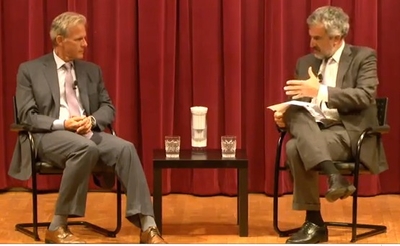
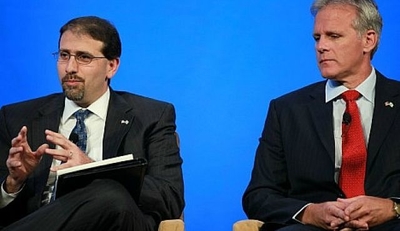
This is an interview conducted by Daniel Pipes with Michael Oren centered around the book "Ally: My Journey Across the American-Israeli Divide". The interview brings out Oren's thoughts on Barack Obama, how Obama has conducted foreign policy with Israel and Obama seemingly allowing Iran to develop nuclear weapons.
JRH 7/22/15
***********************
Michael Oren Interviewed by Daniel Pipes
A discussion reveals how Obama purposefully broke the historic US-Israel alliance
A discussion reveals how Obama purposefully broke the historic US-Israel alliance
Interview
June 24, 2015
Originally: FrontPageMag.com
Daniel Pipes Email Sent: 7/21/2015 9:16 AM
N.B.:
(1) This interview took place at the Free Library of Philadelphia. FrontPageMag.com transcribed it and I edited it. The transcript does not include the question-and-answer period but the video does.
(2) The video is available to watch here.
(3) About the alarm that goes off at the very end: As Amb. Oren was answering my final question, a buzzer went off, we could not continue talking, the event organizer came on the stage to announce that the library had to be evacuated immediately, and the video camera suddenly shuts off. This unceremonious conclusion, fortunately, was just a drill and no one or property were harmed.
(4) The transcript has been edited for clarity and brevity.
Daniel Pipes
+++
Multimedia for this item
[Blog Editor: Explicit language ALERT. When Oren tells a story relating to Rahm Emanuel and Washington-Speak, the profanity flies especially the F-bomb.]
Daniel Pipes: I am delighted to be here with Michael Oren.
I'll admit that when I began reading his book, Ally: My Journey Across the American-Israeli Divide, a very well-written account of his four-plus years as Israeli ambassador to the United States, I started at the beginning, as one tends to do with books, so I had no idea of the news bombshells that lay ahead. (Laughter)
The first inkling came to me when I read a column by John Podhoretz, who suggested that "the annals of diplomatic history" had never witnessed "anything quite like this astonishing account" that "makes news on almost every page." Indeed, the next few days saw a furor over the book and its related three articles. "Borderline hysteria" is how one Israeli journalist, Ben Caspit, summarized the Obama administration's response.
Because of the enormous attention the book has attracted, I will make the assumption that you, the audience, know something about its contents, and I will focus my questions on specific issues regarding three topics: US-Israel relations, the response to the book, and Barack Obama.
Michael: You portray two principles governing historic US-Israel relations—no daylight and no surprises. You argue these have been broken since 2009 and you hope they'll be quickly reasserted. But do you really see this as possible in the year and a half left of Obama's administration? Or do you only hope for this after he leaves office?
Michael Oren: The US-Israel relationship is not static but has evolved. We fought the '67 war with French bullets, not American ones. Beginning in the 1980s, in the middle Reagan years. These two principles, no surprises and no daylight, began to coalesce. What I mean by them?
No surprises: if the United States is going to set out a major new policy position on issues related to the Middle East and Israel's security, it will give us an advance draft of the speech or paper to give us a chance to look at it, give our comments.
No daylight: the two governments will differ over settlements, Jerusalem, and a lot of other issues. But we keep these differences behind closed doors, not display them in public where our mutual enemies will discern the distance between us and will insinuate themselves between us.

I can't say that these two principles were always honored; we did surprise one another; there was occasional daylight. But these were the historic twin pillars of our alliance. Starting in 2009, however, the new Obama Administration as a matter of policy decided it would not preserve these two pillars.
On surprises, the rupture isn't a matter of debate. For example, the president went to Cairo in June 2009 and gave a very long speech (twice as long as his first inaugural address) which served as the foundational document of his administration's positions on the Middle East. It also touched on many issues vital to Israel's security, such as America's relationship with what Obama called the Muslim world, particularly the outreach to Iran and Iran's right to nuclear energy. Although it had amazing and far-reaching ramifications for Israel, we in the embassy never saw a draft of it, we had no warning of it. And that was just one of many such speeches.
As for daylight, the president openly said, "Look at the past eight years [a reference to the George W. Bush administration]. During those eight years, there was no space between us and Israel, and what did we get from that? When there is no daylight, Israel just sits on the sidelines, and that erodes our credibility with the Arab states." Turns out, he put daylight between the two countries on other issues too, like Iran.
These two pillars were jettisoned and they must be restored. It's not only in the interest of the United States and Israel but, given the immense chaos in the Middle East, it's important for that region as well. Indeed, it's needed for the wellbeing of the world. Why? Because everybody looks at the US-Israel bond. Whether jihadist or Japanese, the globe looks at the way the United States treats its Israeli ally as a litmus test of its ability to rely on the United States.
Therefore, the two pillars need to be restored. Whether that's possible in the year and a half remaining of this presidency, I don't know. All I can say is, I hope so. My book is an ardent and impassioned call to bring this relationship back from the brink, which we've reached, and restore it.
Daniel Pipes: Along with the problems you just delineated, all in the know agree that the US-Israel military relationship is better than ever. How is this possible, what's the logic behind it?
Michael Oren: True, it is better than ever. The cooperation on weapons development, on military aid—which is close to $4 billion a year (75 percent of it spent in the United States)—joint maneuvers, ports of call, and intelligence sharing are indeed superb right now.
Why so? Because the Obama administration distinguishes between diplomatic daylight and security daylight and it calculated that the closer relations are in the security field, the greater leeway it has to put daylight in the diplomatic field. This amounts to a very interesting intellectual exercise, one that did not work.
Middle Easterners simply do not distinguish between diplomatic and security daylight. In the Middle East, daylight is daylight. Daylight in our area of the world, where the sun is very strong, can be blinding and searing. What most Middle Easterners saw over the course of the last six-plus years was the United States and Israel drifting quite far apart in spite of increased security cooperation.
By the way, if you define security relationship more broadly, things look differently. If you include the fact that the United States negotiated for seven months with the Iranians—and that has a certain impact on our security—without even telling us, you can't say the security relationship is better than ever.
Daniel Pipes: You mentioned being unaware of US-Iranian discussions, yet, the president has said that he and his administration have consistently shared information with Israel. True?
Michael Oren: We had a longstanding, intimate dialog with the United States on the Iranian nuclear program which I was privileged to take part in. The Americans were very candid. We looked at the same data and often derived the same conclusions. But we were unaware of the content of that secret track taking place in the Persian Gulf.
Daniel Pipes: You quote former White House chief of staff Rahm Emanuel waking you up early one morning and yelling, "I don't like this eff-ing excrement."
(Laughter) On another occasion, the deputy secretary of state, the number-two man in the State Department, Tom Nides, screamed at you, "You don't want that eff-ing UN to collapse because of your eff-ing conflict with the Palestinians."
Michael Oren: You understand, if we were in Israel, we'd have no problem actually saying this word? (Laughter) So American. (Laughter)
Daniel Pipes: My question: Is this really the state of diplomacy today? (Laughter)
Michael Oren: Yes. (Laughter) Yes, it is funny. As an aside, Ally went through seven security vettings by the State of Israel: the military censor, two departments within the Defense Ministry, the Mossad, and others. They were very good; believe me, it's amazing there's actually a book.
I was never a diarist, I never before wrote a book in the first person. Making that transformation was profound for me and not at all easy. But when I took this job, my wife Sally gave me a little diary and said, "Hey, you may want to jot down a few things." I replied, "Nah, I don't believe in diaries."
Then, soon after that, Rahm Emanuel calls me at 2 o'clock in the morning and says—can I say this? "I don't like this f**king s**t." (Laughter) And it's like 2 o'clock in the morning. And I said, "Well, I don't like this f**king s**t, either." And it begins from there. (Laughter) So I wrote this incident into my diary. The diary is not classified; you're not going to find secrets in there. But it did provide a lot of color and depth to the book.
Tom Nides—poor Tom Nides. That line, "UNESCO teaches Holocaust studies, for chrissakes. You want to cut off f**king Holocaust studies?" gets quoted a lot as evidence of Nides' animus against the State of Israel. But it's just the opposite: Tom Nides is a great friend of mine and of the State of Israel. In Washington, that's just the way people talk.
One story I didn't include in the book, from a high-ranking member of the administration, a very sweet, young man, who says to me something like, "We're getting out of f**king Iraq, because we've f**king had it with the f**king Iraqis. And we're coming f**king home." And then he looks at me and says, "Why am I talking like this?" (Laughter)
Daniel Pipes: Did you get "special" treatment because you're a born American? Had you been from another country, and not a Native American, would you have been treated the same way?
Michael Oren: No I wouldn't have. This is the flip side of the special US-Israel relationship.
It was also part of my special relationship with people like Rahm Emanuel, who I'd known for a long time before I got into office. Rahm's father had fought in the Irgun, in the Israeli War of Independence. (Hence, his name, Rahm, or thunder.) Rahm had a deli accident when he was 16 and sliced off the top part of a finger. According to Obama, when he lost the top part of that finger, he lost half of his vocabulary. (Laughter) I used to get that finger, all the time.
But when Rahm left the White House and went off to be the mayor of Chicago, I viewed it as a loss for me because he was somebody I could call in the middle of the night. Yes, I was going to get that language. Even though we had serious policy disagreements sometimes, I know he cared passionately about Israel. He was a proud Jew, proud of his father. That created a link that couldn't be broken by policy differences.

The same thing's true with Dennis Ross (who doesn't talk like Rahm). Dennis was that rare Washington Middle East expert who wasn't, as we say in Washington-speak, stove-piped. Which means, you know, you go to somebody who's an expert in Lebanon between 1976 and 1977, that's what they know. (Laughter) Dennis was the only person I knew in Washington who saw the entire region and also saw it historically. He saw it vertically and horizontally. And he had a personal memory too, having been involved in peacemaking for 30 years. When he left, there was another huge loss.
Daniel Pipes: I'd like to try out two favorite theories of mine on you. First: Noting that the government of Israel tends to give away too much when relations are really warm between Jerusalem and Washington, I believe that low-level tensions between the two governments are actually good.
Michael Oren: Here I'd beg to disagree. Historically, Israelis make concessions when we feel secure. In his first meeting with American Jewish leaders, as I quoted earlier, Obama said that he's going to put daylight between Israel and the United States because when there is no daylight, Israel "just sits on the sidelines."
Interesting observation, but empirically wrong. During the Bush years, for example, there was no daylight, so Israelis felt secure. As a result, Israel yanked up 21 settlements from Gaza in 2005. It made a full offer of Palestinian statehood to Mahmud Abbas in 2008: all of Gaza, most of the West Bank, half of Jerusalem. At the height of the second intifada in 2002, Israeli support for a two-state solution was exactly zero; by the time I came onboard in 2009, the intifada was behind us and 70 percent of Israelis supported a two-state solution.
So, when we feel secure, we make more concessions. Strangely enough, the person who understood this best was Richard Nixon: give them support, they'll make concessions.
Daniel Pipes: That was my point.
Michael Oren: Okay. I'm sorry.
Daniel Pipes: I'm saying when US-Israel relations are flourishing, Israelis hand things over. For example, the Philadelphia Corridor in 2007, but that was a mistake. Therefore, I don't mind seeing—
Michael Oren: Oh, you want a little low-level tension, so we don't give in.
Daniel Pipes: Exactly.
Michael Oren: Well, I can't argue with that.
But my responsibility as ambassador was to try to get us on the same page. They were coming to us and asking us to do many very difficult things: "We demand a settlement freeze on the West Bank, a building freeze in eastern Jerusalem, a final-status map for the Palestinians." Take the map issue: every time we gave the Palestinians a map, they put it in their pocket, walked away, and came back two years later saying, "Okay, let's start negotiating from the map you gave us last time." So, we didn't want to give them another map, although the administration demanded we do so.
I would say all the time to the administration, "Rather than threaten us, try love." That was always my line, "Try love, try love." Because Israelis make concession when we feel secure. That's not just Israelis, it's human nature.
Daniel Pipes: Second theory: there used to be a consensus, say in the 1980s, between Republicans and Democrats, conservatives and liberals, on Israel. It's falling apart, with conservatives ever more friendly to Israel and liberals ever cooler to Israel. From the anecdotes in your book, it sounds like you agree with this analysis, correct?

Michael Oren: My anecdotes point to the challenges we faced from certain segments of the American electorate. American opinion on Israel is a little like what physicists say about the universe—it's expanding and contracting at the same time. If you look at all the polls, support for Israel in this country keeps on going up. Even last summer, at the height of Gaza war with the terrible images coming out of Gaza, American support for Israel went up. When I left Washington, something like 74 percent of Americans defined themselves, to one degree or another, as pro-Israel. Crazy! We were right behind Sweden and Canada, which is amazing, considering all the bad press we get.
On the other hand, if you break these statistics down demographically by ethnic group, age group, and party affiliation, the picture's a lot less sanguine.
I've lived in Israel for close to 40 years. Yes, I've come back and even taught at various universities. But for the first time in 2009, I returned for an extended period. I had a Rip Van Winkle experience, as though I'd woken after 25 years and didn't recognize my own village. America had transformed demographically.
America is no longer a white majority population. There are more single-parent families than two-parent families. There was one Jewish judge on the Supreme Court and the rest basically WASPs; now, there's not a single WASP on the Supreme Court but three Jews and six Catholics. The populations growing the most and having greater political influence, especially the Hispanics, lack a traditional attachment to Israel.
Because many Israeli leaders, including our prime minister and defense minister, had been educated in America in the '70s or '80s; they remembered a different America. So, I had to tell them, "Guys, the America you remember ... it ain't there anymore."
I saw Obama's election in 2008 as the symptom of a transformative moment. I'm no prophet but I told Israeli leaders back in 2009 that we have to plan for a two-term president because these changes are permanent. The election of 2012 was much more significant than 2008; it confirmed that the changes are permanent and that Israel has to adjust to them.
Israel has a paramount strategic interest in preserving support for Israel as a bipartisan issue; we should never become the monopoly of one party. This has become increasingly challenging because Israel's experience with terror moved it significantly to the right even as America moved to the left. Israel became more traditional; America less traditional. I had to grapple and try to bridge this reality. Did I succeed entirely? Obviously not. Can we give it up? We cannot. We have to keep on reaching out.
Daniel Pipes: Turning to responses to your book—American officials have been incensed by Ally. Secretary of State John Kerry's spokesman said that it is "absolutely inaccurate and false." Your former counterpart, the US ambassador to Israel, Daniel Shapiro, said, "I can say as an ambassador that sometimes ambassadors have a very limited view of the conversations between the leaders, and his description does not reflect the truth about what happened." Oddly, Shapiro says he doesn't know anything and therefore you don't know anything. Your response?

Michael Oren: It's a strange remark for one ambassador to say about another ambassador. In the past week and a half, I've been called a moneygrubbing politician, delusional, and some other choice words. But all these ad hominem attacks aside, nobody's taking on the book substantively. I tell a story in 400 pages and virtually no one says the facts are faulty: that, say, the Americans did not negotiate for seven months without telling us or that the administration did not cancel flights to Ben Gurion Airport in mid-2014. No one says I just imagined these events.
I think part of the reaction I've received from people in government—notice people in government, not people out of government—has been an oversensitivity to the issues I'm trying to raise.
Which brings me to my reason to bring the book out now. June is a terrible time to bring out a nonfiction book. It's already summer reading, when you bring out Jaws. (In this spirit, I told Random House we should change the name of the book to Jews.) (Laughter) People will read it on the beach! They won't go in the water! You bring out a book like this in October or November to take part in Jewish book month in November and jump on the Christmas-Hanukkah book season.
Also, I'm in the Knesset, Israel's parliament, which means I can't promote the book as I should. I previously went on two-month book tours, which I cannot do with this one.
Nonetheless, I brought it out now because in the next week or so there is liable to be an agreement signed between the United States, other permanent members of the Security Council plus Germany, with the Islamic Republic of Iran. The State of Israel—not just my party, not just the prime minister—views this as a terrible deal, one that deeply endangers us. I would be derelict if I did not tell this story right now. The book had to come out now to trigger the precise conversation we're having tonight. What do they expect from us—to go silently into that night of the signing of this agreement? The Jewish people can't do that.
Daniel Pipes: Let's turn to the last of the three topics: the American president. What do you better think explains Obama's approach to the Middle East and the world: a grand strategy or improvising responses as things happen?
Michael Oren: Barack Obama—as all presidents—came into the White House with a worldview. His happens to be very challenging for the State of Israel. It does not include the notion of American exceptionalism or American leadership. Instead, it prefers a collegial approach to crisis management and world affairs. It implies a certain recoiling from the use of military might and a heavy reliance on international organizations, like the UN, that are not always so friendly to the State of Israel.
Some of us wake up in the morning and say a little berakhah [blessing] that the greatest democracy in the world just happens also to be the greatest military power. It's a wonderful thing. In this light, one of the most illuminating remarks I ever heard Barack Obama make was at the nuclear security summit in 2010, where he said—these words are engraved on my soul, "Whether we like it or not, we remain a dominant military superpower." Think about that for a second. That was very revealing about the president's attitude toward military might. Would John Kennedy have said that? Would Bill Clinton? George W. Bush?
And then there are Obama's positions on our specific issues, such as his outreach to the Muslim world. I thought it perfectly fine, indeed, it's in our interest, that America improves relations with Muslims—so long as it's not at our expense. The unprecedented support for the Palestinian cause and the reconciliation with Iran, are very problematic for us, however.
This worldview has collided with reality and the result looks like patchwork. Intervention against Qaddafi but nonintervention against Assad. Sort of implicitly cooperating with Shiite forces against ISIS in Iraq but kind-of resisting what Saudi Arabia is doing in Yemen against ISIS and definitely opposing what Egypt is doing against ISIS in Libya. I can go on.
After almost five years of unprecedented turmoil, violence, and disappointment in the Middle East, that worldview has remained mostly impermeable to change.
______________________________________________
Edited by John R. Houk (particularly profanity)
All materials by Daniel Pipes on this site: © 1968-2015 Daniel Pipes. daniel.pipes@gmail.com and @DanielPipes