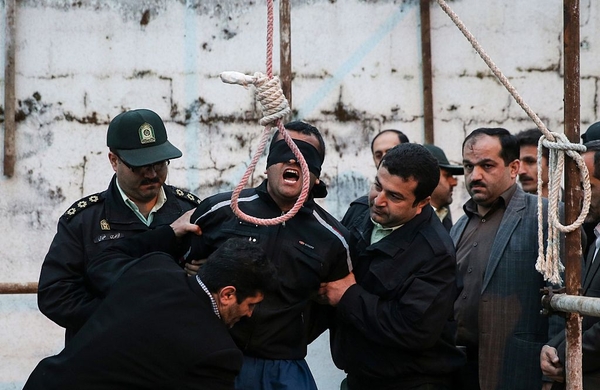
Iran should be a nation everyone should keep their mind on. The next global conflict will likely emerge either because direct military between Iran and Israel or indirect Iranian Middle Eastern meddling exporting its Shi’ite revolution to the Shi’ites outside of Iran which would include aiding Sunni Islamists in acts of terrorism against Israel and the USA.
Michael Rubin has written a lengthy article that could be expanded into a book analyzing Iran’s very UnWestern political system and it Foreign Policy related to that political system. Iran’s political system is tied to radical Shi’ite ideology which includes the concept that the hidden 12th Imam will appear to cement the old Khomeini Revolution into a global manifestation of Shia Islam.
JRH 1/29/13
********************************
Deciphering Iranian decision making and strategy today
January 28, 2013
Iran’s political structure is complex and might appear mysterious: the presidency is more about style than substance, and it is the supreme leader who wields dictatorial power. But the Islamic Revolutionary Guards Corps (IRGC) has become the most influential power broker in recent years, ruining the traditional balancing of power centers that the supreme leader maintained to keep control. As the IRGC has grown more powerful, the Islamic Republic has renewed its drive to export its revolutionary ideology abroad in an attempt to expand its influence and strategically position itself to counter rivals like the United States and Israel. The Iranian strategy involves not only terrorism and military action, but also soft power and charity work. Iran claims defense of Shi’ism as an excuse to propagate its radical influence in nations as far away as Venezuela through groups such as Hezbollah that pose a growing threat all over the world. The United States and its allies must understand the sources of influence on Iranian political and military strategy and ways Tehran crafts its strategy and be willing to establish red lines on issues such as Iran’s nuclear program if they are to counter the threats posed by an increasingly bold Tehran.
Key points in this Outlook:
§ Iran's dictatorship is a nontraditional one in which the supreme leader often wields veto power rather than issuing direct orders.
§ In recent years, the Islamic Revolutionary Guards Corps has grown stronger and has upset the traditional balance by which Iran's clerical class maintains control.
§ Export of revolution remains a central tenet of the Islamic Republic. Recent political debates affirm the regime's view that Iran should export its ideology violently and not only through soft power.
The Islamic Republic of Iran is a dictatorship, but not in the mold of Kim Jong-un’s North Korea, Bashar al-Assad’s Syria, or Alexander Lukashenko’s Belarus; rather, it is a dictatorship by veto power. Supreme Leader Ali Khamenei maintains an opaque office. While the names of top advisers are public, little is known about the rank-and-file clerical commissars whom Iran watchers estimate number between 600 and 2,000. These "political guides" permeate every bureaucracy and power center inside Iran. For example, Ali-Reza Adyani is the supreme leader’s representative to the IRGC Navy and, while running for parliament, Gholamreza Baghbani listed among his credentials his work in the Office of the Supreme Leader as a political guide for the Sistan va Baluchestan province.[1]
How the Supreme Leader Operates
When policy disputes arise among political factions, the commissar’s job is to stovepipe information to the supreme leader. This is traditional Persian statecraft: Abu Ali al-Hasan al-Tusi Nizam al-Mulk, an 11th-century vizier and the Persian Machiavelli, wrote, "It is the king’s duty . . . to know everything that goes on. . . . In every age in the time of ignorance and of Islam, kings have had postmasters, through whom they have learnt everything that goes on, good and bad. . . . They must be directly responsible to the king and not to anyone else."[2]
When the supreme leader learns about internal debates, he quietly determines if the debate should continue or whether he should warn one side to fold, often by a subtle warning in a sermon. The Friday prayer leaders—whom the supreme leader directly appoints for provinces, cities, and major towns—are deceptively important as barometers of regime direction.[3]
During August 2012 Eid ul-Fitr prayers, for example, Khamenei ended discussion of sincere dialogue with the United States. "We should know that America and Zionism are enemies of the Islamic Ummah [community]. . . . They destroy whatever they can and they cause as much disruption as they can," he declared.4 Temporary Tehran Friday prayer leader Hojjat-ol-Islam Kazem Sedighi sounded the same theme less than a week later.[5]
For American intelligence analysts, Iran’s dictatorship by veto poses a problem: there will seldom, if ever, be a smoking gun in signals intelligence. If policymakers consider only intercepted telephone conversation or written orders to be definitive proof, then they will never find proof; the supreme leader is more likely to describe red lines his subordinates cannot cross than to give direct operational orders.
It is arrogant for American policymakers to project the American chain of command onto Iran. Ordinary Iranian bureaucrats and officers enjoy relative autonomy between sometimes amorphous regime red lines. Iranian officials are far more likely than their North Korean and Syrian counterparts to make decisions and, indeed, embrace relative autonomy, a system that works well since the Iranian leadership prioritizes not traditional battlefield confrontation but asymmetric operations.
The Rise of the Revolutionary Guards
The supreme leader is also a master puppeteer. The Zoroastrian notion of duality that permeated the Persian past was not only religious, but also cultural. What Western democracies might see as redundant bureaucracy, Iranian leaders embrace as insurance against treachery. The leader can check any official’s rise by bestowing favor upon competing officials.
The Islamic Republic has embraced this philosophy wholeheartedly in both foreign affairs and domestic policy. During Operation Iraqi Freedom, for example, Tehran supported both Abdul Aziz Hakim, the late leader of the Islamic Supreme Council of Iraq, and his competitor, firebrand cleric Muqtada al-Sadr. Whenever one would prove too independent, the Iranian leadership would shift resources and assistance to the other, creating incentive for loyalty.
The strategy explains the supreme leader’s political longevity. When the president grows too strong, the leader empowers the parliament to check the president’s power. If both the president and parliament find solidarity, as they did during Mohammad Khatami’s populist presidency, then the supreme leader might bolster the Guardian Council or Expediency Council by imbuing them with greater political responsibility and supervisory functions or even charge security services or vigilante groups like Ansar-e Hezbollah to cut rivals down to size.
Mahmoud Ahmadinejad’s rise to power was also the result of this balancing act. His 2005 victory was less the product of any democratic process than of behind-the-scenes machinations. "Up until five o'clock in the morning . . . on the basis of the votes cast, I was often among the first," former speaker of the parliament and frontrunner Mehdi Karroubi noted after Iranian authorities announced Ahmadinejad victorious in the initial balloting. "However, suddenly from seven o’clock on Saturday morning everything changed," he said. The issue was not a sudden wave of Ahmadinejad ballots, Karroubi speculated, blaming "forces that are like tools in the hands of some complex organizations."[6]
Ahmadinejad was the Islamic Republic’s first president to rise to power on military rather than clerical credentials. His victory likely represented a conscious effort by the supreme leader to empower the IRGC to counterbalance reformist clerics who contradicted Khamenei’s vision. The 1999 student riots frightened Khamenei, forcing him for the first time to confront the animosity of Iranian youth toward their system of government. By empowering the IRGC, he rolled back the reformist movement. But as Ahmadinejad completes his final year as president, Khamenei’s gamble has backfired and the supreme leader’s traditional balancing act has gone permanently awry.
Ahmadinejad may be subordinate to Khamenei and, after multiple power struggles, be isolated within the Iranian hierarchy, but he has used the limited power of the presidency to push the IRGC into the driver’s seat. Not only are there now more ministers and deputy ministers who are IRGC veterans, but there are also more governors and deputy governors and other functionaries throughout the system. The April 2011 political crisis that erupted when Ahmadinejad tried to fire Intelligence Minister Heydar Moslehi had more to do with purging the only cleric in an IRGC-dominated cabinet rather than simply attacking a supreme leader favorite. Although many American analysts and journalists examine Iranian decision making and policy formation through the prism of the wire diagrams of the Islamic Republic’s formal hierarchy, the informal relationships among IRGC veterans forged in the trenches during the Iran-Iraq War (1980–88) now trump formal structure.
The IRGC’s rise also puts the group’s revolutionary ideology front and center. As in any dictatorship, the populace may be moderate, apolitical, and even pro-American, but policymakers must focus on those in the regime who actually hold power. Reports about drunken parties in northern Tehran or the pro-Western attitudes of Iranian youth are irrelevant to policymakers who must determine how their Iranian counterparts think and what beliefs motivate their actions.
The Iran-Iraq War shaped today’s senior Revolutionary Guardsmen. Much of the animosity between Ahmadinejad and his predecessors involve the IRGC cadres’ resentment that clerical politicians like Hojjat al-Islam Ali Akbar Hashemi Rafsanjani and former judiciary chief Mohammad Yazdi grew rich while the Guardsmen suffered in the trenches.
The front line with Iraq was an incubator for IRGC leaders, many of whom have never had formal education outside the IRGC nor exposure to the outside world. Quds Force head Qassem Suleimani, for example, likely has only a fifth-grade education; everything else he learned through the Guards.[7]
With the Iran-Iraq War over, the IRGC transformed the paramilitary Basij-e Mostaz'afin, literally "Mobilization of the Oppressed," into the chief mechanism to indoctrinate youth. The Basij began as a volunteer militia operating in defense of revolutionary principles. The iconic image of Basij members in the organization’s early years was of unarmed 15-year-olds with headbands singing Imam Hussein’s praises, running across minefields with plastic keys to paradise dangling from their necks. In subsequent years, the regime institutionalized the Basij. Secondary school and university students, teachers, doctors, factory workers, women, craftsmen, and even nomads have their own Basij chapters.
Recruits are as likely to join for the privileges as for ideology. IRGC and Basij members receive higher quotas on subsidized goods like gasoline and often have slots reserved for them in the university and for government jobs. Those who are not true believers, however, are subject to intense indoctrination in the group’s clubs, summer camps, and recreation centers.8 Those who rise through the ranks of the IRGC can attend Imam Hossein University, the IRGC’s own university, for advanced study. Basijis and Guardsmen can attend Baqiyatollah University to gain medical degrees. Political commissars matriculate at Qom’s Martyr Mahallati University, where the IRGC completes its political and religious indoctrination.[9]
It is fashionable in some circles to suggest moral equivalence between Tehran and Washington. When tension rises, journalists too often suggest the trappings of normalcy in Iran means US fear about the Islamic Republic’s intentions is misplaced. "Memo to Secretary Clinton: Iran is neither a military dictatorship nor or a police state. Yet. There is no visible military presence at the international airport. . . . There is also no visible military presence in the sprawling city of some 12 million souls and at times it seems an equal number of cars," Iranian American journalist Hooman Majd wrote.[10]
University of Minnesota anthropologist William Beeman wrote a book professing moral equivalence between "The Great Satan" and the "Mad Mullahs."[11] Even some American diplomats accept the moral equivalence arguments.[12] Ordinary Iranians, however, do not hold the levers of power. It is the revolutionary theocratic ideology of those who do that should concern American national security professionals.
Ahmadinejad and the Hidden Imam
Ahmadinejad’s Holocaust denial, his threats to eradicate Israel, and his claims to have personal channels to the Mahdi, Shi’ism’s messianic figure, drove Iran’s religious ideology to the forefront of domestic politics and international news. Upon winning the presidency, Ahmadinejad allocated $17 million to the Jamkaran Mosque, the site from where the Mahdi will reemerge from his centuries-long disappearance from the physical world.[13] Just one month after taking office, Ahmadinejad concluded a speech to the United Nations by beseeching, "O mighty Lord, I pray to you to hasten the emergence of your last repository, the promised one, that perfect and pure human being, the one that will fill this world with justice and peace."[14] Upon his return to Tehran, Ahmadinejad claimed "a halo of light" appeared above his head as he spoke to the assembled world leaders and diplomats.[15] He subsequently claimed that all assembled in the United Nations hall sat transfixed, not even blinking, as he inspired them with the Hidden Imam’s words.
The root of concern is not belief in the Mahdi itself—Khatami also spoke of the Hidden Imam during his presidency—but Ahmadinejad’s belief that he could hasten the Mahdi’s return.[16] He repeatedly alluded to the return of the Hidden Imam in a 2006 letter he sent to President George W. Bush, and he also sponsored conferences calling Mahdism the "defining strategy of the Islamic Republic."[17] Ayatollah Mohammad-Taqi Mesbah-Yazdi, Ahmadinejad’s theological guide, has argued that it is a Koranic duty for Muslims to wage war against non-Muslims "to prepare the way for the advent of the Mahdi and conquering the world."[18]
Ahmadinejad’s strategy may also be cynical. Traditional Shi’ite exegesis suggests clergy will initially deny recognition of the Hidden Imam upon his reemergence: to recognize the Mahdi’s return would be to forfeit their privileged position in society. By suggesting that his policies will hasten the Mahdi’s return, Ahmadinejad subtly suggests to ordinary Iranians steeped in folk practice that his policies and the opposition to "corrupted" clergy are consistent with "true" religion. In effect, every Ahmadinejad reference to the Hidden Imam’s return during a political crisis is an attempt at a "Hail Mary" pass over the heads of the clergy into the end zone. Shi’ism might form the basis for the Islamic Republic’s ideology, but who best interprets the Hidden Imam’s desire is increasingly the subject of political struggle.
Is the IRGC Cohesive?
For American intelligence, the IRGC remains a black hole. Although it is easy to label Iranian politicians as reformists, pragmatists, or hard-liners, it is not as easy to divide IRGC members into factions. Although the RAND Corporation claimed in a 2009 report to identify divisions within the Guards, its report was more theoretical than practical and was not able to place individual officers in any particular category.[19] Even if most IRGC members were pragmatic, some IRGC commanders surely internalize the ideology and radical religious interpretations espoused by Ahmadinejad.
In September 2007, Mohammad Ali Jafari replaced Yahya Rahim Safavi as head of the IRGC. He immediately enacted a broad restructuring.[20] Arguing that the greatest threats to the revolutionary regime no longer came from Iraq or Afghanistan, he turned the IRGC’s focus inward to counter ideological threats to the regime.21 He reorganized the IRGC into provincial units charged with crushing insurrection.[22]
This creates an opportunity for US intelligence to gauge the loyalty of IRGC members: if Jafari assigns native Guardsmen into provincial units, it suggests that the supreme leader believes the IRGC to be loyal enough to carry out the order to fire on friends, families, and neighbors. If, however, Guardsmen cannot serve in their native province, then it suggests that the supreme leader understands that the embrace of regime ideology is not absolute even among his Praetorian Guards. To some extent, the solution would simply be to ask members of the Iranian diaspora to inquire of their family and friends serving in the Iranian armed forces. Finding the answer should be important to crafting US strategy to neutralize the IRGC.
The lack of attention among American policymakers to factionalism within the IRGC is unfortunate. Although American officials place their hope in reformers moderating Tehran, we will see neither meaningful reform nor regime collapse without first fracturing the IRGC. After all, sovereignty in the Islamic Republic comes not from the people but from God through the supreme leader. It matters little to Khamenei what the people think so long as the IRGC remains a buffer against the public will. An almost desperate desire for diplomacy, however, prevents the White House from pursuing strategies to identify and exploit IRGC fissures.
The lack of insight about the degree to which IRGC members internalize regime ideology also undercuts the efficacy of containment. Many analysts and diplomats insist that because the Iranian regime is not suicidal, it would not endanger itself with a nuclear first strike and so could be contained. Such an argument, however, discounts consideration of command, control, and custody of Iran’s potential nuclear arsenal.
It is safe to assume that the most loyal and ideologically pure unit of the IRGC would have custody over the nuclear arsenal. To assume that the IRGC’s ideological elite operate as Americans would is naïve. Even if they did, regime collapse might create a situation in which deterrence would break down: if the Iranian people rise up and make regime collapse inevitable, those controlling Iran’s nuclear weapons might launch them against ideological enemies because the regime they are charged to defend is doomed. Iranian leaders calculate that American politicians would never gratuitously kill several million Iranians in retaliation against a regime that has already fallen. After all, when in April 2008, then-senator Hillary Clinton promised that should Iran "foolishly consider launching an attack on Israel, we would be able to totally obliterate them," then-senator Barack Obama castigated Clinton for "saber-rattling."[23]
There may be no way to undo the IRGC’s stranglehold on Iranian policymaking. Ahmadinejad’s machinations have enabled the IRGC to gain financial autonomy. Gharargah Sazandegi-ye Khatam al-Anbia (Construction Base of the Seal of the Prophets), often referred to as GHORB or simply Khatam al-Anbia, is the IRGC’s economic wing. It is a massive enterprise, like a cross between the Army Corps of Engineers, Bechtel, and Halliburton, but with even greater influence not only within Iran’s defense industries, but also throughout its civilian economy.
Since 2007, Khatam al-Anbia has reaped billions of dollars in no-bid contracts. In March 2010, for example, the Oil Ministry awarded Khatam al-Anbia an $850 million pipeline project.24 In April 2010, the group won a $7 billion no-bid contract to develop part of the South Pars oil and gas field.25 In June 2010, a consortium of IRGC companies won a $5 billion no-bid contract to develop yet another portion of the South Pars field and, in February 2011, the Iranian government awarded Khatam al-Anbia two contracts worth a total of $2.6 billion to build pipelines.26 In less than a year, therefore, the IRGC’s economic wing more than doubled the annual Iranian military budget.27 Add to that smuggling income of perhaps $12 billion per year,28 and the IRGC becomes financially independent of the government.
Even if a diplomatic grand bargain led the Iranian government to cancel the IRGC’s official budget of $5 billion annually, the breadth of Khatam al-Anbia and smuggling activities would mean, effectively, that the IRGC would face a budget cut less severe than that the Obama administration now contemplates for the Pentagon.
"Export of Revolution"
"Export of revolution" is the Islamic Republic’s raison d’être. The concept is enshrined in the Islamic Republic’s constitution. Article 3 declares the goals of the regime to be both "the expansion and strengthening of Islamic brotherhood and public cooperation among all the people" and "unsparing support to the oppressed of the world," while Article 154 calls for support of the just struggles of the oppressed against the arrogant in every corner of the globe."[29] On its surface, support for the repressed may sound like a noble goal, but in practice, Ayatollah Ruhollah Khomeini, leader of the Iranian Revolution, defined the repressed as any living under a system other than Iran’s. "The United States can’t do a damned thing; we will export our revolution to the world," became Khomeini’s mantra and, subsequently, an IRGC slogan.[30]
On July 25, 1981, Payam-e Enghelab defined "the principle of jihad" as one of the two main tasks of the Guards, the other being defending the supreme leader’s government.[31] In the Islamic Republic’s early years, it sought to export revolution to Lebanon, Saudi Arabia, Bahrain, Pakistan, Iraq, and others. With the exception of Lebanon, where Hezbollah took root, all Khomeini’s revolutionaries achieved was bad blood between Tehran and regional capitals.
The one commonality among regime officials—whether reformers or hard-liners—is the acceptance of revolutionary export as a pillar of policy. Iranian leadership accepts only an interpretation of revolutionary export rooted in violence, not soft power. In a May 3, 2008, speech, Khatami suggested that Iranian officials redefine the concept in terms of soft power. "What did the Imam [Khomeini] want, and what was his purpose of exporting the revolution? Did he wish us to export revolution by means of gunpowder or groups sabotaging other countries?" Khatami asked, before suggesting Khomeini "meant to establish a role model here, which means people should see that in this society, the economy, science, and dignity of man are respected."[32]
Iranian authorities were furious. Not only had Khatami undercut Iran’s plausible deniability as he acknowledged that Iranian terror support enjoyed state sanction, but he also sought to dilute an important pillar of the revolution. Seventy-seven members of parliament responded by demanding the Intelligence Ministry investigate Khatami for his comments.33 As the controversy over Khatami’s remarks faded, Ayatollah Mahmoud Hashemi Shahroudi, the powerful judiciary chief and a man who often serves as Khamenei’s stand-in for foreign visits, enunciated Tehran’s continued commitment to exporting the revolution. Speaking to armed forces, he declared the IRGC to be "the hope of Islamic national and Islamic liberation movements."[34] The Iranian government has even been so bold as to include a line item for "resistance" in its budget.[35]
Iran’s Strategic Objectives
Iranian strategic objectives are shaped by a combination of Khomeini’s vision, Iranian nationalism, and pragmatism. Khomeini made antipathy toward the United States and Israel a cornerstone of his philosophy. Grievances toward America pepper his speeches from his days in exile in Najaf through his final sermons in Tehran.[36] As the founding father of the Islamic Republic, Khomeini is untouchable. Today, all political debates—be they about the justification for the role of the IRGC in domestic politics or the meaning of export of revolution—are rooted in Khomeini’s intent. If Iranians used bumper stickers, Iranian leaders would have "WWKD?" [What Would Khomeini Do?] on their Paykans, Saipas, and Peugeots. From his early years, Khomeini warned against any compromise with Israel, whose very existence he considered anathema, and had no appetite for normalization with the United States.
It would be difficult, if not impossible, for any official to challenge, let alone reverse, official antipathy toward the United States. Former president Ali Akbar Hashemi Rafsanjani learned this lesson in April 2012 after he suggested that no real difference existed between Tehran developing relations with Beijing and Moscow and normalizing ties with Washington.[37] Speaking at Mashhad Friday prayers, Ayatollah Ahmad Alamolhoda declared, "Our foreign policy is based on the principle of fighting with the Arrogance," adding, "Undoubtedly, negotiations with America have never been and will never be in our interests."[38] Ahmad Khatami, in his capacity as temporary Friday prayer leader, likewise castigated Rafsanjani as "naïve" and "timid."[39]
Nationalism also colors Tehran’s attitude. Although ordinary Iranians may no longer believe in the religious philosophy that drove the Islamic Revolution, most are nationalistic. Iran—or Persia, as it was called before 1935—is one of the few states in Asia that has a near-contiguous history of nationhood going back millennia. Iranian nationalism predates the ethnic nationalism that forms the basis of many states’ identities. Ethnic minorities in Iran are generally neither aggrieved nor separatists. The exceptions are Sunni Kurds and Baluch, who face the double whammy of being both ethnic and sectarian minorities, treated as second-class citizens. Khamenei himself is not an ethnic Persian, but an Azeri. Likewise, Khatami is half Azeri, and Shahroudi is an Arab.
Many Iranians believe their country is only half the size today that it should be. In the 16th century, the Portuguese wrested control of Persian Gulf islands—including Bahrain—from Iran. Although Tehran resisted formal European colonization during the 19th and 20th centuries, it nevertheless lost territory. In 1828, Iran lost much of what today are Armenia, Azerbaijan, and Georgia to Russia. The Anglo-Persian War of 1856–57 led it to forfeit western Afghanistan. In the early 1870s, British telegraph workers awarded most of Baluchistan to what is now Pakistan.
Iranian leaders do not seek to recapture lost territory. But they do consider their immediate environs—from Iraq and the Persian Gulf through Afghanistan and much of Central Asia—to be a "near abroad" in which they deserve predominant political and cultural influence.
Contemporary Iranian nationalism is also interwoven with the belief that Iran should protect both ethnic Persians and Shi’ites. Genetics may dominate the Western understanding of ethnicity but, in the Middle East, ethnicity is defined by native language. Because Tajik and Dari are dialects of Persian, Iranian leaders extend their big-brother attitude to the border of China, often to the frustration of local Tajiks and Afghans.[40]
The regime uses propagation and defense of Shi‘ism not only to justify Iranian interference in majority Shi’ite states like Azerbaijan, Iraq, and Bahrain, but also in countries like Venezuela, where hard-line press outlets trumpet bizarre stories about whole Venezuelan tribes converting to Shi’ite Islam.[41]
Dominating the Shi’ite world is a matter not only of ideological ambition, but also of revolutionary survival. Traditionally, Shi’ites believe that the return of the Hidden Imam will herald the creation of a perfect, incorrupt Islamic government. Until the Mahdi returns, then, all governments are by definition unjust, corrupt, and un-Islamic. Khomeini revived and expanded the concept of velayat-e faqih (guardianship of the jurist) to justify clerical rule, arguing that the supreme leader could be the Nayeb-e Imam (deputy of the Messiah).[42] Khomeini explained, "fuqaha (Jurists) are the proof of the Imam (upon whom be peace) to the people. All the affairs of the Muslims have been entrusted to them."[43] Because most ayatollahs do not accept this interpretation, Shi’ism is not only the Islamic Republic’s raison d’être, but also its Achilles’ heel.
After all, Shi’ism, like Roman Catholicism, is hierarchical. Unlike Catholicism, however, no consensus exists regarding who is the ultimate leader. Shi’ites choose their marja’ at-taqlid (source of emulation) from among the leading living ayatollahs. This person, in effect, becomes their personal pope, their supreme source of religious guidance.
There are certain conditions. Individuals must follow only one ayatollah, rather than take an a la carte approach, and he must be living. In exchange for such guidance, laymen pay khums, a religious tax to their marja. When ordinary Shi’ites cast their allegiance with other ayatollahs, this creates a legitimacy crisis for Iran’s supreme leader. In 1994, when Grand Ayatollah Mohammad Ali Araki died, the Islamic Republic sought to impose Khamenei as the undisputed marja for all Shi’ites.[44] It did not work: Grand Ayatollahs Mohammad al-Husayni al-Shirazi, Mohammad Mohammad Sadeq al-Sadr, and Ali Sistani had far greater clout, and in the face of grassroots resistance, Khamenei withdrew his claim.[45]
As Sistani ages, the pattern is repeating. While Khamenei is too wise to float his own name again, the Islamic Republic has been quietly pushing Shahroudi as a successor to Sistani.[46] Clerics opposed to velayat-e faqih are preparing for the Iranian push. Although Shi’ites may only follow living marja, the agents for the late Grand Ayatollah Muhammad Hussein Fadlallah have continued to accept khums two and a half years after Fadlallah’s death. Iraqi religious sources explain the continued activities of Fadlallah’s agents by suggesting that clerics understand that Fadlallah’s office is using his name to raise funds for the Iraqi-born Ayatollah Hussein Ismael al-Sadr; al-Sadr, they say, does not want to insult Sistani by raising money directly while his mentor is still alive.
The stakes are huge. When Khamenei lost to Shirazi, Sadr, and Sistani in 1994, he licked his wounds. He could live with spiritual rivals so long as they remained trapped under the repressive hand of Saddam Hussein. Saddam’s fall empowered Khamenei’s clerical rivals. If the Islamic Republic manages to unify the marja under its philosophy, it will consolidate its philosophy among all Shi’ites. If, however, Khamenei fails, the blow to the Islamic Republic’s legitimacy could be crippling.
The Hezbollah Strategy
Iranian officials and their fellow travelers claim often that Iran has not invaded another country for almost two centuries. "Iran has not invaded any country in the last two centuries and is the only country victim of weapons of mass destruction since the World War II," wrote Hossein Mousavian, Iran’s former nuclear spokesman.[47] Likewise, University of Michigan professor Juan Cole declared, "Modern Iran has not aggressively invaded another country for two centuries."[48] Such claims are disingenuous. Not only did the Iranian military seize islands belonging to the Emirate of Sharjah in 1971, but in the years after the Islamic Revolution, Iranian aggression has occurred both frequently and by proxy.
Hezbollah is the marquee example. The Islamic Republic founded Hezbollah for pragmatic reasons: Israel had invaded Lebanon. Ali Muhtashimi, Iran’s ambassador in Syria between 1982 and 1985, sought IRGC units to fight the Israelis in Lebanon. Khomeini balked. "The Imam cooled me down and said that the forces we send to Syria and Lebanon would need huge logistical support," Muhtashimi recalled. He added, "Reinforcement and support would need to go through Turkey and Iraq. We are in a fierce war with Iraq. As for Turkey, it is a NATO member and an ally of the United States. The only remaining way is to train the Shia men there, and so Hezbollah was born."[49] Muhtashimi described training 100,000 Hezbollah fighters in batches of 300. The Iranian embassy in Damascus was the nerve center for operations.[50]
The proxy relationship proved beneficial for Tehran. While the IRGC has continued to supply Hezbollah through Damascus International Airport, Hezbollah has also been able to develop its own revenue stream through drug cultivation, taxation, and its own business enterprises. Hezbollah maintains its fealty to the supreme leader,[51] and the Iranian leadership benefits from debates regarding Hezbollah’s autonomy. Utilizing Hezbollah enables Tehran to maintain plausible deniability.
Whether because of ideological sympathy or pragmatic necessity, Hezbollah often acts as the front line for the Quds Force and the IRGC. Investigations of the 1992 Mykonos Café assassinations of Kurdish dissidents in Berlin and the bombing of the Asociación Mutual Israelita Argentina in Buenos Aires in 1994 show Hezbollah worked hand in hand with the Quds Force and the Islamic Republic both by conducting surveillance and operationally.[52]
Throughout the Middle East, Hezbollah helps the IRGC bridge the ethnic divide between Persians and Arabs. Hezbollah agents operated openly in southern Iraq in support of Iranian goals and have provided Iran plausible deniability about Quds Force involvement in Syria during the anti-Assad uprising. Likewise, Bahraini authorities denied some medical doctors entry into the country, accusing them of being Hezbollah operatives working on behalf of Iran.[53]
In pursuit of greater ideological goals, the Iranian leadership is also willing to strike pragmatic alliances. It has, for example, sided with Christian Armenia against Shi’ite Azerbaijan in the territorial and military dispute between its two Caucasian neighbors. It has turned its back on Chechen Islamists to cultivate far more lucrative relations with Russia.
Anti-Americanism can be the tie that binds. Even though Iran and the Taliban almost went to war in 1999, the IRGC has, since the fall of the Taliban regime, assisted the Taliban insurgency against American forces in Afghanistan. This does not mean that Tehran wants a Taliban resurgence or victory. Rather, its goals are pragmatic. "It is better for Iran if America is entangled in Afghanistan with the Taliban," a political analyst for the hard-line daily Hamshahri explained.[54] The International Security Assistance Force has intercepted Iranian weapons shipments to the Taliban, and the Afghan National Army has captured Taliban commanders in possession of Iranian bank books.[55] Afghan authorities have also accused Iran of training both Taliban fighters and suicide bombers.[56]
Iranian support for al Qaeda follows the similar logic that an enemy’s enemy can be, if not a friend, then a partner for a common goal. The 9/11 Commission found repeated interaction between Iranian officials and al Qaeda dating back to the early 1990s and that Iran facilitated the hijackers’ transit to and from their Afghan training camps.[57] In subsequent years, Iranian authorities have provided safe haven for senior al Qaeda officials, sometimes in IRGC facilities.[58] On July 30, 2012, US District Court Judge Frank Maas assigned civil blame to the Islamic Republic for its cooperation with Al Qaeda prior to 9/11 and ordered it pay damages.[59]
Despite the emphasis on hard power incumbent in exporting revolutions, the Iranian regime is agile with soft power. Tehran engages in pocketbook diplomacy, utilizing its oil wealth to dispense aid to countries whose votes it needs on bodies such as the United Nations Security Council and International Atomic Energy Agency. Hence, the Islamic Republic has at various times cultivated aid relationships with South Africa, Nigeria, and the Ivory Coast but shifted its focus elsewhere once those nations fell off international bodies.[60]
Iran’s reliance on checkbook diplomacy has repercussions for US security. If officials in Tehran require high oil prices both to achieve diplomatic goals and to keep their inefficient economy afloat, then precipitating crises may become an economic survival tactic. Threatening to close the Strait of Hormuz can increase the price of oil by several dollars per barrel. The IRGC has positioned itself central to Iran’s oil industry in terms of not only development, but also control. Ahmadinejad appointed Rostam Ghasemi to be oil minister in August 2011. Ghasemi joined the IRGC in 1981 and rose through the ranks to become head of Khatam al-Anbia.
Education is also an important component of Iranian soft power. In Kabul, Ayatollah Asif Mohseni, a figure beholden to Tehran because his religious credentials are not recognized in Najaf, created Khatam al-Anbia University. Its professors are trained in Iran, and its curriculum and library derive almost exclusively from the country. In 2010, the budget for that single Iranian-backed university was greater than the Afghan government’s entire higher education budget.
Revolutionary authorities also utilize charities and media in order to expand their influence. The combination between hard and soft power coalesces into a "Hezbollah Model" in which the IRGC works to weaken its target’s government by creating a state within a state. As in Lebanon, it seeks to entrap through fear those citizens whom it cannot entice with patronage.
Of myriad Iranian charities, the Imam Khomeini Relief Committee (IKRC) is the regime’s chief overseas aid organization. With assets supplied by the supreme leader, the committee sponsors programs similar to those conducted by Western nongovernmental organizations for orphans, the disabled, and the elderly. It also provides food aid, blankets, and fuel; sponsors computer classes and medical clinics; and offers interest-free loans.[61] It spreads influence in a way few Western organizations could, sponsoring mass weddings for those for whom the price of weddings would otherwise put marriage out of reach, forever indebting them to their Iranian benefactors.[62]
While IKRC’s activities might look benign, its track record is more sinister. In 1997, its office provided cover for surveillance on the US Embassy in Tajikistan.[63] In 2010, the US Treasury Department designated the IKRC branch in Lebanon to be a terrorist entity because of its aid and assistance to Hezbollah.[64] With both the IRGC and IKRC funded from the same trough, IKRC offices in Afghanistan, Azerbaijan, Bosnia, and the Comoros Islands likely provide cover for IRGC operations. The same holds true for other charities. In 2009, the FBI seized the assets in New York City of the Alavi Foundation, an Iranian charity funneling money and providing other services to the Islamic Republic.[65]
While US policymakers downplay information operations, media is central to the Iranian strategy. Bahraini Shi’ites listen almost exclusively to Iranian radio and watch Iranian satellite channels. Iranian authorities set up Al-Alam television to broadcast into Iraq months before the United States unveiled its Iraqi service.[66] Iraqi Kurdish students related how Al-Alam distributed phones and video cameras to Kurdish youth promising to pay them for footage that Al-Alam could use; seldom was there a bombing, protest, or an incident embarrassing to American forces that Al-Alam did not cover. The Iranian-backed Ahlulbayt television and radio saturates southern Iraq with religious programming.
The Islamic Republic employs the same strategy in Afghanistan. Upon the Taliban’s fall, Quds Force commander Hassan Kazemi-Qomi began to expand Iranian influence in Western Afghanistan by establishing radio and television stations.[67] The Kabul-based Tamadon television broadcasts an Iranian perspective nationwide.
Assessing Iranian Actions and the American Response
The Islamic Republic is not a status quo power. Neither diplomatic agreements nor traditional containment will end the threat posed by Iran. For Tehran, the ideology of the regime is not negotiable. So long as it remains in existence, the Islamic Republic will continue to act on its ideological prerogatives to export revolution, dominate areas it considers its "near abroad," and counter its enemies, first and foremost Israel and the United States.
Iranian officials often quip that they play chess while Americans play checkers. Although the US political calendar often dominates Washington’s planning, the Iranian leadership faces no such constraints. The IRGC and Quds Force have global reach and will confront the United States wherever they can, so long as they can maintain plausible deniability. To interpret Iranian behavior through a lens of Iranian grievance would be a critical mistake because it downplays the ideology that motivates the regime’s decision makers.
Having experienced the deprivations of war in their youth, the new generation of Iranian leadership calculates its members can weather any storm. The consolidation of Iranian influence in Iraq on the US withdrawal more than offsets the strategic blow a loss of Syria would entail. Although few other states in the region sympathize with Iran, the perception of American weakness will lead regional states to more broadly accommodate the Islamic Republic and could further embolden it to act with renewed vigor.
Wars in the Middle East are caused not by oil or water but by overconfidence. In 1988, an Iranian mine damaged a US guided missile cruiser. In retaliation, President Ronald Reagan ordered Operation Praying Mantis to destroy Iranian oil terminals. The US Navy decimated its Iranian challengers in the ensuing battle, the largest US naval surface engagement since World War II. The red line Reagan established created a tacit understanding that governed US-Iranian relations for another 15 years.
As the Iranian leadership has concluded that it could—literally—get away with murder in Iraq and Afghanistan, that American red lines were ephemeral, and that the United States was not prepared to stop its nuclear program, Tehran has grown bolder. Iranian diplomats might talk, but the powers that be will not abide by any deal. The IRGC and its proxies will continue to test American red lines until the United States forcibly pushes back.
Notes
1. "Masoulan-e 'Aghidati-Siyasi-ye Sepah Ta'kid Kardand: Baznegari Dar Nezam-e Amouzeshi-'Aghidati Ba Rouy-Kard-e Ma’naviat-Afzayi" [Ideological-Political Heads of the Guards Stress upon Reorientation of the Educational System of the Guards toward Added Spirituality], Sobh-e Sadegh (Tehran), April 28, 2008; "Mokhtasari az zendaginameh Sardar Gholamreza Baghbani" [A Brief Biography of Commander Gholamreza Baghbani], February 25, 2012, http://majles-9-zahedan.blogfa.com.
2. Nizam al-Mulk,The Book of Government or Rules for Kings, trans. Hubert Darke (London: Routledge & Kegan Paul, 1978), 64.
3. Arash Sigarchi, "The Battle for Cyberspace: Blogging and Dissidence in the Middle East," American Enterprise Institute conference, Washington, DC, February 4, 2008.
4. "Supreme Leader’s Sermons during Eid ul-Fitr Prayers," Khamenei.ir (website of Supreme Leader Khamenei), August 19, 2012.
5. "Friday Prayer Leader Warns About Enemies’ Decisive Plots," Islamic Republic News Agency, August 24, 2012.
6. "E’teraz-i shadid-i Karrubi" [Karrubi’s Strong Protest] E’temad (Tehran), June 19, 2005.
8. "Avqat-e qaraghat-e kodakan dar paigah-haye Basij" [Leisure-Time Activities in Basij Centers], MehrNews.com (Tehran), August 2, 2012.
10. "Hooman Majd, "Postcard from Tehran," Foreign Policy, May 6, 2010, www.foreignpolicy.com/articles/2010/05/06/postcard_from_tehran. See also, Alan Taylor, "A View Inside Iran," The Atlantic, January 6, 2012, www.theatlantic.com/infocus/2012/01/a-view-inside-iran/100219/.
11. See, for example, William Beeman, The Great Satan vs. The Mad Mullahs: How the United States and Iran Demonize Each Other (Chicago: University of Chicago Press, 2008).
13. Said Amir Arjomand, After Khomeini: Iran under His Successors (New York: Oxford University Press, 2009), 156.
15. "A'lami responds to Ahmadinejad’s remarks at a meeting with Ayatollah Javadi-Amoli," Aftab-e Yazd (Tehran), November 29, 2005, as translated.
16. Sharif News (Tehran), October 30, 2005, as quoted in Mohebat Ahdiyyih, "Ahmadinejad and the Mahdi," Middle East Quarterly, 15, no. 4 (Fall 2008): 27–36.
17. "Ahmadinezhad Letter and Return of Hidden Imam," Open Source Center Analysis, May 18, 2006; Ahdiyyih, "Ahmadinejad and the Mahdi."
18. Ahdiyyih, "Ahmadinejad and the Mahdi."
19. Brian Nichiporuk et al., The Rise of the Pasdaran (Santa Monica, CA: RAND, 2009).
21. "Sardar Jafari: Ma’mouriat-e asli-ye Sepah moghabeleh ba tahdid-ha-ye dakheli ast" [Commander Jafari: The Main Mission of the Guards Is to Counter Internal Threats], Hamshahri, September 29, 2007; Mohsen Sazegara (founder of the Islamic Revolutionary Guard Corps), "Iran in Three Dimensions" (speech, American Enterprise Institute, Washington, DC, May 19, 2008).
22. "Farmandeh-ye nirou-ye zamini-ye Sepah: Tarh-e moza’ik-ha-ye defa'I sor'at-e 'amal-e Sepah va Basij ra bala mibarad" [IRGC Ground Forces Chief: Realization of the Mosaic Defensive Doctrine Increases Operational Speed of the Guards and the Basij], Mardomsalari (Tehran), July 27, 2008.
24. "Vagozari-ye 850 Melyoun Dolar Prozhehpye Jadid-e Nafti Be Khatam al-Anbia" [$850 Million New Oil Project Given to Khatam al-Anbia], Abrar (Tehran), March 16, 2010.
25. "Gharargah-e Khatam al-Anbia Jaygozin-e Torkiyeh Dar 3 Faz-e Pars-e Jonoubi Mishavad" [Khatam al-Anbia Base to Replace Turkey in Three Phases of the South Pars], Abrar (Tehran), April 19, 2010.
26. "Jaygozinan-e Dakheli-ye Shell va Repsol Dar Pars-e Jonoubi" [Domestic Replacements for Shell and Repsol in South Pars], Pol (Tehran), June 5, 2010, "Vagazari bidun nashrifat 2 pirouzeh-i nafti beh qirargah Khatam al-Anbia" [No-Bid Contracts for Two Oil Projects Awarded to Khatam al-Anbia], Mehr (Tehran), February 26, 2011.
27. Budget estimate in "Iran Plans 127 Percent Defense Budget Increase," Defense News, February 2, 2012.
28. Frederic Wehrey et al. The Rise of the Pasdaran (Santa Monica: RAND, 2009), 38.
30. "Tars-e Amrika az Ahiya-e Islami" [The US Fear of the Islamic Revival], trans. Open Source Center, Khorasan (Mashhad), January 25, 1996; "Tandar bidun Baran" [Thunder without Rain], Javan (Tehran), August 18, 2005.
31. Quoted in Ali Alfoneh, "The Revolutionary Guards’ Role in Iranian Politics," Middle East Quarterly, 15, no. 4 (Fall 2008): 3–14.
32. "Khatami: Dar Zamineh-e tahrif andisheh-ha-ye hazirat-e Imam 'alam khatar mikonam" [Khatami: I Find Danger in the Distortion of His Excellence the Imam’s Thoughts], Tehran Emrooz, May 3, 2008.
33. "Jamayeh-i Avari Imza ‘Alebeh Khatami" [Gathering Signatures against Khatami], E’temad (Tehran), May 7, 2008.
34. "Iran’s Forces Are Models of Resistance," Press TV (Tehran), May 22, 2008.
35. Flatow v. Islamic Republic of Iran, 999 F. Supp. 1 (District Court of the District of Columbia, 1998).
36. See, for example, Imam Khomeini, Islam and Revolution, trans. Hamid Algar (London: KPI, 1981).
37. "Hashemi va tasmimesh bara-ye mazakereh ba Amrika" [Hashemi and His Decision to Talk with America], Fararu.com (Tehran), April 2, 2012.
38. "Highlights: Iran Provincial Friday Sermons 6 Apr 12—Part 1," Open Source Center, April 6, 2012.
39. Hojjat al-Islam Sayiid Ahmad Khatami, "Khutbah-ye Nimaz Jameah," (Friday Prayer Sermons), Nasim Online (Tehran), April 6, 2012.
40. "Aval Hamsaye-ha gharamit bipurdazand" [First, the Neighbors Should Pay Compensation], Hasht-e Sobh (Kabul), March 28, 2012.
41. "Garayesh-e dasteh jama’eh dar barkhi qaba’il-e amrika-ye latin" [Mass Conversion of Some Tribes in Latin America], Raja News (Tehran), November 3, 2007.
42. Martin Kramer, Shi’ism, Resistance, and Revolution (Boulder: Westview Press, 1987), 128.
43. Ayatollah Ruhollah Khomeini, "Hukumat-e Islami" [Islamic Governance], trans. Hamid Algar, pamphlet, 1971.
49. Ali Muhtashimi interview with Shargh (Tehran), August 3, 2008.
50. Manal Lufti, "Akhtari: Hizballah and HAMAS Legitimate Sons of Islamic Revolution, Operational Father of Hizballah and Engineer of Special Relations between Syria and Iran Reveals to Al-Sharq al-Awsat in Rare Dialogue the Inside Story of the Establishment of the Party and the Compound Relations with Damascus," trans. Open Source Center, Ash-Sharq al-Awsat (London), May 14, 2008.
52. Iran Human Rights Documentation Center, Murder at Mykonos: Anatomy of a Political Assassination (New Haven, CT: Author, 2007), 2–20; "Acusan a Irán de haber planeado elatentado contra la AMIA" [Iran Accused of Masterminding the Bombing of AMIA], La Nacion (Buenos Aires), October 25, 2006.
53. Author’s interviews with Bahraini officials, Manama, February 2012; David Cohen, "Briefing on the Designation of Hezbollah for Supporting the Syrian Regime," US Department of State, August 10, 2012.
55. Denis Blair, "Annual Threat Assessment of the Intelligence Community for the Senate Select Committee on Intelligence," presented to Senate Select Committee on Intelligence, February 12, 2009, http://intelligence.senate.gov/090212/blair.pdf; "Farmandeh Taliban dar Iran Hesaab-e Banki Darad" [Taliban Commander Has Bank Account in Iran], Hasht-e Sobh (Kabul), January 8, 2011.
56. "Gulab Mangal, Vali Helmand: Iran va Pakistan Muhalafan-e Maslah ra Hamayat Mikonad," [Helmand Governor Gulab Mangal: Iran and Pakistan Support Armed Opposition," Hasht-e Sobh, February 13, 2011.
57. National Commission on Terrorist Attacks upon the United States, The 9/11 Commission Report (Washington, DC: Author, July 22, 2004), 60–61, 169, 240–41.
58. Sharon Chadha, "What Is al-Qaeda Management Doing in Iran?" Radio Free Europe/Radio Liberty Newsline (Prague), December 2, 2004; "Nearly 400 al-Qaeda Members and Other Terror Suspects in Iran," Agence France Presse, July 15, 2004.
59. United States District Court, Southern District of New York, In Re: Terrorist Attacks on September 11, 2001, Regarding Havlish v. bin Laden, 03 Civ. 9848 (GBD) (FM), July 30, 2012.
60. See, for example, "Senegalese President: Nuclear Technology Is Iran’s Legitimate Right," Islamic Republic News Agency (IRNA), November 25, 2007; "SA Commends Iran’s Stance on Nuclear Program," IRNA, September 14, 2007; and "Ivory Coast Blasts West for Opposing N. Iran," Fars News Agency, April 24, 2007.
62. "Jashan-e Komiteh-e Emdad Baraye zawjha-ye Afghan" [Relief Committee Celebration for Afghan Husbands], Fararu.com, May 24, 2012.
63. Author was an intern based at the US Embassy in Tajikistan at the time.
64. "Fact Sheet: US Treasury Department Targets Iran’s Support for Terrorism Treasury Announces New Sanctions against Iran’s Islamic Revolutionary Guard Corps-Qods Force Leadership," US Treasury Department, August 3, 2010.
65. Benjamin Weiser, "US Moves to Seize Properties Tied to Iran," New York Times, November 12, 2009, www.nytimes.com/2009/11/13/nyregion/13seize.html; "Former President of Alavi Foundation Pleads Guilty in Manhattan Federal Court to Obstruction of Justice," US Attorney’s Office, Southern District of New York, December 30, 2009, www.justice.gov/usao/nys/pressreleases/December09/jahedifarshidpleapr.pdf.
66. "Iran Launches Arabic-Language Satellite News Channel," Agence France-Presse, February 24, 2003.
67. "Iranian Envoy Lists Iranian Infrastructure Projects in Afghan Herat Province," IRNA, October 27, 2003.
_______________________