One of the things that sealed the deal for me to vote for
Donald Trump in 2016 was his anti-Islamic terrorism and anti-Muslim immigration
stand. I have recently become convinced that President Trump’s National
Security Advisor H.R. McMaster is removing pro-Trump people
from the National Security Council (NSC). What’s up with
that?
Now I am finding out President Trump’s Secretary of State
Rex Tillerson is schmoozing with radical Islamists that hate America and
Israel. What’s up with that?
Here are the radical Muslim details from Freedom Outpost.
While President Donald Trump
is but one man, he was very vocal about Islam and speaking out against it, but
it appears that those he chose to fill positions in his administration just
don't have the same mindset, and the latest to demonstrate this is Secretary of
State Rex Tillerson, as he hosted designated terror organization and Hamas-tied Council on American-Islamic
Relations(CAIR), along with other Muslims Brotherhood front
groups at the State Department on Thursday.
Jordan Schachtel at Conservative
Review that the meeting with State Department representatives to discuss
the ongoing situation in Jerusalem waspostedby the American
Muslims for Palestine (AMP).
Schachtel writes:
The
delegation was brought together by an umbrella conglomerateof Islamist
outfits known as the U.S. Council of Muslim Organizations (USCMO). They went to
the State Dept. to discuss the “ongoing Al-Aqsa Mosque crisis and Israel's
denial of religious freedom in Jerusalem, which is holy to the three Abrahamic
faiths,” the AMP website said.
In
July, Palestinian terrorists stormed outside the Al-Aqsa mosque compound and
assassinated two Israeli police officers, setting off a diplomatic firestorm
that would result in Israel securing the facility with metal detectors (which
would later be removed due to international pressure).
Represented
at the meeting included a CAIR official and members of other suspected Muslim
Brotherhood front groups, such as the Islamic Circle of North America and the
Islamic Shura Council of North America.
The
delegation included Osama Abu Irshaid, a leader at AMP and an open supporterof Hamas.
Terrorism expert Steven Emerson reportedthat he once
served as the editor of “Al-Zaitounah” periodical,which Emerson
describes as “pro-Hamas propaganda.”
Emerson
has compared AMP as a whole to a “Hamas-support network” that mimics the
Hamas-funding organizations that federal prosecutors shut down during the
George W. Bush administration.
Islamic expert and author of
numerous books on the subject, Robert Spencerwrote, "This is the kind
of thing that should have ended with the inception of the 'Drain the Swamp'
administration."
"Unfortunately, Trump
appointed too many people who did not share his vision, and so that vision is
not being implemented, and Obama holdovers are still in charge," he added.
They have the same ideology
as Herman Mustafa Carroll, executive director of the Dallas-Fort Worth CAIR
branch, does when he announced:
"If
we are practicing Muslims, we are above the law of the land."
Dr. Muzammil Siddiqi, who was
a part of the delegation to the State Department, oncecalledfor Islamic law to
dominate the world, declaring: “Allah's rules have to be established in all
lands, and all our efforts should lead to that direction.”
We,
the Palestinian Arab people, who believe in its Arabism and in its right to
regain its homeland, to realize its freedom and dignity, and who have
determined to amass its forces and mobilize its efforts and capabilities in
order to continue its struggle and to move forward on the path of holy war
(al-jihad) until complete and final victory has been attained.
Israel
will exist and will continue to exist until Islam will obliterate it, just as
it obliterated others before it.
Nothing in this has changed!
Not one word.
Now, look, I'm not Zionist by
any stretch of the imagination [Blog Editor: In full disclosure, I
consider myself a Christian Zionist fully supporting the existence of Israel as
God’s plan], but when you have people who have put in print that they
seek the utter destruction of an entire state and its people, and on top of
that, their fellow brothers in the "hood" (Muslim Brotherhood) are
literally Hell bent on taking over the US and the West in the name of the false
prophet Muhammed and Allah, then there is a serious issue there.
"There are elements of
the Muslim Brotherhood that have become parts of governments," he said,
pointing out parliaments in Bahrain and Turkey as examples.
"Those elements... have
done so by renouncing violence and terrorism," he said.
"So in designating the
Brotherhood in its totality as a terrorist organization… I think you can appreciate the complexities this
enters into our relations with [governments in the region]," said
Tillerson.
Nope, I can't see the
complexities, especially in light of the goals of the Muslim Brotherhood, which
are to destroy the West and claim it in the name of Allah.
Tillerson is just
demonstrating he is a stooge for Islam, just like others before him.
Welcoming these people who
hold to these doctrines of demons into our places of government is not only a
bad move, but in my opinion is dangerously close, if not over the line, to
treason.
Esam
Omeish at Dar Al-Hijrah Islamic Center 9-18-15
I
realize that the government situation in Libya is not exactly stable, yet I find it very amusing that a Libyan parliamentary procedure
has placed Muslim Brotherhood linked Esam Omeish - who resides in
America - on a terrorist watch list. Omeish has gone ballistic when a foreign
government has exposed his trojan nature in the USA.
A prominent Muslim American political activist is included
on a list of 75 terrorists issued
by a Libyan parliamentary committee.
Esam Omeish is
a former president of the Muslim American Societyand
remains a prominent figure at the Dar al-Hijrah mosque in Falls Church, Va. He
is among 75 people the Libyan House of Representatives' Defense and National
Security Committee labeled Friday as enemies.
Libya's government remains fragmented, with the House of
Representatives based in a city called Tobruk. It is considered closely aligned with
Egypt.
Omeish is the 29th name listed on the terror
list and is described as an "international member of the Muslim
Brotherhood." Another American, Aly Abuzaakouk, appears just
after Omeish's, also identified as an international Muslim Brotherhood member.
Omeish blasted the move in
a statement on his Facebook page, saying "my name had unjustly and falsely
been placed on a so called list of supporters of terrorism." He protested
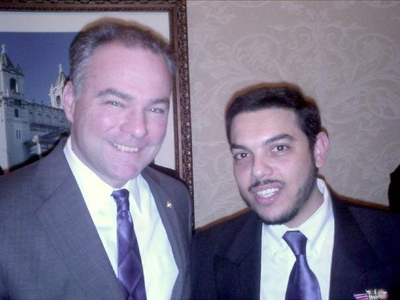
Saturday to Virginia U.S. Sen. Tim Kaine, the 2016 Democratic vice presidential
nominee, and plans to try meeting more members of Congress today.
Omeish wants the committee's leader "legally prosecuted
for fraud, slander and defamation to obtain a judgement inhibiting their
ability to travel to America..." He also wants penalties for committee
members who approved the list, accusing them of "randomly charging
American citizens who have no offense or crime, or involvement with any of
the forms of terrorism, and who are major in the American landscape in the
fight against terrorism and working with all security and legal agencies to
preserve the country's security and the safety of the society and communities
with transparency and integrity which everyone near and far knows."
Omeish formerly served as president of the Muslim American
Society (MAS), which insiders have
acknowledged is the Muslim Brotherhood's
overt arm in the United States. In a December Facebook
comment, Omeish wrote that Muslims
"have not known of the people of Islam ... those more just in
understanding, wider in approach and closer in application than the Muslim
Brotherhood. We have not known of humane brotherliness and its people, (and we
are affiliated with all men whom Allah has created a propensity for love,
mercy, an upright disposition, good morals and honorable character) better in
ethics, of gentler parts, deeper in adherence to duty, nobler in morals among
all their sons, and every one of their actions than the Muslim
Brotherhood."
Last year, he advocated that
the U.S. support for a group known variably as
the "Revolutionary Shura Council," or the "Mujahideen Shura of
Derna," despite ties between its officials and al-Qaida. Egypt's air force bombed the group last
month in retaliation for terror attacks against Coptic Christians in April.
Abuzaakouk also has deep Muslim Brotherhood connections. He
has served as executive director of the American Muslim Council (AMC), and
publications director for the International Institute of Islamic Thought
(IIIT). He became foreign minister of the
Muslim Brotherhood-dominated Government of National Salvation based in Tripoli
after dictator Muammar Gaddafi fell. That group opposes the internationally
recognized government in Tobruk.
The AMC was founded in part by Mahmoud Abu Saud, who helped
Hassan al-Banna create the Brotherhood in Egypt, the Washington Postreported in
2004. FBI officials have longsuspectedthat
the IIIT housed leading Brotherhood officials in the United States.
Despite his overt support for "the jihad way" and
for the Brotherhood, Omeish has been close to Kaine for at least a decade. When
Kaine was Virginia's governor in 2007, Omeish was forced to resign from
a state immigration panel after Investigative Project on Terrorism video showed
him praising Palestinians during a 2000 rally for knowing that "the jihad
way is the way to liberate your land."
At a separate event two months earlier, Omeish similarly praised Palestinians
"for their bravery, for their giving up their lives for the sake of Allah
and for the sake of Al-Aqsa [Jerusalem]. They have spearheaded the effort to
bring victory upon the believers in [Palestine]."
It was during a 2010 fundraiser for Omeish's state assembly
campaign that U.S. Rep. Keith Ellison – now the Democratic National Committee's
vice chair – complained that
Israel unduly influence U.S. policy in the Middle East. "A region of 350
million all turns on a country of 7 million," Ellison said. "Does
that make sense?"
Ellison added:
"We can't allow another country to treat us like we're their ATM. Right?
And so we ought to stand up as Americans. Now some of us have affinity for
other places around the globe. Some of us are new Americans and adopted America
as our home. But whether you're born here or whether you accepted America as
your own voluntarily, this is our home. Right? All of our home equally, and we
can't allow it to be disrespected because some, by a country that we're paying
money to."
In this case, Kaine serves on the Senate Foreign Relations
Committee's subcommittee for North Africa.
It is unclear what impact the Libyan House committee's
terror list will have, especially among U.S. policy makers. There's no public
information indicating Omeish was directly involved in any terror support. But
he has openly advocated for "the jihad way" and lauds the
Brotherhood, a movement which articulated a goal of creating a global
Islamic state and serves as an inspiration for
Sunni jihadist groups including al-Qaida, Hamas, Palestinian Islamic
Jihad and Ja'amat Islamiya.
"The common link here is the extremist Muslim
Brotherhood – all of these organizations are descendants of the membership and
ideology of the Muslim Brothers," former National Security and
Counter-terrorism Coordinator Richard Clarke testified in
2004 before a U.S. Senate committee.
There are twin bills pending in Congress that would designate the
Muslim Brotherhood a terrorist group. The United Arab Emirates has already done so.
______________
About The Investigative
Project on Terrorism
The Investigative Project on
Terrorism (IPT) is a non-profit research group founded by Steven Emerson in
1995. It is recognized as the world's most comprehensive data center on radical
Islamic terrorist groups. For more than two decades, the IPT has investigated
the operations, funding, activities and front groups of Islamic terrorist and
extremist groups in the United States and around the world. It has become a
principal source of critical evidence to a wide variety of government offices
and law enforcement agencies, as well as the U.S. Congress and numerous public
policy forums. Research carried out by the IPT team has formed the basis for
thousands of articles and television specials on the subject of radical Islamic
involvement in terrorism, and has even led to successful government action
against terrorists and financiers based in the United States.
The IPT accepts no funding
from outside the United States, or from any governmental agency or political or
religious institutions. Tax deductible contributions should be made to its
fund-raising arm, the Investigative Project on Terrorism Foundation, a
501(c)(3) tax-exempt organization.
Founder and executive
director Steven Emerson is an internationally recognized expert on terrorism
and national security and author. Consulted by the White House, National
Security Council, FBI, Justice Department, Congress and intelligence agencies,
Mr. Emerson is in great demand as one of the most astute, insightful and
knowledgeable experts in the world today on the threat and prospects of
militant Islamic terrorism. He has been quoted in more than 500 news articles
and …READ THE REST
In the 1967 – 50-years ago – June 5 -10; Israel fought a war
with at least four Arab nations amassing troops on Israel’s border. Begin
counting from day one through the last day, you have the Six-Day
War.
Israel AGAIN defeated armies much-much larger than the
Israel Defense Force (IDF). The Arab nations prepared for invasion for what
they believed would be the utter destruction of Israel. Wisely, Israel utterly
surprised the Egyptian military front by launching a preemptive attack which
destroyed most of Egypt’s air force. Using the shock to Israel’s advantage, the
IDF then launched their vastly outnumbered tanks and pushed Egypt out of the
Sinai. Then Jordan and Syria launched
their invasions unaware that Egypt had gotten their butts kicked in the Sinai.
Although there was a less of a surprise, the IDF ultimately prevailed against
Syria and Jordan. The Golan Heights was taken from Syria and the land conquered
by Jordan in 1948 was taken back which included Israel’s heritage of uniting
Jerusalem. Making Jerusalem whole allowed Jewish access to their most holy site
left to them – the Western Wall still standing after the Romans destroyed the
Jewish Temple circa 70 AD.
The Six Day War Project has a
great video setting up the scene leading to 1967:
1/12 | In the first video of the
mini-series, find out about the early steps that led to the 1967 Six Day War -
a war that changed the future of Israel. Surrounded by enemy neighbors and only
nine miles wide at its narrowest point, Israel was vulnerable.
In May of 1967, the state of Israel was only 19 years old. At its inception in
1948, five Arab armies had coordinated a military invasion to prevent the
creation of the small Jewish country. But Israel’s War of Independence
succeeded in repelling the forces bent on Israel’s destruction. Israel
reclaimed sovereignty over the ancient Jewish homeland, making way for the
establishment of a Jewish country after 2,000 years of statelessness and
periods of persecution.
Yet despite Israel’s success in creating a new country, it did not enjoy peace
with its neighbors. Terrorism and frequent attacks on three borders kept Israel
in a perpetual state of alert.
To the north, from the Golan Heights, Syria shelled Jewish communities below on
a regular basis. In the South and East, Arab terrorists from
Egyptian-controlled Gaza and the Jordanian-controlled West Bank infiltrated and
perpetrated attacks on Israeli civilians, killing 400 in the 19 years since
Israeli independence.
The attacks reached the point that they were condemned as “deplorable” by
then-Secretary General of the United Nations U Thant.
Although the Jewish state had been welcomed into the United Nations and hailed
by the international community, its Arab neighbors rejected its very right to
exist, preparing to resume a war for Israel’s destruction which they had halted
19 years earlier. The Arab buildup for all-out war was very near.
In this video - the first in a 12-part mini-series - you will learn about the
regional atmosphere leading up to the 1967 Six Day War, and find out about the
early steps that led to the war that changed the future of Israel.
This video was produced by Jerusalem U in partnership with The Jerusalem Post,
the Jewish Federations of North America, the Jewish Council for Public Affairs,
the Jewish National Fund, the Israel Action Network, the European Jewish
Congress and the Center for Israel Education. For more on the dramatic events
and impact of the Six Day War, visit sixdaywarproject.org.
Thumbnail Photo Credit: Israel GPO/Moshe Milner
-----------
Are you Jewish and aged 16-28? You could be eligible for …READ
THE REST
If you are a bit impatient to educate yourself at the Six Day War Project, here
is a 6:45 abbreviated 6-Day War documentary that will provide the highlights:
While the military victory was
resounding, the Six-Day War created unresolved challenges that Israel grapples
with to this day. The war also bolstered America’s pro-Israel community and
helped to further reinforce the foundation of the U.S.-Israel strategic
relationship and America’s pro-Israel community. Learn more: http://fal.cn/SixDayWarReflections
Adam Garfinkle wrote an essay for the Foreign
Policy Research Institute (FPRI) reflecting on his historical
view of the results of the Israeli victory in the 6-Day War.
Defense
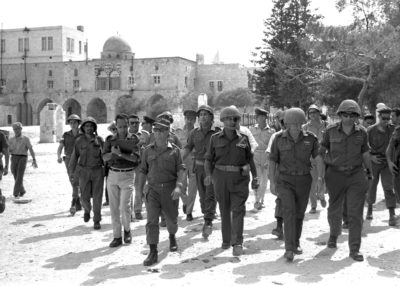
Minister Moshe Dayan, Chief-of-Staff Yitzhak Rabin, Gen. Rehavam Zeevi R and Gen.
Narkis in the old city of Jerusalem -Source: GovernmentPress Office/Flickr
The most important lesson of the June 1967 Arab-Israeli war
is that there is no such thing as a clean war. That war was very short and
stunningly decisive militarily; it has been anything but politically. From the
Israeli point of view, military victory solved some serious near-term
challenges, but at the cost of generating or exacerbating a host of longer-term
ones—some of which may have come along anyway, some not, some of which may have
been averted (or worsened) had Israeli postwar policy been different—and we
cannot know for certain which are which. To ask whether what has transpired
after the war “had to be that way” constitutes an aspiration to levitate the
philosopher’s stone.
At any rate, of the war’s many consequences, three stand out
as pre-eminent. First, major wars change the societies that fight and endure
their consequences. The Six Day War changed the political,
social-psychological, and, in at least one key case, demographic balances
within all the participating states and a few others besides, with multiple and
varying secondary and tertiary effects over the years. Second, despite the
war’s after-optic of a smashing Arab loss, it was the best thing that ever
happened to the Palestinian national movement. And third, the war catalyzed a
redirection of U.S. Cold War policy in the Middle East (and arguably beyond)
from one teetering on the edge of generic failure to one of significant
success.
At this fiftieth “jubilee” anniversary of the war, buckets
of ink will inevitably be spilled mooting and booting about such questions and
many others; a lot already has been, and I am not reluctant to add to the
bucket count.[1] But
before doing so, we all need to take a deep breath to inhale as much humility
as we can—to remind ourselves what exactly we are doing and what we cannot do
when we exhume moldering chunks of anniversarial history for reexamination.
Shiny Anniversaries
We are so very attracted to anniversaries in the long parade
of political history. We love to draw clear lessons from them, if we can—and if
we can’t some others will claim to do so anyway. We are also attracted to
thinking in terms of parsimonious eras with sharp lines of delineation between
them; anniversaries of turning or tipping points help us mightily to draw such
lines—which is precisely why we call them epochal. Wars, mostly hot but
occasionally cold, figure centrally in the pantheon of such points.
The June 1967 Arab-Israeli War is all but universally
considered to be epochal in this sense, so the recent ink flow is no wonder as
journalists, scholars, memoirists, and others look for lessons and insight as
to how those supposed sharp lines that divide eras were drawn. The subtitle of
a new book furnishes a case in point: “The Breaking of the Middle East.”[2]
There is a problem here—at least one, arguably more than
one. Without yet having read this book, I cannot say for sure that this
subtitle is not magnificently meaningful. But I can say for sure that it
puzzles me. What does it mean to say that a region of the world is “broken”?
Does it imply that before the 1967 Middle East War the region was somehow
whole, a description that implies adjectives such as peaceful, stable, and
nestled in the warm logic of a benign cosmos; and suggests that regional
wholeness also meant that its state or regime units were seen as legitimate by
their own populations and by other states and regimes? So on June 4, 1967, the
Middle East was whole, and by June 11, it was well on its way to being broken?
All of which is to say that the penchant for reposing great
significance in anniversaries is often distortive, because for many it
reinforces the right-angled sureties and sharp distinctions—and presumed causal
chains leading into our own time bearing those precious, sought-after lessons—that
historical reality rarely abides. Only by rounding off the ragged edges,
usually with a rasp composed of our contemporary concerns and convictions
unselfconsciously pointed backwards, can such artificial categories be devised.
Ambiguity annoys most people, and so they go to some lengths to duck it, in the
case of getting arms around history by generating categories, boxes, and labels
into which to shove obdurate facts. History, meanwhile, remains the sprawling
entropic mess it has always been and will always remain.
To employ the anti-ambiguity rasp presupposes, too, that the
craftsman commands cause and effect. We can, after all, only simplify a reality
we presume to understand in its detail. When it comes to the Six Day War, that
means presuming to know how it started and why, how it ended and why, and what
the war led to thereafter in an array of categories: how the postwar
geopolitical trajectory of the core Middle Eastern region and its periphery
spilled forth; how the region’s relationship to the key Cold War superpower
protagonists shifted; the war’s impact on the domestic political cultures of
participants and near-onlookers; and more besides.
The problem here is that we know with confidence only some
of these causal skeins, and, what is more (or actually less), some of what we
know has not stayed constant over the past half century. At one point, say
thirty years ago, we thought we understood the Soviet government’s role in
fomenting the crisis by sending false reports of events in Syria to the
Egyptian leadership; after the Soviet archive opened in the early 1990s,
consensus on that point has weakened as revisionist interpretations have come
forth.[3] Nasser’s
moving-target motives at various points in the crisis leading to war seemed
clear for a time, until they no longer quite did. Several more examples of
elusive once-truths could be cited.
Alas, every seminal event has a pre-context and a
post-context: the convolutions of historical reality that give rise to an event
and its causal afterflow. The further we get from the event, the greater the
still-expanding post-context overshadows the pre-context, because we can see,
for example, how various things turned out in 2017 in a way we could not have
in, say, 1987. But so much else has happened that must, of necessity, dilute any
construction of direct or preponderant causality.
Thus, did the war push Israeli society into becoming more
religious, as many have claimed? Did it help shift Israeli politics to the
Right by transforming the relationship of Orthodox Judaism to Zionism, leading
Orthodox Israelis to engage on many political issues to which they had been
formerly aloof? Or was that a deeper social-demographic trend that would have
happened anyway, if differently, war or no war? So we face a paradox: the
richer the post-context becomes for any epochal event, the poorer becomes our
ability to isolate its downstream impact. As already suggested, we often enough
make up for that poverty by exiling natural ambiguity before the demands of our
current questions or biases. That is how we predict the past.
Scholars do try to isolate causal threads, of course, but
differently because intellectual business models, so to speak, differ.
Historians tend to seek out particularities; political scientists tend to
search for general rules. Historians like their rocks fresh and jagged;
political scientists like theirs rounded by patterns that flow through time.
Each to their own intellectual aesthetic.
And the rest of us? How do we chase truth in history?
Consider that if you pick up a history book and a memoir old enough to serve as
an adjunct to it, you will have in your hands two different perspectives on the
political world. An international political history of the 1930s written in the
2010s will take a passage of reality—say about the British, French, and
American reaction to the 1935 Italian aggression against Ethiopia—and might
spend two sentences or perhaps a paragraph on it. A memoir written in the 1950s
by someone actually involved in debating and shaping that reaction will read
very differently, recalling details, sideways connections to other issues, and
nuances of policies and personalities bound to be lost in a general text if it
aspires to be less than 10,000 pages long. In a history book such a mid-level
event is likely to be framed as a consequence of larger forces that were
leading to more portentous happenings (say, World War II); in a memoir it is
more likely to be framed as both illustration of a synthetic historical moment,
akin to a zeitgeist that is fully felt but is recalcitrant to
reductionist analysis, and partial cause of what came after. Which do we read;
which do we trust?
The answer is both, and wholly neither. How will the Six Day
War figure in history books fifty years from now? There’s no way to know,
because it will depend at least as much on what happens between now and then as
it will on what happened in May and June 1967. But one thing we do know: As the
post-context of the war doubles, the thinness and sameness of the description
will grow, and be of little help in understanding how the main actors involved
saw their circumstances. It will lose a sense of human verisimilitude. Details
invariably give way to theme, and narratives grow shorter even as their truth
claims grow larger. The thickness of memoirs will retain that sense of human
verisimilitude. But what they provide in terms of broader context may suffer
from too narrow an authorial aperture, and perhaps a bad memory in service to
ego protection, if not other incidental causes of inaccuracy. As with many aspects
of life, intellectual and otherwise, tradeoffs spite us in our search for
clarity.
The point of all this? Anniversaries are shiny. They
attract a lot of attention, much of it self-interested and sentimental enough
to lure some people into excessive simplifications if not outright
simplemindedness. If someone will bait the hook, someone else will swallow it.
We witnessed exactly such a spectacle not long ago at the 100th anniversary
of Sykes-Picot, and we’ll see it again a few months hence with the 100th anniversary
of the Balfour Declaration.[4] But
as Max Frankel once said, “simplemindedness is not a handicap in the
competition of social ideas”—or, he might have added, historical
interpretations. If it gets you on TV talk shows to sell your book, no form of
simplification is liable to remain out of bounds these days. After all, what is
fake history if not a collection of aged fake news?
Shining On
Never mind all that: I want people to read this essay, so
rest assured that I know what happened and why, and what it all means even down
to today. And now that I have donned sequins and glitter, I can be almost as
brief and punchy as I am shiny, as is the current custom.
What did the war mean for the region? Plenty. It proved to
remaining doubters that the Arabs could not destroy Israel by conventional
force of arms. It helped establish Israel’s permanence in the eyes of its
adversaries, the world at large, and, to an extent, in the eyes of its own
people. That changed Israel’s domestic political culture. It no longer felt to
the same extent like a pressure-cooking society under constant siege, and that,
along with demographic and other subterranean social trends, ironically
loosened the political grip of Israel’s founding generation of leaders, and the
Labor Party. Less than a decade after the war Revisionist Zionists came to
power for the first time, and now, fifty years later, Israel has the most
rightwing government in its history. Did the Six Day War directly cause that?
Of course not; but it was one of many factors that steered Israeli politics
toward its current circumstances.
The war also began the occupation, first of Golan, the West
Bank, and Gaza—in time a bit less of Golan and not of Gaza at all. If you had
told typical Israelis in the summer of 1967 that fifty years later the West Bank
would still be essentially occupied, neither traded for peace nor annexed, they
would have thought you mad or joking. Israel as an independent state was 19
years and a few weeks old on June 5, 1967. The twentieth anniversary of the war
in 1987 was about the midpoint of Israel’s modern history, half
within-the-Green-Line and half beyond it. Now vastly more of Israel’s history
has passed with the occupation as a part of it. Many more Israelis today cannot
remember Israel in its pre-June 1967 borders than can—and that includes the
Arabs citizens of the state as well as their ethno-linguistic kin living in the
West Bank and Gaza.
In Israel there is a huge open debate, and a constant more
private discussion beneath it, as to how the occupation has changed the nature
of Israeli society. It is a difficult debate to set premises for, because in
fifty years a lot is going to change in any modern society, occupation or no
occupation. My view, like that of most Israelis I know, is that the occupation
has been significantly corrosive of many Israeli institutions. They would like
the occupation to end if it could be ended safely; but increasingly most agree
that it can’t be, at least anytime soon. The remarkable fact is that,
considering the circumstances, the damage to morale and heart, beyond
institutions, has not been even worse. Israel’s moral realism has proved
resilient. But the damage has not been slight, and of course it is ongoing.
As for the Arabs, the war crushed the pretentions of Arab
Socialism and of Gamal Abdel Nasser. Within what the late Malcolm Kerr called
“the Arab Cold War” it played in favor of the Arab monarchies against the
military-ruled republics and hence generally in favor of the West; but it did
not guarantee the safety of monarchical rule everywhere: Just 27 months later
the Sanusi kingdom in Libya fell to a young army colonel named Muamar Qadaffi.
None of the defeated Arab states lost its leader right away: not Nasser in
Egypt, or King Hussein in Jordan, or Nurredin al-Atassi in Syria. But by the
late autumn of 1970 Nasser was dead and al-Atassi had been displaced by Hafez
al-Assad. Rulers also rolled in Iraq, and the very next year, with the British
withdrawal from East of Suez, the United Arab Emirates came into being against its
own will.
The war, therefore, was one element—more important in some
places than others—in a general roiling of Arab politics (and I haven’t even
mentioned stability-challenged zones like Yemen and Sudan), those politics
being pre-embedded, so to speak, in generically weak states (again, some more
than others).[5] Not
that Arab politics was an oasis of serenity before June 1967 either, as a
glance at post-independence Syrian history will show. Indeed, the contention
that the Six Day War, by hollowing out the pretensions of secular Arab
nationalism for all to see, presaged the “return of Islam” with which we and
many others struggle today is both true and overstated—in other words, too
shiny. The frailties of secular nationalism among the Arab states preceded the
war and would have multiplied on account of any number and kind of failures to
come, war or no war.
In any event, the political impact of the Arab loss was
mitigated by the “Palestine” contradiction that then lay at the heart of Arab
politics. “Palestine” was, and remains to some extent, a badge of shame, for it
epitomizes the failure of the Arab states to achieve its goals. Yet it is only
a badge; the persistence of the conflict, sharply inflected by the 1967 loss,
has served as a raison d’être for most ruling Arab elites,
their unflagging opposition to Israel as a symbol of legitimacy. In the parlous
context of inter-Arab politics, too, the conflict has served as the only thing
on which all the Arab regimes could symbolically unite. Non-democratic Arab
elites have used the conflict both as a form of street control internally, and
as a jousting lance in their relations with other Arab states.
Yet by far the most important consequence of the Arab defeat
in 1967 was to free the Palestinian national movement from the clutches of the
Arab states. The theory before June 1967 was that the Arab states would destroy
Israel in a convulsive, epic war, and then hand Palestine over to the
Palestinians. The hysteria that overtook the Arab street leading to war shows
how widespread this theory was, and the war itself showed how hollow a promise
it was. So the Palestinians took matters into their own hands for the first
time, seizing control of the Palestine Liberation Organization from its
Egyptian sponsors and reversing the theoretical dynamic of liberation:
Palestinians would liberate Palestine, and that victory would supercharge and
unify the Arabs to face the hydra-headed monster of Western imperialism. The
key bookends of this transformation as it manifested itself in Arab politics
writ large were the Rabat Arab Summit of 1974, which passed responsibility for
“occupied Palestine” from Jordan to the PLO, and the 1988 decision by King
Hussein to formally relinquish Jordan’s association with the West Bank, which
it had annexed and ruled for 18 years after the 1949 Rhodes Armistice
agreements.
But how would the Palestinians themselves, led by the new
and authentic PLO, liberate Palestine? They had in mind a revolutionary
people’s war, an insurrection focused on the territories Israel newly occupied.
It took its inspiration from lukewarm Maoism and its example from the Vietcong.
The attempted insurrection in the West Bank failed miserably and rapidly;
terrorist attacks mounted from east of the Jordan and across the border with
Egypt became the next tactical phase as Palestinian nationalism’s
organizational expression fractured. In time, Palestinian use of contiguous
lands in Jordan and later in Lebanon to launch repeated terror attacks against
Israeli civilians sparked civil wars in both countries. It did not bring about
the “liberation” of even one square centimeter of “Palestine.”
Terrorism, however, did put the Palestinian issue “on the
map” for much of the world, and now, fifty years later, Palestinians can have a
state if their leaders really want one and are prepared to do what it takes to
get it—the evidence so far suggesting that they don’t, and won’t. Nevertheless,
looking back from fifty years’ hindsight, the Six Day War was about the best
thing that could have happened for the Palestinians; that fact that they have
not consolidated that windfall politically is their own doing, but everyone’s
tragedy.
As to terrorism, it is true that the pusillanimous behavior
of many governments in the 1970s, including some allied in NATO to the United
States, helped the PLO shoot, bomb, and murder its way to political
respectability. So one might venture that by helping to show that terrorism
post-Six Day War can work at least to some extent, these governments bear some
responsibility for the metathesis of nationalist, instrumentalist terrorism
into the mass-murder apocalyptical kind we have witnessed more recently with
al-Qaeda and ISIS. To me it’s another in a series of shiny arguments, more
superficially attractive than fully persuasive. It is not entirely baseless,
however.
But far more important than what the war did for the
thinking of the Palestinians was what it did to the thinking
of the Arab state leaders whose lands were now under Israeli occupation: Egypt,
Jordan, and Syria. Before the war, Arab support for “Palestine” was
highly theoretical, highly ineffectual, and in truth amounted merely to a
symbolic football the Arab regimes used to compete with one another in the
ethereal arena of pan-Arab fantasies. Now, suddenly, the core national
interests of three Arab states—including the largest and most important one,
Egypt—became directly and ineluctably entwined with the reality as opposed to
the symbol of Israel.
The Egyptians, particularly after Nasser’s death brought
Anwar el-Sadat to power, got downright pragmatic. Israel had something these
three states wanted—chunks of their land. And the Egyptian and Jordanian leaderships,
at least, knew that a price would have to be paid to redeem that pragmatism.
Complications aplenty there were, as anyone who lived through the dozen years
after the 1967 War knows well. Nevertheless, this critical divide among the
Arabs—between state leaders who could afford to remain only symbolically
engaged and those who could not—shaped inter-Arab politics then and still does
to some degree today. First Egypt in March 1979 and then Jordan in October 1994
paid the price and made peace with Israel. It seemed like forever passed
between June 1967 and March 1979, but it was less than a dozen years—quick by
historical standards.
While Egypt recovered the entire Sinai through its peace
arrangement with Israel, Jordan did not recover the West Bank. The war had
shifted the political demography of the Hashemite Kingdom, sending more
Palestinians to live among East Bankers—some now refugees twice over and some
for the first time. The consequence was to intensify Jordan’s internalization
of its problem with Palestinian nationalism: It had lost land but gained souls
whose fealty to the monarchy was presumably weak. The benefit of peace to
Jordan in 1984, and hence its main purpose from King Hussein’s point of view,
was therefore not to regain territory but to strengthen the stake that both
Israel and the United States had in Jordan’s stability in the face of future
challenge from any quarter, internal and external alike.
Syria, do note, did not follow the Egyptian and Jordanian
path to peace, and so the Golan Heights remain for all practical purposes part
of Israel. The reasons have to do with the complex sectarian demography of the
country, and specifically with the fact that since 1970 Syria has been ruled by
a minoritarian sect in loose confederation with the country’s other non-Sunni
minorities. The Alawi regime has needed the symbolic pan-Arab mantle of the
Palestinian cause more than any other Arab state, particularly as one with a
border with Israel. Regime leaders anyway did not consider the Golan to be
their sectarian patrimony, but more important, peace and normalization seemed
to the Syrian leadership more of a threat to its longevity (and to its ability
to meddle in Lebanese affairs) than a benefit. Now that Syria as a territorial
unit has dissolved in a brutal civil war, the legacy of 1967 has been rendered
all but moot.
Does that mean that Egypt and Jordan essentially sold out
the Palestinians, making a separate peace? Well, much political theater aside,
yes. But they really had no choice, and not selling out the Palestinians would
not have gained the Palestinians what they wanted anyway. That, in turn, left
the Palestinians with little choice. Eventually, the PLO leadership also
decided to “engage” Israel directly, but without giving up what it still called
the “armed struggle.”
Its partial pragmatism, tactical in character, gained the
PLO a partial advance for the Palestinians through the truncated Oslo process:
a kind of government with a presence in Palestine; some “police” under arms; a
transitional capital in Ramallah; wide international recognition; and more.
Withal, the “territories” remain under Israeli security control, and the
Palestinian economy (jobs, electricity grid, water, and more) remains
essentially a hostage to Israel’s.
This has given rise to perhaps the most underappreciated
irony in a conflict replete with them: First Israel internalized the
Palestinian nationalist problem in June 1967 by occupying at length the West
Bank and Gaza, and then the PLO internalized its Israel problem by drifting via
Oslo into essential dependence on Israel for basic sustenance and even security
support (against Hamas, for example). Note that it was hard for Israel to bomb
PLO headquarters in Tunis in October 1985, but very easy to send a tank column
into downtown Ramallah ten years later. It’s all so very odd, you may think,
but there you have it.
The Bigger Picture
Now to the larger, international scene. What the Six Day War
showed was that Soviet patronage of the Arabs and arms sales to them could deliver
neither victory to the Arabs nor reflected advantage for the Soviet Union. This
devalued the allure of Soviet regional overtures reassured the Western-oriented
Arab regimes and hence played directly into the portfolio of U.S. and Western
interests: keep the Soviets out, the oil flowing, and Israel in existence (the
latter construed at the time as a moral-historical obligation, not a strategic
desideratum).
The Johnson administration figured the essence out, which is
why in the aftermath of the war it did not do what the Eisenhower
administration did after the Suez War of 1956: pressure Israel to leave the
territories it had conquered in return for promises that, in the event, turned
out to be worthless. It rather brokered a new document—UNSCR 242—calling for
withdrawal from territories (not “the” territories) in return for peace.
But it was not until the War of Attrition broke out in 1969
around and above the Suez Canal—a direct follow-on to the Six Day War—that the
new Nixon administration codified in policy this basic strategic understanding.
To prevent and if possible roll back Soviet inroads in the Middle East, the
U.S. government would guarantee continued Israeli military superiority—that was
the start of the major U.S. military supply relationship to Israel that endures
today (the younger set may not know it, but Israel won the Six Day War with a
French-supplied air force). In short, nothing the Soviets could supply or do
would help the Arabs regain their lands or make good their threats. The events
of the Jordanian Civil War in September 1970, and the way Nixon administration
principles insisted on interpreting and speaking about that civil war, only
deepened the conviction and the anchors of the policy.
On balance, the policy worked well, despite one painful
interruption. By July 1972, President Sadat had sent a huge Soviet military
mission packing out of Egypt, and was all but begging the United States to open
a new relationship. Egypt had been by far the most critical of Soviet clients
in the Middle East, and Sadat’s volte face represented a huge
victory for U.S. diplomacy. Alas, neither the victory-besotted Israelis nor the
increasingly distracted Americans paid Sadat the attention he craved—so he
taunted the Soviets to give him just enough stuff to draw Jerusalem and
Washington’s eyes his way: He started a war in October 1973. This also worked,
leading as already noted to the March 1979 peace treaty—a geopolitical and
psychological game-changer in the region and, ultimately, beyond.
For most practical purposes, Israel’s role as an effective
proxy for U.S. power in the Middle East endured through the end of the Cold
War, although its benefits paid out quietly, more often than not in what
trouble it deterred as opposed to actively fought.[6] And
the Israeli-Egyptian relationship—imperfect as it may be—still endures as a
guarantee that there can be no more Arab-Israeli conventional wars on the scale
of 1967 or even 1973. These are both, at least partially, strategic
achievements born of the conjoining of Israeli power and American diplomacy,
and—it bears mentioning—these are achievements that were constructed and made
to endure pretty much regardless of the state of play in Israel’s relations
with the Palestinians.
Obviously, the end of the Cold War put paid to the structure
of this regional American strategy, its logic dissipated through victory. In
that sense, the larger global strategic impact of the Six Day War ended when
the Berlin Wall fell. While Israel remains a strategic partner of the United
States in the post-Cold War environment, largely through intelligence sharing
and other activities, its value as strategic proxy diminished as the focus of
U.S. concerns moved east, toward Iraq and the Gulf. In the 1991 Gulf War, for
example, Israel through no fault of its own became a complication for American
policy—a target set for Iraqi scuds—not an asset, such that the U.S. government
pleaded with its Israel counterpart not to use its military
power against a common foe.
Amid the sectarian and proxy wars of the present moment in
the region, Israeli arms lack any point of political entrée that can aid U.S.
policy. Even when it comes to counterterrorism efforts, Israeli intelligence is
indeed valuable but we will not see Israeli special forces attacking salafi terrorist
organizations far from home. The last thing Israel needs is to persuade still
more murderous enemies to gaze its way.
Only if the two parties come to focus on a common
enemy—never the case during the Cold War, by the way, when for Israel the Arabs
were the threat and for the United States the Soviets were the threat—could a
truly robust U.S.-Israeli strategic partnership be born anew. And that common
enemy, which could bring in also many Sunni Arab states and possibly Turkey as
well, is of course Iran. But we are now very deep into the post-context of the
Six Day War, more than six degrees of separation from any plausible causal
skein leading back to June 1967.
A Smaller Picture
The war affected the political and social-psychological
condition not only of state actors but of some others as well. As the Middle
East crisis deepened in May 1967, I was a (nearly) 16-year old Jewish high
school student in the Washington, D.C. area. Just like every American who was
of age in November 1963 can remember where they were and what they were doing
when they heard that President Kennedy had been assassinated, I suspect that
just about every Jew of age anywhere in the world in May and June of 1967 can
remember where they were and what they were doing when they heard that the war
had started, and how they felt when it had ended.
We had been frightened, and afterwards we were relieved and
even elated. It turned out that a lot of what we thought was true about the
state of affairs at the time was incorrect. That was hardly a unique
experience, but more important, over time the effects of the Six Day War on
American Jewry and other Jewish communities outside Israel were dramatic—and
the triangular relationship between Israel, American Jewry, and the United
States has never since been the same.[7]
Figuring it all out has borne its own challenges, surprises,
and disappointments. Those on all three sides who thought they knew what was
going on—who was dependent on whom, who could count on whom, who had political
leverage over whom, and so on—learned better, often the hard way. But none of
this has involved armies with modern weapons and high-level state diplomacies
interacting; no, it is truly complicated and tends to generate
narratives that are very, very shiny—so let’s just leave it at that.
If You Pick Up the Gun, You Roll the Dice
Let us conclude by returning to where we began, using
another’s much earlier conclusion as our prooftext. On Saturday, June 3, 1967,
Israeli Prime Minister Levi Eshkol concluded a meeting of his inner cabinet
with these words: “Nothing will be settled by a military victory. The Arabs
will still be here.”
Eshkol (as well as the out-of-office but still prominent
David Ben-Gurion) had counseled patience and restraint to Israel’s confident
military leadership as the spring 1967 crisis grew, and only reluctantly came
to the decision for war. Keenly sensing the ironies of history—Jewish history
not least—he knew that the war would not be politically conclusive. He realized
that whatever immediate threats needed to be extinguished, war would not
deliver peace and security before, if ever, it delivered mixed and
unanticipated consequences. He was right.
Not even the shrewdest statesmen are wise enough to foresee
the consequences of a major war: When you pick up the gun, you roll the dice.
That, I think, is no shiny lesson, but one more likely for the historically
literate to recall the past’s many dull pains. May it help future leaders to
control their own and others’ expectations if use force they must.
[1] I
have written on the anniversary of the Six Day War before: See “Arab Loss
Had Profound Effect on Politics in the Middle East,” Jewish Exponent,
June 5, 1987; “1967: One War Won, a Few Others Started,” Newsday,
April 30, 1998; and “Six Days, and Forty Years,” The American Spectator,
June 5, 2007.
[2] Guy
Laron, The Six-Day War: The Breaking of the Middle East (Yale
University Press).
[3] See,
for example, Isabella Ginor & Gideon Remez, Foxbats Over Dimona:
The Soviets’ Nuclear Gamble in the Six-Day War (Yale University Press,
2007).
[4]
On the former, note my “The Bullshistory of “Sykes-Picot”, The American
Interest Online, May 16, 2016.
[5] For
detail on what is meant by “pre-embedded” in “generically weak states,” see my
“The Fall of Empires and the Formation of the Modern Middle East,” Orbis (Spring
2016).
[6] A
point emphasized in Michael Mandelbaum, “1967’s Gift to America,” The
American Interest Online, June 2, 2017.
[7] I
have written of this triangular relationship elsewhere: “The Triangle
Connecting the U.S., Israel and American Jewry May Be Coming Apart,” Tablet,
November 5, 2013.
________________
Israel Kicks Hostile Arab
Armies’ Butts 50 Yrs. Ago
The Foreign Policy Research
Institute, founded in 1955, is a non-partisan, non-profit 501(c)(3)
organization devoted to bringing the insights of scholarship to bear on the
development of policies that advance U.S. national interests. In the tradition
of our founder, Ambassador Robert Strausz-Hupé, Philadelphia-based FPRI
embraces history and geography to illuminate foreign policy challenges facing
the United States. More about FPRI »
Foreign Policy Research
Institute · 1528 Walnut St., Ste. 610 · Philadelphia, PA 19102 Tel:
1.215.732.3774 Fax: 1.215.732.4401 www.fpri.org