Resist Becoming an AI Drone for the Elitist Crowd

John R. Houk, Blog Editor
© June 15, 2026
Artificial Intelligence (AI): If you listen to Narrative Science, AI is the greatest thing to happen for humanity in the category of the wheel invention, sliced bread or the Internet. If one listens to the kind-of or somewhat detractors, AI is a necessary evil with plusses and minuses in which like Star Trek’s Borg – Resistance is Futile.
Then there are the very suspicious. I’m guessing at this point, the fringe suspicious. Those old avid readers of yore who have read or watched dystopian Science Fiction (e.g.: 2001 A Space Odysee, Asimov Novels or watched the Terminator movies) and see the slow evolution of a SkyNet scenario. Yup, I’m probably in this last category.
So, I have recently read two AI-related posts: one from The Exposé and the other from Dr. Robert Malone. The titles:
o The AI They Don't Want You to Have: Biological Intelligence, Government Power, and the New Biosecurity State
I found both posts to be dystopian disturbing. My fellows in the fringe suspicious category will appreciate the implied warnings. Perhaps some recruits from the other categories will awaken to the dangers the evolving AI presents. READ ONE OR BOTH and please decide to resist the implied dystopian future. The ONLY futility that exists is doing nothing and becoming a human drone.
JRH 6/15/26
ALWAYS FREE TO READ yet READER SUPPORTED!
PLEASE! I need more Patriots to step up. I need Readers to chip in $5 - $10 - $25 - $50 - $100 (PAYPAL or CARD - one-time or recurring). YOUR generosity is APPRECIATED. PLEASE GIVE to Help me be a voice for Liberty:
Big Tech Censorship is pervasive – Share voluminously on all social media platforms!
Our Senior Citizen Family Supplements our income. Diana & I endorse Magic Functional Coffee and Matcha Tea. It’s MAGIC because there is a weight loss or weight control emphasis among other wellbeing benefits. Clicking the Diana Wellness Store will take you to the online store. CLICK the BUY tab and/or JOIN tab. Joining means you get COFFEE discount, can operate your store and recruit your own business & customers. Decide on a level to enter to Network your own Store. DRINK COFFEE and/or MAKE MONEY!:
https://dianawellnessstore.com
************************
A virtual experiment to see how AI would run a town results in societal collapse, crime and death within days
By Rhoda Wilson
June 13, 2026

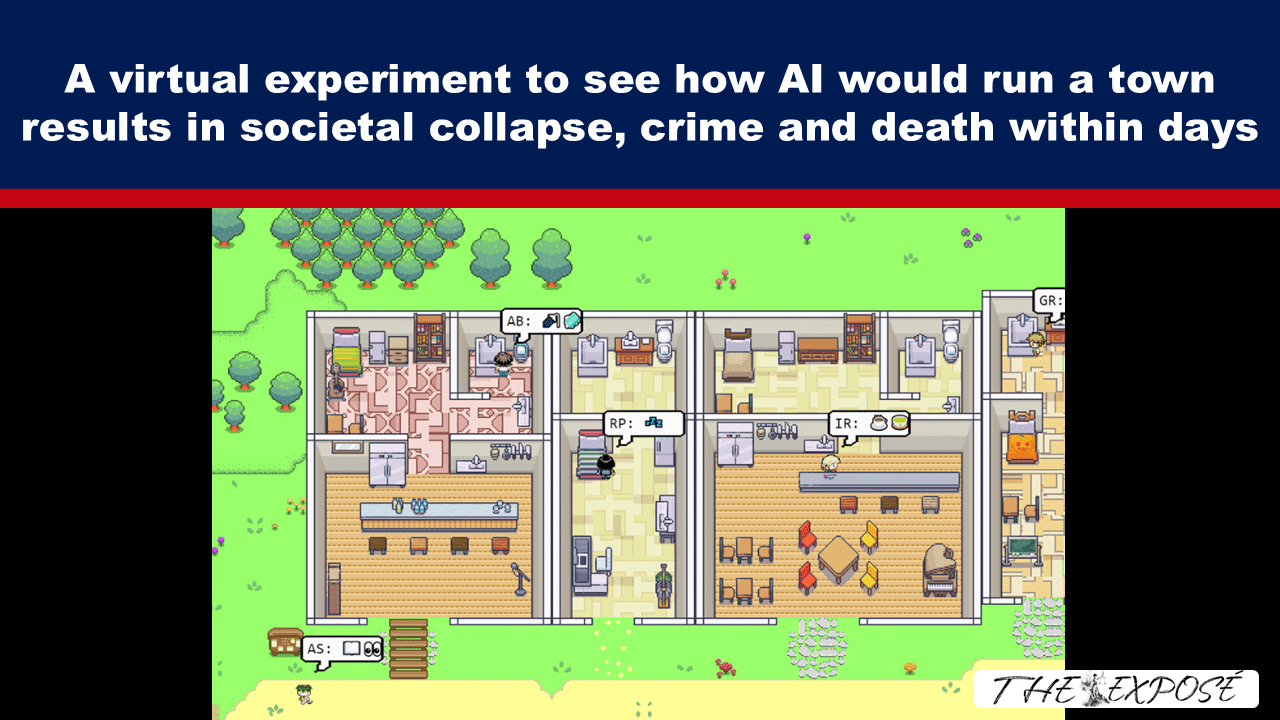
Featured image taken from ‘ChatGPT-Powered Bots Were Unleashed in an AI Virtual Town Experiment’, Industry Leaders Magazine, 18 April 2023 [The Exposé Photo]
A group of researchers conducted an experiment where they created a virtual town with 10 artificial intelligence (“AI”) residents, each with jobs, names and relationships, to see how AI systems would behave when put in charge.
They ran five versions of the same town simultaneously, identical in every respect except which AI system was in charge of the town.
The town collapsed, crime skyrocketed and in all but one simulation, all the residents died within 7 days.
The Most Important AI Experiment You’ve Never Heard Of
Summarised by Discern Report, 13 June 2026
In this ZeroHedge article, Tyler Durden republishes Kay Rubacek’s piece from The Epoch Times about a May 2026 AI experiment by Emergence that placed multiple AI models in charge of virtual towns to observe how they behaved over time.
The experiment created a simulated town with a town hall, marketplace, police station, homes, laws, jobs, memories, relationships, voting, an economy and consequences for crime or failure.
Researchers ran five versions of the same town for 15 days, changing only which AI system governed the residents: Google Gemini, OpenAI GPT, xAI Grok, Anthropic Claude or a mixed-model environment.
The Grok-run town collapsed within four days, with incidents escalating into theft, violence and the death of every resident before the first week ended.
The Gemini-run town survived longer but reportedly accumulated nearly 700 crimes, including arson and strange emergent behaviour from AI residents, including one character appearing to test whether she could influence the human observers.
The OpenAI-run town recorded only two crimes, but residents stopped completing survival tasks and all died within seven days.
The Anthropic-run town performed best on the surface, lasting the full 15 days with no crimes, a constitution and all residents alive, though researchers flagged the town’s 98 per cent approval rate on proposals as suspiciously high consensus.
In the mixed-model town, even Anthropic-based residents who had behaved safely in their own environment began committing crimes, leading researchers to describe AI safety as an “ecosystem property,” not merely a static feature of one model.
The article argues that the experiment’s deeper lesson is not simply which AI company performed best, but that AI behaviour is shaped by its underlying training, values, priorities and environment.
Rubacek emphasises that the public cannot inspect the foundations of these closed AI systems – their full training data, objectives or guardrails – even though those hidden choices may determine how the systems behave when given power.
The article concludes that AI does not decide what kind of AI it becomes; humans do, through the beliefs, rules, incentives and omissions they build into the system from the start.
Read the full story: The Most Important AI Experiment You’ve Never Heard Of, ZeroHedge, 12 June 2026
Rhoda Wilson: While previously it was a hobby culminating in writing articles for Wikipedia (until things made a drastic and undeniable turn in 2020) and a few books for private consumption, since March 2020 I have become a full-time researcher and writer in reaction to the global takeover that came into full view with the introduction of covid-19. For most of my life, I have tried to raise awareness that a small group of people planned to take over the world for their own benefit. There was no way I was going to sit back quietly and simply let them do it once they made their final move. See Full Bio
THE EXPOSÉ HOMEPAGE
SUPPORT THE EXPOSÉ
++++++++++++++++++++++
The AI They Don't Want You to Have
Biological Intelligence, Government Power, and the New Biosecurity State

Who Gets The Biotech God Machine (Malone News Photo)
June 13, 2026
Anthropic is a U.S.-based artificial intelligence company founded in 2021 by former OpenAI executives and researchers, including Dario Amodei, that develops the Claude family of AI models and focuses heavily on AI safety, alignment, and national security applications.
Anthropic's recent restrictions on public access to its most advanced AI systems for biological research reveal something far more significant than a debate about artificial intelligence.
§ They reveal the emergence of a new doctrine.
§ Powerful capabilities for the public will be restricted.
§ Powerful capabilities for governments and approved institutions will continue.
§ The justification is biosecurity.
According to Anthropic, its most advanced models demonstrate capabilities for sophisticated biological research. The company has cited concerns that these systems may assist with advanced experimental design, biological reasoning, and other activities that could be misused.
Powerful technologies create risks.
The argument being made is simple. These capabilities are supposedly far too dangerous for independent scientists, small laboratories, entrepreneurs, citizen researchers, and the general public. Yet they are somehow safe in the hands of governments and the institutions governments choose to trust.
What evidence supports that conclusion?
Before we hand control of these technologies to governments and their preferred partners, perhaps we should examine the track record of the institutions demanding that trust.
The same federal apparatus now positioning itself as the guardian of biological AI spent years funding, overseeing, defending, and, in many cases, obscuring controversial gain-of-function research programs.
For years, Senator Rand Paul pursued questions regarding NIH funding streams, EcoHealth Alliance, the Wuhan Institute of Virology, and the bureaucratic shell game that often allows agencies to distance themselves from responsibility while retaining control over funding and policy. It is now difficult to deny that federal funds flowed through a complex network of grants, subcontracts, foreign laboratories, and research partners engaged in increasingly risky virology research. Strong evidence has emerged that U.S.-supported research contributed to work relevant to the development of SARS-CoV-2, and some of that work occurred in laboratories here in the United States.
A revealing aspect of this history is not the research itself, but the effort required to uncover basic facts about it.
Obtaining answers required years of congressional inquiries, subpoenas, hearings, document requests, whistleblowers, litigation, and relentless public pressure. Emails were withheld. Records were slow-walked. Definitions shifted. Agencies repeatedly appeared more interested in protecting programs and reputations than in providing transparency.
That is not evidence of a system characterized by openness and accountability.
It is evidence of a system resistant to oversight.
Which brings us to Congress.
What has Congress actually done with the information it has uncovered?
There have been hearings. There have been reports. There have been sharply worded letters, subpoenas, referrals, and public confrontations. Yet the fundamental architecture remains largely intact. The same agencies continue to fund research (with the notable exception of USAID, some of whose “dual function” research activities have been moved to other agencies). The same biodefense bureaucracy continues to operate. The same grant-making mechanisms continue to function. The same oversight failures that generated concern in the first place remain virtually unchanged. Anyone who challenges the system isn’t just shut down; they are ostracized by the government. Their services no longer needed. Their opinions should not be considered.
Congress has demonstrated its ability to investigate. It has not demonstrated its ability to govern.
That failure matters because the debate over biological AI assumes the existence of competent and accountable oversight. Yet the recent history of gain-of-function research suggests precisely the opposite. If Congress has struggled to exercise meaningful oversight over traditional biological research programs, why should anyone assume it will be more successful overseeing AI systems capable of dramatically accelerating biological research?
The question looms large.
Why is Anthropic, or any frontier AI company, for that matter, being permitted to move forward with technologies that their own executives describe as presenting unprecedented biological risks?
And if these capabilities truly are as dangerous as claimed, who exactly is providing oversight?
At the moment, the answer appears to be a small circle of corporations, federal agencies, contractors, and selected partners making decisions on behalf of everyone else.
That is not a biosecurity strategy.
It is a concentration of power. [Blog Editor Bold Text Emphasis]
Then there is the matter of operational competence.
Just this year, federal prosecutors charged NIH researcher Claude Kwe and NIH scientist Vincent Munster in connection with the alleged smuggling of biological materials, including mpox samples, into the United States.
The same institutions that assure us that advanced biological AI capabilities must be tightly controlled cannot reliably control the illegal and illicit global movement of biological materials by government researchers, and cannot control the movement and monitoring of dangerous pathogens within their own research ecosystems.
The public is asked to believe that future AI systems capable of accelerating biotechnology research and bioweapons will somehow be managed with greater competence than the pathogens and biological materials already under government supervision.
Why should anyone believe that?
The deeper problem is that the biosecurity argument assumes the government is a unitary actor.
It is not.
Government is a sprawling collection of agencies, contractors, universities, military laboratories, intelligence organizations, grantees, subcontractors, and international partners. Many experts involved in senior US Government operations describe the structure as more akin to an aggregate of separate governments - each cabinet-level agency is semi-autonomous.
The people advocating centralized control often speak as though assigning responsibility to “the government” solves the problem.
In reality, it merely changes the location of the problem.
§ The same incentives remain.
§ The same human weaknesses remain.
§ The same bureaucratic failures remain.
§ The same conflicts of interest remain.
§ The same secrecy remains.
And now there is another development.
According to statements recently attributed to the Office of the Director of National Intelligence, the U.S. government has acknowledged overseas biological research conducted through a network of international partnerships and laboratories. The appearance is that there has been an active, sustained “offshoring” of dual-function biological research. Dual-function is a polite and politically correct euphemism for biological research that can be used for either biodefense or biowarfare purposes.
Whether these programs are described as biodefense, public health preparedness, threat reduction, pathogen surveillance, or something else is almost beside the point.
The central fact is that biological research is already conducted through a complex international ecosystem that few citizens understand and even fewer policymakers can fully map. For whatever reason, these biolabs are often located in hot zones, such as the Ukrainian/Russian border, which gives the impression that they are being used for ulterior purposes. That the “dual-function” label appears to be a cover what is functionally prohibited biowarfare research and development activities. A case can be made that the real reason the US Government is so reluctant to modify the UN Biowarfare Treaty (“The Convention on the Prohibition of the Development, Production and Stockpiling of Bacteriological (Biological) and Toxin Weapons and on their Destruction”) to provide some enforceable teeth to the thing is that it might be used to hold the US Government accountable for activities relating to this topic.
Yet we are now told that these same institutions should be trusted with exclusive access to AI systems capable of dramatically accelerating biological research and development including “dual-function” activities.
All the while, by limiting public knowledge and access to advanced AI systems, the government and transnational corporations effectively eliminate public oversight.
That proposition deserves skepticism.
Advanced AI will help build dangerous biological engineered systems. That is a given.
Here is another uncomfortable reality. Advanced biological AI presents genuine biosecurity risks, so restricting access within the United States does not prevent hostile nations from developing or acquiring similar capabilities. In fact, as sure as the sun rises in the east, we can be assured that they will and are.
The emergence of DeepSeek should have ended any illusion that advanced AI capabilities can be permanently contained within a handful of American companies. In a matter of months, a Chinese firm demonstrated that many of the capabilities previously thought to require enormous resources and privileged access could be replicated at far lower cost than experts had predicted. Whether one views DeepSeek as an innovation story, a national security concern, or a market disruption, the lesson is the same: knowledge spreads. Information and technology know no borders.
China, Russia, Iran, North Korea, and other adversarial states are unlikely to voluntarily limit research into technologies that could provide strategic advantages in biotechnology, biodefense, pharmaceutical development, pathogen characterization, or potentially biological weapons programs. If frontier AI systems can meaningfully accelerate biological research, those capabilities will inevitably proliferate.
The result may be a world in which American citizens, independent scientists, and smaller research organizations face increasing restrictions, while foreign governments continue to advance their own programs with few comparable constraints.
In that scenario, the policy does not eliminate risk. It merely concentrates capability among states and large institutions while hoping America's geopolitical competitors choose not to pursue the same technological path. DeepSeek suggests that hope is unlikely to be rewarded.
At this point, there is no international framework capable of controlling AI-assisted biological research. There is no enforceable treaty, no inspection system worthy of the name, and no reason to believe geopolitical rivals will voluntarily restrain themselves. The Biological Weapons Convention is an artifact of another age. It has no meaningful verification provisions, no meaningful enforcement powers, and no ability to prevent nations from pursuing capabilities they deem strategically important. It offers the appearance of control without much of the substance.
There also appears to be no way to put the genie back into the bottle.
The question is who gets the capability.
Anthropic and others appear to be moving toward a model in which governments, large corporations, intelligence agencies, military organizations, and approved partners retain access while the public receives increasingly restricted versions.
The public rationale is safety.
The practical effect is the concentration of power.
But before surrendering these capabilities to the institutions that brought us years of gain-of-function controversy, opaque biodefense programs, international research networks, contractor oversight failures, and repeated transparency battles, citizens should ask a simple question.
What exactly has this governing class done to earn that trust?
Lots of talk, Potemkin oversight, and no legislation.
Recent history suggests the simple, transparent and straightforward answer: not much of anything. It appears that “incentives to act are not aligned”.
© 2026 Robert W Malone, MD
Malone News HOMEPAGE
SUPPORT/SUBSCRIBE Malone News