John R. Houk, Blog Editor
© December 28, 2024
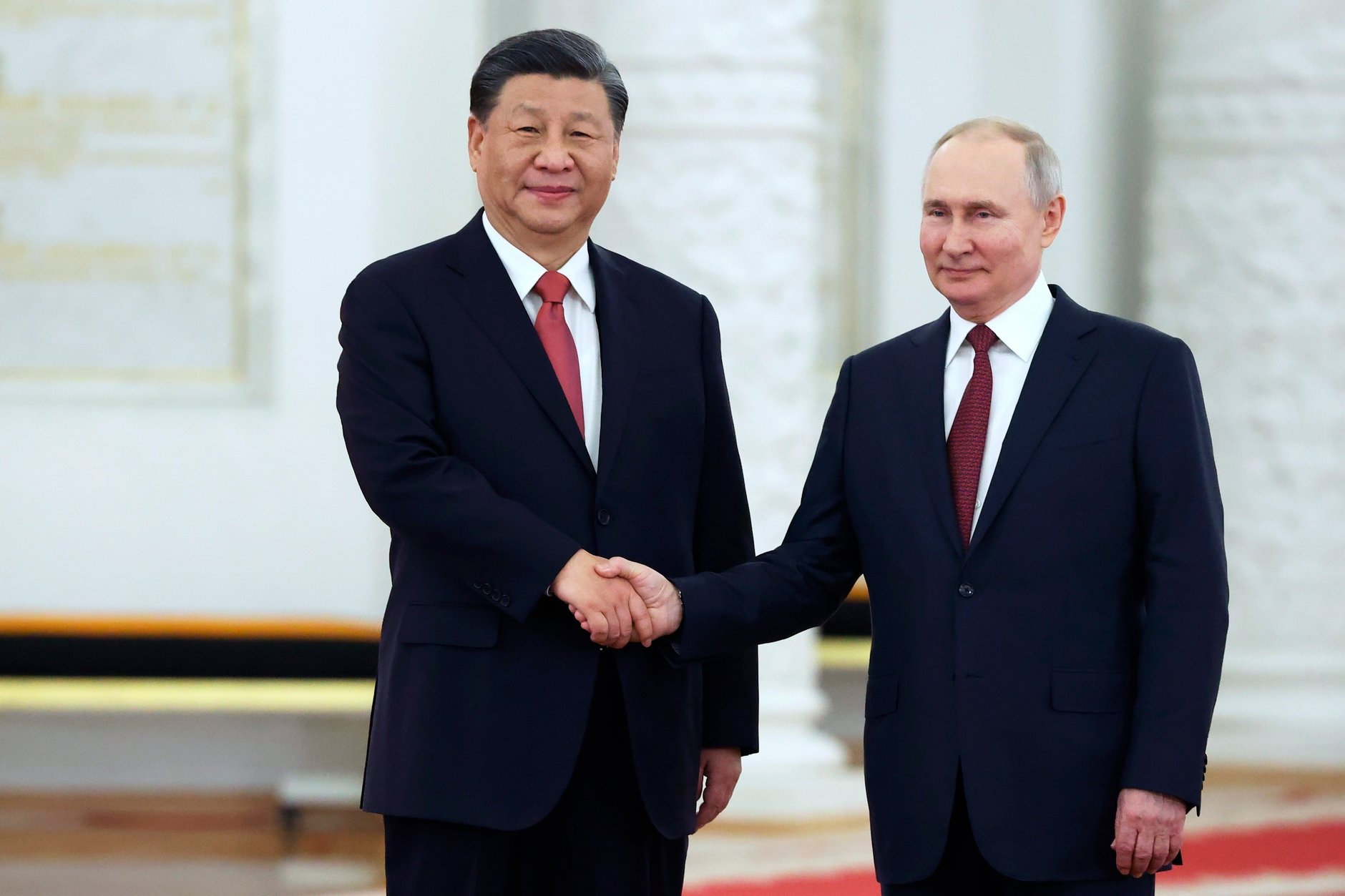
Vladimir Putin, right, and
Chinese President Xi Jinping - photo during an official welcome ceremony at The
Grand Kremlin Palace, in Moscow, Russia 3/21/23 [Photo
from Courthouse
News Service]
I suspect my opinion of Vladimir Putin will irritate many
Conservative Americans for placing him on a pedestal for his anti-Globalist
image.
Putin is an ex-KGB agent that pushed the old Soviet line of
Communist tyranny especially when he was stationed in then Communist East
Germany. AND SO, I do not trust anything Putin devises because there is no way
a Putin agenda is American friendly.
On the other hand, I do believe Putin’s agenda is a Make
Russia Great Again agenda. Which for me translates into Putin focusing on
regional power and security more than the old Soviet international concept of
spreading Communism globally.
As long as now independent former USSR satellite States tow
the Putin-Russian regional agenda, their independence is probably secure. A
deviation from a Russia stance will bring a Putin military intrusion. HENCE the
Ukraine-Russia war.
Russia’s war with Ukraine is the result of Globalist (EU)
and Dem-Marxist USA gambits into Russia’s sphere of influence.
I don’t know about you, but I have become extremely weary of
Globalist/American-Military-Industrial-Complex FOREVER WARS. On a personal
level, I advocate returning to the USA’s Isolationist policies militarily while
maintaining a superior military to confront Globalists who desire to end
America’s National Sovereignty.
That would kind of be a modified Reagan era Peace
Through Strength. BUT NOT to engage in foreign wars that have zero
to do with the USA’s National Sovereignty.
Rumble VIDEO: Ronald
Reagan – Peace Through Strength
Posted by SlantRight
Published December 27, 2024
I found this clip of President
Ronald Reagan while research “Peace Through Strength”. I found it at
Archive.org (https://archive.org/details/reagan-peace-through-strength).
Putin’s regional agenda coupled with EU-(Biden-led)USA-NATO
intrusion into Ukraine has pushed Russia into an alliance with Communist China.
AND CHINA is definitely has an agenda to end the USA because the CCP views American
Liberty as threat to its Communist rule.
If there ever was a reason to rebuild the U.S. Military
might with a purge of Obama/Biden military officers and doctrine, Communist
China is that reason.
AND NOW I want to share a post from The Federalist that I believe
gives impetus to my way of thinking. It is entitled: “Report:
China Rapidly Builds Up Weapons And Psychological Warfare Operations”.
JRH
12/28/24
READER SUPPORTED!
PLEASE! I need more Patriots to step up. I need Readers
to chip in $5 - $10 - $25 - $50 - $100 (one-time or recurring). PLEASE YOUR generosity is NEEDED. PLEASE GIVE to
Help me be a voice for Liberty:
Please
Support SlantRight 2.0
Big Tech Censorship is pervasive – Share voluminously on
all social media platforms!
Our Senior Citizen Family Supplements our income by
offering healthy coffee products. BETTER YOUR HEALTH with healthy & good
tasting COFFEE and enjoy some weight management supplements. BUY Happy Coffee
& Weight Loss Supplements at the Diana Wellness Store: https://dianawellnessstore.com
>>DRINK
COFFEE-MANAGE WEIGHT or MAKE SOME EXTRA CASH<<
********************************
Report: China Rapidly Builds Up Weapons And Psychological
Warfare Operations
CCP Military Buildup - Defense
Intelligence Agency/Public Domain (The Federalist Photo)
By Chuck DeVore
December 27, 2024
The
Federalist
China’s military buildup and cognitive warfare strategy
are clear indications of its intent to defeat the U.S. and its allies by any
means necessary.
The People’s
Republic of China (PRC) is undertaking an unprecedented military buildup aimed
at challenging America and its allies, particularly in the Indo-Pacific. And,
like Nazi Germany’s buildup in the 1930s, the militarization program ordered by
the Chinese Communist Party isn’t simply a great power buildup — it’s a weapon
in service of a deadly ideology.
The 2024 Department of Defense China Military Power Report and recent analysis by Bill Gertz in the Washington
Times reveal this buildup as part of a broader strategy by the Chinese
Communist Party (CCP) to position itself as a global superpower. Meanwhile, the
U.S., having spent $5.4 trillion on the global war on terror and
attendant, futile nation-building, has left itself strategically vulnerable by
diverting critical resources while underestimating the threat from China.
Missile Expansion and Strategic Modernization
China has rapidly expanded the People’s Liberation Army
Rocket Force (PLARF) arsenal, adding, that we know of, some:
§ 50
new intercontinental ballistic missiles (ICBMs) capable of striking the
continental U.S., for a cumulative total of 400.
§ 300
medium-range ballistic missiles and 100 long-range cruise missiles.
§ More
than 600 operational nuclear warheads, projected to surpass 1,000 by 2030.
§ Hypersonic
missiles like the DF-27, capable of evading U.S. missile defenses and targeting
Guam, Hawaii, and Alaska.
§
China’s navy, already the largest in the
world with 370 ships and submarines, is expected to grow to 435 by 2030.
Cognitive Warfare and Psychological Operations
Beyond its conventional forces, China’s adoption of
“cognitive warfare” poses a significant threat. This doctrine focuses on manipulating
information to undermine adversaries’ decision-making processes. Cognitive
warfare features tactics right out of a sci-fi film, all enabled by powerful AI
tools. For instance, deepfakes to mislead military and political leaders during
crises and psychological warfare to demoralize U.S. troops and polarize society
— the latter including efforts to erode trust in U.S. leadership among regional
allies via tool such as TikTok.
PLA researchers are also developing advanced voice synthesis
tools for low-cost, high-impact disinformation campaigns. These operations reflect a strategy designed
to win conflicts without direct confrontation, targeting the minds of
adversaries rather than their forces —
Sun Tzu would approve.
Questionable Timelines and Strategic Deception
The CCP’s stated military objectives include readiness for
action against Taiwan by 2027, achieving strategic dominance by 2035, and
fielding a world-class military by 2049, the 100th anniversary of
the CCP’s victory over the Nationalists in China’s civil war. However, these
timelines should be treated with skepticism. They are likely deliberate
deceptions aimed at lulling adversaries into complacency or disguising China’s
actual state of readiness. The pace of China’s missile expansion and cognitive
warfare preparations suggests that Beijing’s capabilities likely exceed what is
required for these projected milestones.
Unfortunately, the DoD’s China report featured a special section on corruption in China’s military
that was seized upon by those who have consistently downplayed the China
threat.
America’s Fiscal Crisis and the Need for Budget Reform
While China accelerates its military growth, even as it
faces what appears to be a weakening economy, the dire state of American
finances threatens our national security. The federal deficit and ballooning
national debt place immense pressure on defense spending. To effectively
counter China’s ambitions, the U.S. must rebuild its fleet, modernize its
nuclear arsenal, expand missile defenses, and restore maritime lift capability.
However, this cannot be achieved without serious budget reform and strategic cuts
within the Pentagon itself. These necessary actions will likely face strong
opposition from some in Congress who seek to defend the status quo.
In short order, President-elect Donald Trump’s national
security team must start to rebuild the Navy with more surface combatants,
submarines, and support vessels to counter China’s maritime dominance.
America’s aging nuclear arsenal requires upgrades to ensure credible deterrence
against China’s rapidly growing stockpile of advanced warheads and delivery
systems.
Lessons learned from Israel and Ukraine show that we must
also invest in next-generation missile defense systems to protect the homeland
and key assets in the Indo-Pacific. And, lastly, we must invest in strategic
sealift capacity to ensure rapid deployment and sustainment of forces during a
conflict. This will require a decade of focused effort to rebuild America’s
shipbuilding industry, including training tens of thousands of highly skilled
workers.
Finding Savings Within the Pentagon
Despite the need for increased capability, the solution is
not simply more spending. The Pentagon’s budget, currently burdened by
inefficiencies, mismanagement, and bloated bureaucracy, must be scrutinized. It
will be difficult, as every dollar cut will have an advocate as well as friends
in Congress, but support for the needed investments will be hard to come by
without serious savings in the Pentagon.
Savings can be found in cutting redundant programs and
eliminating outdated or overlapping initiatives. Reforming the acquisition
process will likely be a big lift as Congress will need to approve enabling
legislation, but a proper streamlining of procurement can prevent cost overruns
and delays and, if done right, can greatly accelerate weapons acquisition and
innovation. And lastly, reducing the DoD’s bureaucracy, including the massive
bloat in generals and admirals, will not only save money but also speed up
decision-making.
The Strategic Realignment Imperative
China’s military buildup and cognitive warfare strategy are
clear indications of its intent to defeat the U.S. and its allies by any means
necessary. Ignoring this threat or trusting Beijing’s stated timelines risks
leaving the U.S. unprepared for a conflict that may arise sooner than
anticipated.
To safeguard national security, the U.S. must adopt a
strategy of fiscal discipline and targeted investment. Reallocating resources
within the Pentagon to prioritize naval strength, nuclear deterrence, missile
defense, and logistics will ensure the United States remains ready to meet the
challenge posed by China.
Strategic competition demands both financial responsibility
and military readiness — two imperatives that cannot be delayed.
Fortunately, President-elect Trump has assembled a team that
understands this threat. With Pete Hegseth at the helm of the Pentagon, and
other key positions filled by people who understand the danger and the urgency
of the situation, it comes down to whether Congress will join in the effort to
preserve peace through strength.
Chuck DeVore is
chief national initiatives officer at the Texas Public Policy Foundation, a
former California legislator, and a retired U.S. Army lieutenant colonel. He's
the author of “The Crisis
of the House Never United—A Novel of Early America.”
© 2024 The Federalist, A wholly
independent division of FDRLST Media. All rights reserved.