
Born February 22, 1732 (Gregorian Calendar)

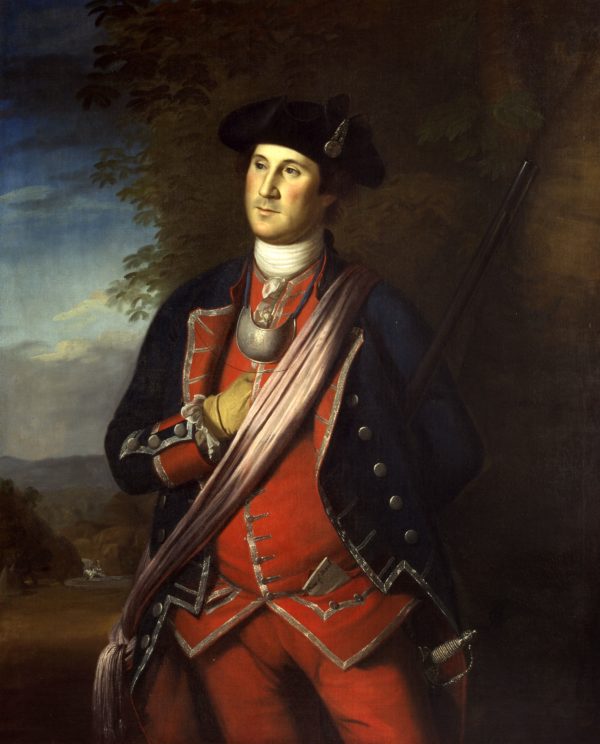
President George Washington (Image Source: Clark Art Museum. Photo from American History Central)
John R. Houk, Blog Editor
© February 22, 2026
For American History buffs: February 22 is the birth date of George Washington – The Father of our nation (February 22, 1732–December 14, 1799). An interesting tidbit: George Washington was born when the British Empire and American Colonies still used the Julian Calendar. Our modern calendar is based on the Gregorian Calendar. Under the Julian Calendar George Washington was born February 11, 1731 (Wikipedia citation).
An interesting Julian vs Gregorian explanation about George Washington from WashingtonCrossingPark.org:
“Washington’s Original Birthday Was February 11

Young Washington as a Military Officer (WashingtonCrossingPark Photo)
We all know that February sometimes involves a leap year. But in a little quirk of history, American colonists once had to leap weeks into the future!
The British (and by extension, the colonists) waited until 1752 to make the jump from the calendar created by Julius Caesar in 45 BC to the one commissioned by Pope Gregory XII in the 1580s, our current standard. They landed about 11 days off the mark.
The solution: At one second after midnight on September 2, 1752, it became September 14.
Of course, all birthdates followed suit—including George Washington’s. Born on February 11, 1731 (according to the Julian calendar), George celebrated his 20th birthday on February 22, which is the date we use today.
If you’re looking to celebrate that special day with us, you can do so a few days before George’s actual birthday. Washington Crossing Historic Park will celebrate Washington’s 290th birthday on Sunday, February 20.”
A good short history of the Founder of the USA George Washington:
o George Washington; American History Central
World History Edu examines 12 myths about George Washington. Three I remember from childhood that in the 1950s and 1960s that achieve legendary status among kids:
o The child George owns up to chopping down Cherry Tree to his father. The Moral: George cannot tell a lie, so you shouldn’t either.
o In a feat of strength, George Washington threw a Silver Dollar across the Potomac River. Never happened. There were no Siver Dollars minted even during the Washington’s two terms of Office.
o George Washington tasked Betsy Ross to make first American Flag. No proof exists of the Washington-Ross-Flag connection.
HOWEVER my favorite stories about George Washington come from eyewitnesses (friends and enemies) that miliary man Washington was bullet proof. A great summary of bullet proof Washington is found at History’s Vault posted originally on 9/23/25. Below is that full post.
JRH 2/22/26
ALWAYS FREE TO READ yet READER SUPPORTED!
PLEASE! I need more Patriots to step up. I need Readers to chip in $5 - $10 - $25 - $50 - $100 (PAYPAL or CARD - one-time or recurring). YOUR generosity is APPRECIATED. PLEASE GIVE to Help me be a voice for Liberty:
Big Tech Censorship is pervasive – Share voluminously on all social media platforms!
Our Senior Citizen Family Supplements our income. A brief advertisement change. Diana & I are Changing from Happy Healthy Coffee to Magic Coffee. It’s MAGIC because there is a weight loss or weight control emphasis. Clicking the Diana Wellness Store will take you to the NEW store. CLICK the BUY tab and/or JOIN tab. Joining means you get COFFEE discount, can operate your store and recruit your own business & customers. Decide on a level to enter to Network your own Store. DRINK COFFEE and/or MAKE MONEY!:
https://dianawellnessstore.com
Have Coffee Customer Question or Earn Money Question - Ask Diana at Facebook Group Good Life Coffee
*******************************
Bulletproof George Washington: Was He Protected by Providence or Luck?

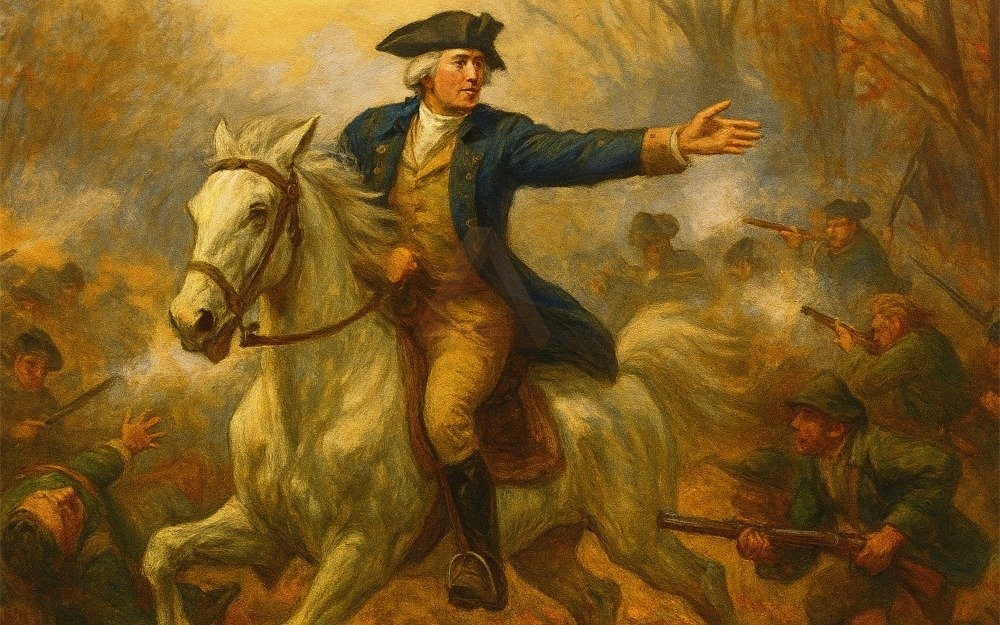
Washington at Monongahela: Untouched, Unshaken, Unforgettable. (History’s Vault Photo)
By Vault Keeper
September 23, 2025
George Washington’s survival in battle often defied logic. From the chaos of Monongahela to the daring charge at Princeton, he emerged unscathed while death claimed those around him. His men saw it. His enemies noted it. And Washington himself, though reserved, acknowledged it. Was it providence, luck — or something else?
The Battle of Monongahela (1755)
In July 1755, a young George Washington rode with British General Edward Braddock into the Ohio Valley. Their mission: to seize Fort Duquesne from French and Native American forces. Braddock’s column — nearly 1,300 strong — marched in European formation through dense forest, unaware they were walking into an ambush.
The enemy struck with precision. French troops and Native warriors fired from concealed positions. British officers, easily identifiable by their uniforms and mounted positions, were targeted first. Braddock was mortally wounded. Chaos followed.
Washington, then just 23, had no formal command. Yet he rode through collapsing
lines to rally the troops. He had two horses shot out from under him and four
bullets pierce his coat, but he was never hit.
“By the all-powerful dispensations of Providence, I have been protected beyond all human probability and expectation; for I had four bullets through my coat, and two horses shot under me, yet escaped unhurt, altho’ death was levelling my companions on every side.”
—George Washington, Letter to John
A. Washington, July 18, 1755
Source: Mount Vernon Digital Archive
The battle was a disaster for the British. Nearly 900 were killed or wounded. Washington’s survival became a point of fascination. Years later, Native leaders reportedly said they had aimed at him repeatedly but could not hit him. One called him “spirit-protected.”
The Battle of Princeton (1777)
Fast forward to January 3rd, 1777. Washington, now Commander-in-Chief of the Continental Army, faced British forces near Princeton, New Jersey. Morale was low. Supplies were thin. The winter was brutal.
During the battle, American troops began to falter. Washington rode forward — within thirty yards of enemy lines — and rallied his men with a shout:
“Parade with me my fine fellows, we will have them soon!”
—George Washington, Battle of
Princeton, January 3, 1777
Source: American Battlefield Trust
His officers were stunned. One reportedly covered his eyes, unable to watch what he assumed would be Washington’s death. But again, Washington survived untouched. The counterattack succeeded. Princeton was a turning point in the war.
Native Accounts and Battlefield Lore
Accounts from Native American leaders — especially those who fought at Monongahela — add a layer of mysticism. One Shawnee chief reportedly said:
“He is not born to be killed by a bullet. I had seventeen fair shots at him… but could not bring him to the ground.”
—Attributed to a Native sachem
recalling the Battle of Monongahela, as recorded by Dr. James Craik, 1770
Source: Mount Vernon Digital Encyclopedia
While these accounts were often filtered through colonial retellings, they reinforced the myth. Washington wasn’t just lucky — he was untouchable.
Cultural Echoes and Presidential Mythmaking
Washington’s battlefield survival became part of his presidential aura. Later generations would thread similar myths around other presidents:
§ Abraham Lincoln reportedly dreamed of his own death days before his assassination.
§ Ronald Reagan survived an assassination attempt in 1981 and later joked about it with characteristic bravado. Some believe his survival marked the end of the so-called Curse of Tippecanoe — a pattern in which presidents elected in years divisible by twenty met untimely deaths.
§ Donald Trump, during his presidencies, has often invoked divine protection and destiny in speeches — threading mythic language into political identity.
Washington’s “Bulletproof” legend was the prototype. It combined battlefield grit with moral purpose and created a mythic template for leadership under fire.
Legacy and Interpretation
Historians rarely dismiss the battlefield accounts outright. The chaos at Monongahela and the charge at Princeton were well documented. But when it comes to the myth that Washington was somehow protected, they tend to pause.
Some treat it as morale psychology. Others point to terrain, timing, and the unpredictability of musket fire. Few try to explain it fully. Most simply note that Washington kept showing up alive where he shouldn’t have survived.
Still, the quotes remain. The coat with bullet holes was real. The horses were real. The men who died beside him were real. And Washington’s survival — again and again — was real.
Whether by providence or probability, George Washington’s battlefield record remains one of the most uncanny in American history.
🔗 Think that was strange? There’s more. Explore our full Oval Office Oddities archive.
References
[1] Washington, G. (1755). Letter to John A. Washington, July 18, 1755. Mount Vernon Digital Archive. Retrieved September 2025.
[2] Chernow, R. (2010). Washington: A Life. Penguin Press.
[3] Ellis, J.J. (2004). His Excellency: George Washington. Knopf. Explores Washington’s leadership style and battlefield instincts.
[4] Smithsonian Magazine. (2006). Washington’s War Tactics. Retrieved September 2025.
[5] National Archives. (n.d.). Founders Online. Retrieved September 2025.
[6] Mount Vernon. (n.d.). George Washington’s Military Career. Retrieved September 2025.
[7] American Battlefield Trust. (n.d.). Battle of Princeton. Retrieved September 2025.
Copyright © 2026 HistorysVault.com
About History’s Vault


No comments:
Post a Comment